

Announcing the 2026 Horizon Zero Gravity Flight Cohort
20 researchers from academia and industry will run experiments in microgravity on two flights this autumn.
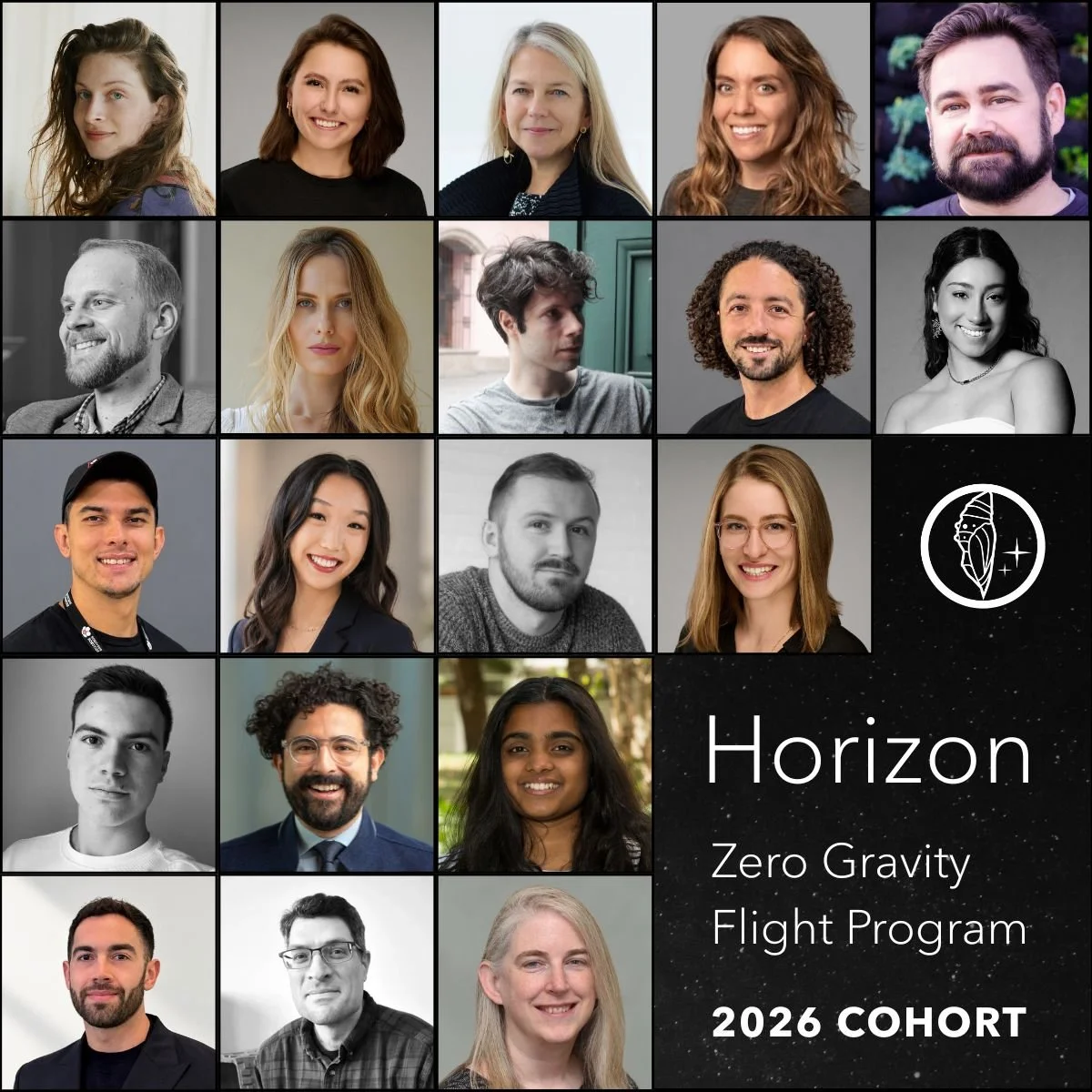
Aurelia Institute is pleased to announce the participants in this year’s Horizon Zero Gravity Program, who will conduct experiments designed for microgravity across two parabolic research flights this fall. This cohort of fliers represent fourteen organizations across projects spanning space architecture, in-space manufacturing, robotics, novel prosthetics, sensors and data collection for space research, medical wearables, and more.
Now in its fifth year, Aurelia’s Horizon Zero Gravity Program aims to offer expert training, flight opportunities, and flight integration expertise to researchers whose experiments can uniquely benefit from testing in the microgravity environment of a parabolic flight. First-time fliers, veteran space researchers, and young professionals and researchers come together in the Horizon program to learn how to prepare an experiment for the specific physical and safety constraints of a zero gravity flight and get the best results for their efforts.
Get to know the 2026 cohort, and stay tuned for details about their projects following the flight!
Will Root
Organization: Tycho Space
Project: RootShell Microgravity Deployment Test
Tycho Space will be testing a kinematic origami deployable model to test the deployment process in microgravity. The RootShell experiment demonstrates the deployment behavior of a rigid-origami inspired inflatable structure under reduced gravity conditions during parabolic flight. The experiment consists of a compact folded origami shell deployed using a commercially available low-pressure electric pump. The objective is to characterize deployment dynamics, folding behavior, structural stability, and operator interaction in microgravity.
Christopher Maurer
Organization: Red House Studio LLC
Project: BioARK: Deployable Disc Station
BioARK will be demonstrating an expandable architecture design as part of the team’s work in designing deployable space stations. The experiment tests whether a set of small, individually light, soft inflatable modules can autonomously aggregate into a single ordered structure when released in weightlessness, guided only by passive magnetic attraction and flexible tethers. In this campaign, twelve 100 mm inflatable spheres, joined in series by light silicone tubing, are inflated to a low gauge pressure and allowed to draw together into a closed ring (torus) — a simple physical analogue of a modular structure assembling itself from loose parts.
Maciej Jamrozik
Organization: Akademia Sztuk Pięknych im. Jana Matejki w Krakowie
Project: CROP: Cutting and Retrieval of Organic Plant-matter in microgravity
The Orbital Emergency Granary team (OEG) will be verify, in microgravity, that their proposed device cuts plant material cleanly, that the suction reliably captures all debris with no escape into the cabin, and that a single operator can complete the full cut-and-collect cycle within the short (~20 s) weightless phase of each parabola. The experiment also compares how the tool performs on 3-4 different plant types. The results support the development of closed-loop plant-harvesting hardware for future space habitats and food-production systems.
Project team: Maciej Jamrozik and Michal Kracik
Hugo Shelley
Organization: Iota Technology
Project: CubeSat Deployable Boom
Hugo will be flying an unfolding tubular structure to see how it behaves in microgravity. This is part of their larger research into deployable structures for space. The objective of the experiment is to deploy the boom in a microgravity environment and record the shock experienced by the payload at the tip of the boom during deployment.
Silvio De Mio
Organization: Independent researcher
Project: Project Loop
The experiment will test The Ring, the core architectural element of the Project Loop design. This experiment brings a physical scale model of the Ring’s interior section onto a microgravity flight for the first time, exposing the habitat design to simulated lunar gravity (1/6g), the actual gravitational condition for which it was conceived. The objective is to document and observe how the interior spatial configuration of the Ring behaves across three gravitational regimes: terrestrial gravity (1g), lunar gravity (1/6g), and microgravity (0g). Small geometric solids placed inside the model serve as spatial references, allowing visual documentation of how objects distribute within the habitat under each condition. This provides a first physical validation of the spatial design in its intended gravitational environment and offers preliminary observations relevant to future orbital habitat concepts with similar geometry.
Alex Miller and Luiz Toledo
Organization: Rendezvous Robotics
Project: HEXARIS-01: Electromagnetic Rendezvous, Proximity Operations, and Docking (EM-RPOD) of Autonomous Hexagonal Tiles in Microgravity
Rendezvous Robotics will test an electromagnetic actuation and mobility system that enables its spacecraft tiles to control their position and orientation relative to each other in microgravity. Rigidly mounted tiles and free-floating tiles will form pairs, each able to be commanded with the push of a button. The objectives are to demonstrate various electromagnetic rendezvous, proximity operations and docking (RPOD) capabilities and collect flight data to validate models. These capabilities are key to Rendezvous Robotics’ modular spacecraft, designed to launch as compact tiles and autonomously assemble into larger systems in orbit.
Project team: Gerry Hudak, Alex Miller, and Luiz Toledo
Elisabeth Funck and Margaret Lea
Organization: DCubed GmbH
Project: OMPTIM-ISM: Origami Prototype Testing Introducing a new Mechanism for In-Space Manufacturing
The Origami Prototype Testing Introducing a new Mechanism for In-Space Manufacturing, or OPTIM-ISM, is a technology development experiment to demonstrate a mechanically joined in-space manufacturing technique for the creation of large-scale boom assemblies. The experiment incorporates an innovative origami solar array structure at the boom tip which serves as a deployable payload for the experiment, providing a forcing function for boom loads while representing a flight-realistic configuration of the ISM boom use-case at scale.
Project team: Thomas Sinn, Daniel Giles, Elisabeth Funck, Margaret Lea, and Antonio Pedivellano
Manuel Sanchez Castro, Andrea Sofia Hernandez
Organization: Orchid Space Technologies LLC
Project: ORCHID: Microgravity Disinfection System for Mitigation of Host–Microorganism Interaction Risk.
This project will test an existing aerosolized hydrogen peroxide disinfection system called Orchid, which was tested on two previous parabolic flights. The primary objective of this campaign is to validate that the ground-run protocol, already tested under controlled conditions, remains operationally stable, controllable, and safe in the reduced-gravity environment. This is a preparatory validation step toward subsequent implementation on the International Space Station (ISS).
Project team: Manuel Sanchez Castro, Daniel Colina, Andrea Sofia Hernandez, Yllen Ramírez
Dava Newman, Ganit Goldstein, Nicole Lee
Organization: MIT AeroAstro; MIT Space Exploration Initiative
Project: Smart Skinsuit
The Smart Skinsuit consists of a wearable suit containing electrical muscle stimulation and advanced 3D knitting technology for the garment. The overall purpose is to provide a comfortable, musculoskeletal neurosensory countermeasure to the physiological deconditioning experienced by astronauts in space. A goal of the flight is to push technology development of the sensors, data acquisition and control system in the 0G, lunar G, and hyper-G portions of the parabola for motor control and biomechanics assessment. This suit is a V9 version with advanced sensing, control, and fabrication techniques, building upon years of development of previous skin suits.
Project team: Dava Newman, Ganit Goldstein, Nicole Lee
Ana Rajcevic
Organization: MIT Media Lab; MIT Space Exploration Initiative
Project: Celestial Limb: A Non-Anthropomorphic Continuum Limb in Microgravity
This project investigates a prosthetic robotic limb modeled on an octopus arm. The octopus limb consists of a soft, compliant, modular, segmented appendage actuated by tendons. The device is capable of curling, extending, and shortening. The experiment will explore how such a limb could be used to help astronauts anchor, stabilize, and reorient themselves. Unlike rigid or anthropomorphic systems, the limb operates through continuous deformation and multi-point contact along its length, enabling alternative strategies of movement and spatial control. The flight will focus on initial testing, observing how the limb moves in the unique environment and how a user engages with its unfamiliar morphology to generate controlled motion. As a first iteration, the system functions as an experimental prototype, probing fundamental interaction dynamics, spatial orientation, and the potential for non-anthropomorphic modes of movement in microgravity.
Heather Panic
Organization: MIT/MGH; MIT Space Exploration Initiative
Project: Tactile Wearable Sensor
This experiment proposes a compact, phone-powered vibrotactile wearable that evaluates whether its sensing and feedback system operates correctly during parabolic flight. An operator wearing the haptic necklace will make controlled body-orientation movements; the phone’s IMU records motion data, and the wearable provides corresponding haptic feedback. The experiment will collect device inputs/outputs and video to verify that the hardware correctly detects orientation changes and delivers the intended response in microgravity.
Project team: Sam Chin and Heather Panic
Cody Paige
Organization: Columbia University
Project: Lunar Sample Return Containment Testing
This project will assess how lunar regolith samples are affected by transit from the moon to Earth. Layering in samples is critical to geologic analysis, and this experiment will specifically assess mixing of layered regolith samples due to the effects of hypergravity (e.g. launch and landing) and microgravity (e.g. transit).
Project team: Cody Paige and Mckynzie Romer
Sneha Ramshanker
Organization: Princeton University
Project: Tumblenaut, a bacteria-inspired robot-swarm for intra-vehicular space inspection
Tumblenaut seeks to investigate unexplored methods for continuously monitoring the interior of habitable spacecraft using micro-robotics. One tumblenaut robot is 8 cm x 10 cm in size, and contains a motor driven propellor to provide thrust and two reaction wheels to provide orientation control in microgravity. Working as a group, multiple Tumblenauts would be able to semi-stochastically translate through a habitat, and provide continuous monitoring of the entire interior of the spacecraft. The goal of this flight will be to test the dynamics of a single tumblenaut. The experiment will involve verifying the motion generated by each actuator independently and then testing the coupling dynamics (i.e. what happens when multiple actuators are acting simultaneously).
Project team: Radhika Nagpal, Sneha Ramshanker, and Valeria Saro-Cortes
Evan Hilgemann and Jamie Milliken
Organization: Aurelia Institute
Project: TESSERAE Transform - Mechanized Hinge Deployment System
The Mechanized Hinge experiment will test a sub-scale version of an advanced deployable TESSERAE system. In this version, tiles will be attached together using actuated hinges to ensure repeatable, deterministic deployment. The tiles will initially be stacked vertically (like a stack of books), and the hinges will deploy one-by-one on each parabola, resulting in a final shape reminiscent of a flourette. This system has applications for many types of large in-space structures including large arrays, habitats in space and on the moon, and other lunar infrastructure such as landing pads.