
Aurelia Prize 2026 Winners
Announced in December 2025, the Aurelia Prize in Design for Space Urbanism asked architects, engineers, designers, and enthusiasts around the world to submit concepts for near-future space stations, lunar habitats, and autonomous industrial facilities. The envisioned structures could be designed for low-Earth orbit, the lunar surface or lunar orbit, or a Lagrange point, and were required to be centered on habitat and industrial designs that consider utility, benefit to Earth, and efficiency in the space environment.
Explore the winning project, four honorable mentions, and six finalists on this page.
Winner: Tycho
Will Root
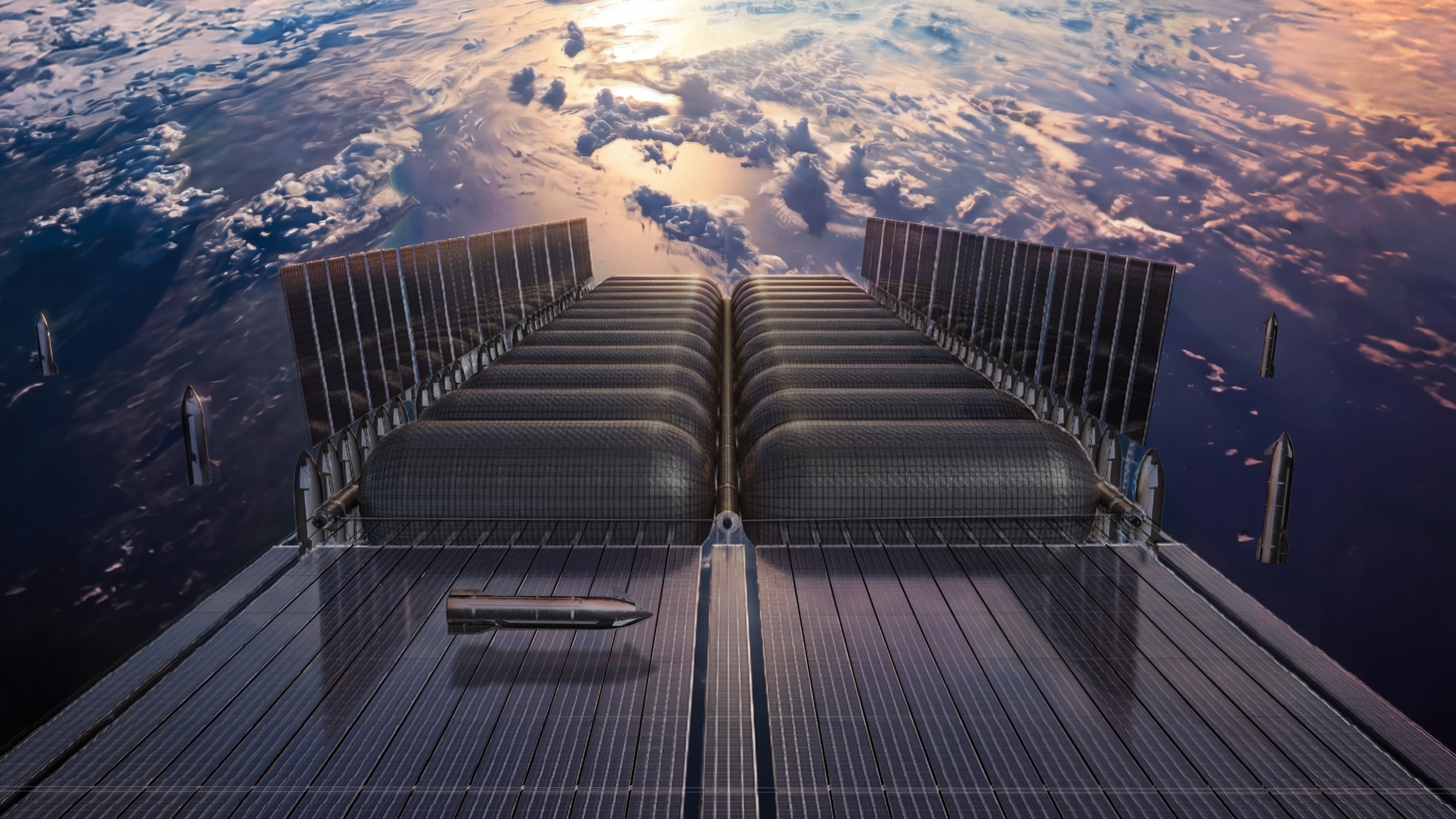
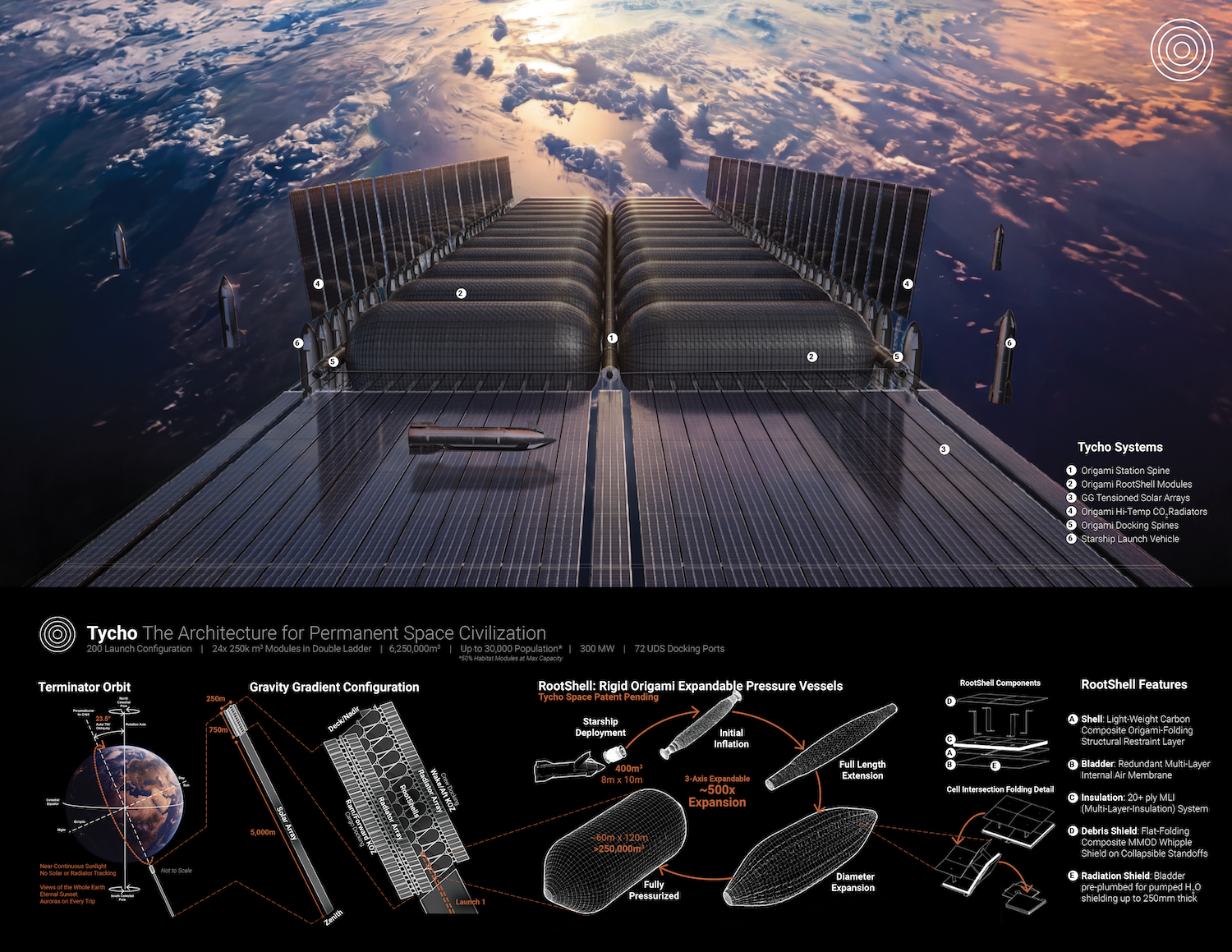
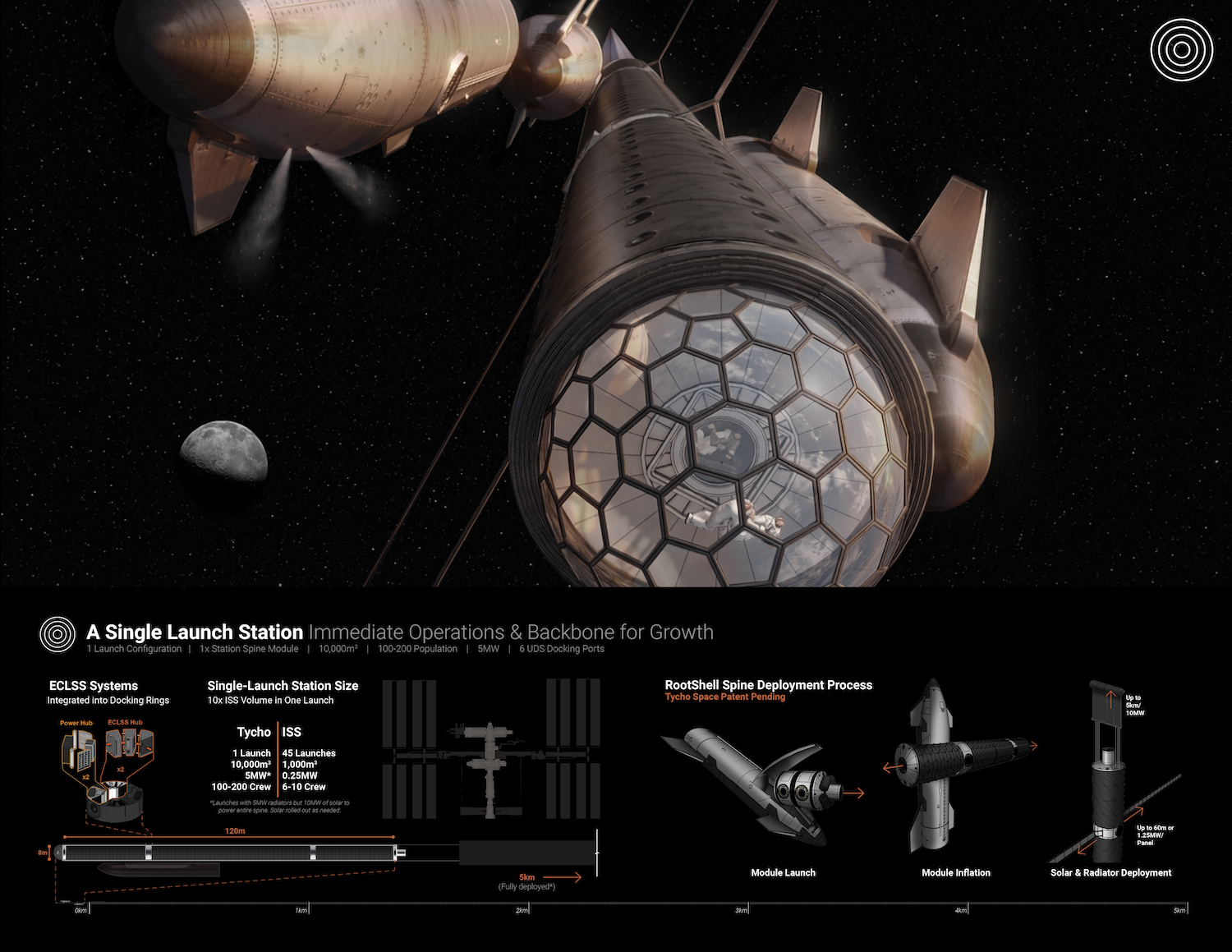
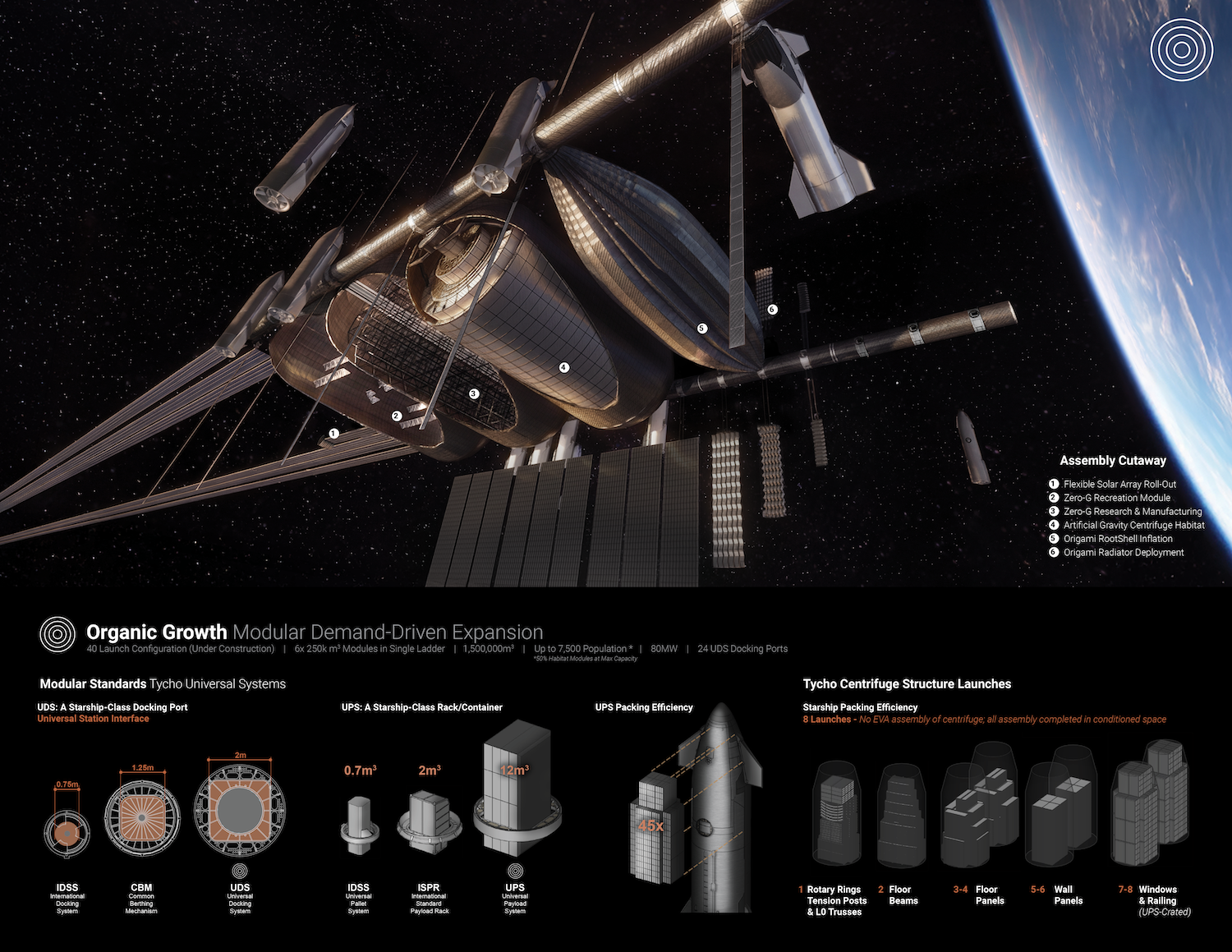
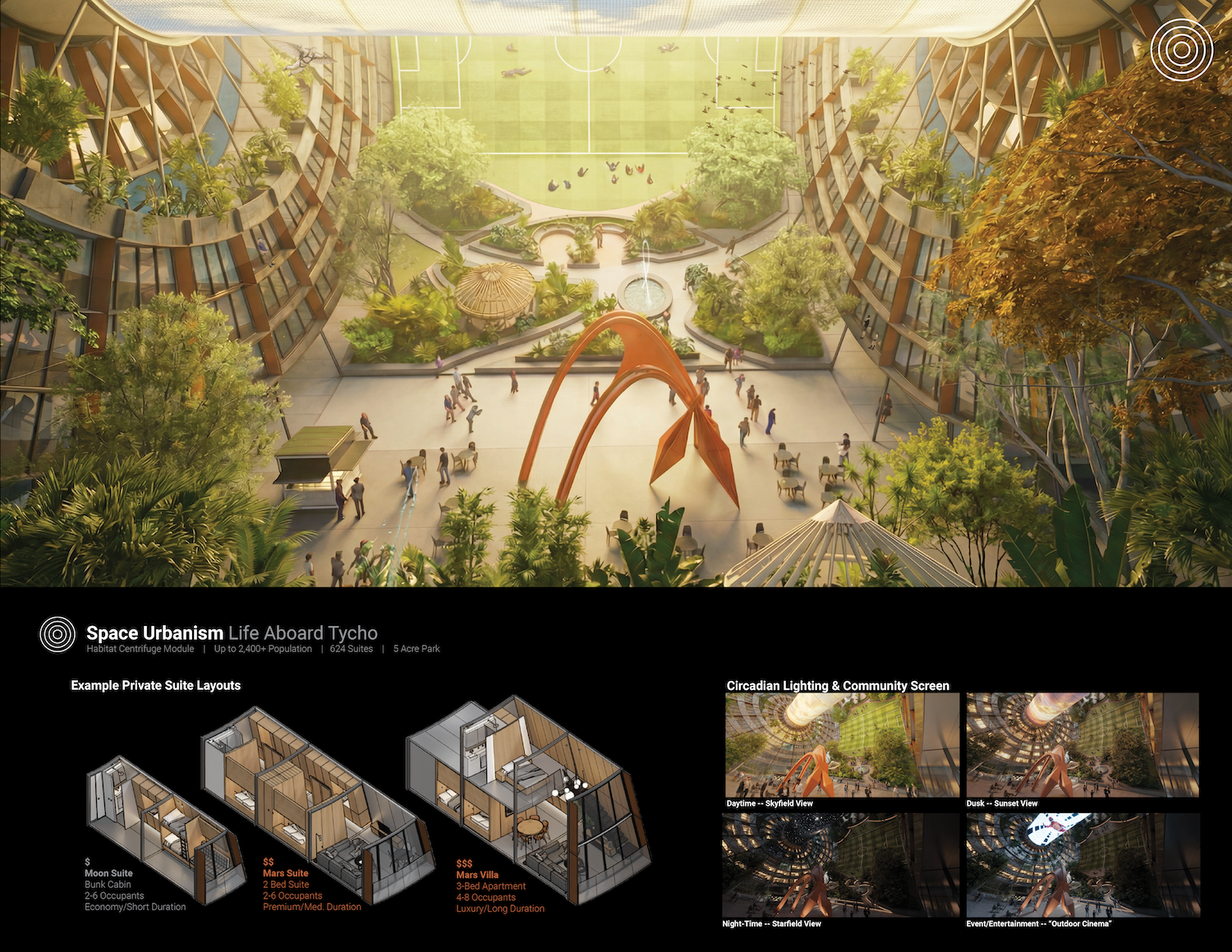
The judging panel has awarded first prize to Tycho: The Architecture for Permanent Space Civilization from designer Will Root. Tycho proposes a rigid origami space station design, enabling vastly larger habitable volumes capable of supporting thousands of people in low-Earth orbit in the near future.
Tycho envisions a realistic, scalable architecture for permanent human civilization in orbit—one designed to grow incrementally, operate continuously, and support life and industry at civic scale. Tycho leverages the unique conditions of the space environment to permit its scale. Operating in a Terminator Orbit, it achieves near-continuous solar generation while eliminating the need for solar or radiator articulation. In LEO, its five-kilometer cable-stayed flexible solar array is passively tensioned by gravity-gradient forces with oscillation damping—reducing reliance on active attitude control while maintaining the station’s primary orientation and planetary alignment.
The station’s scale is unlocked by Tycho’s patent-pending “RootShell,” a rigid origami pressure-vessel technology. These expandable geometries allow a single Starship launch to deploy modules exceeding 250,000 cubic meters, without the compromises of soft inflatables or the need for extensive orbital assembly.
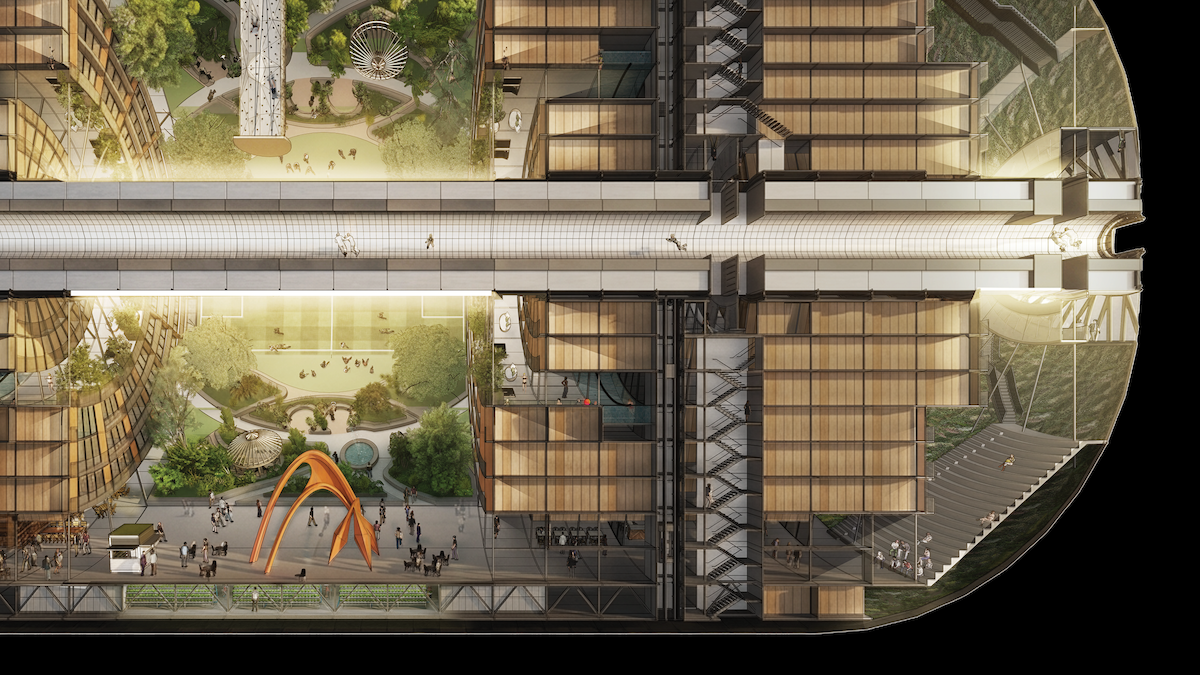
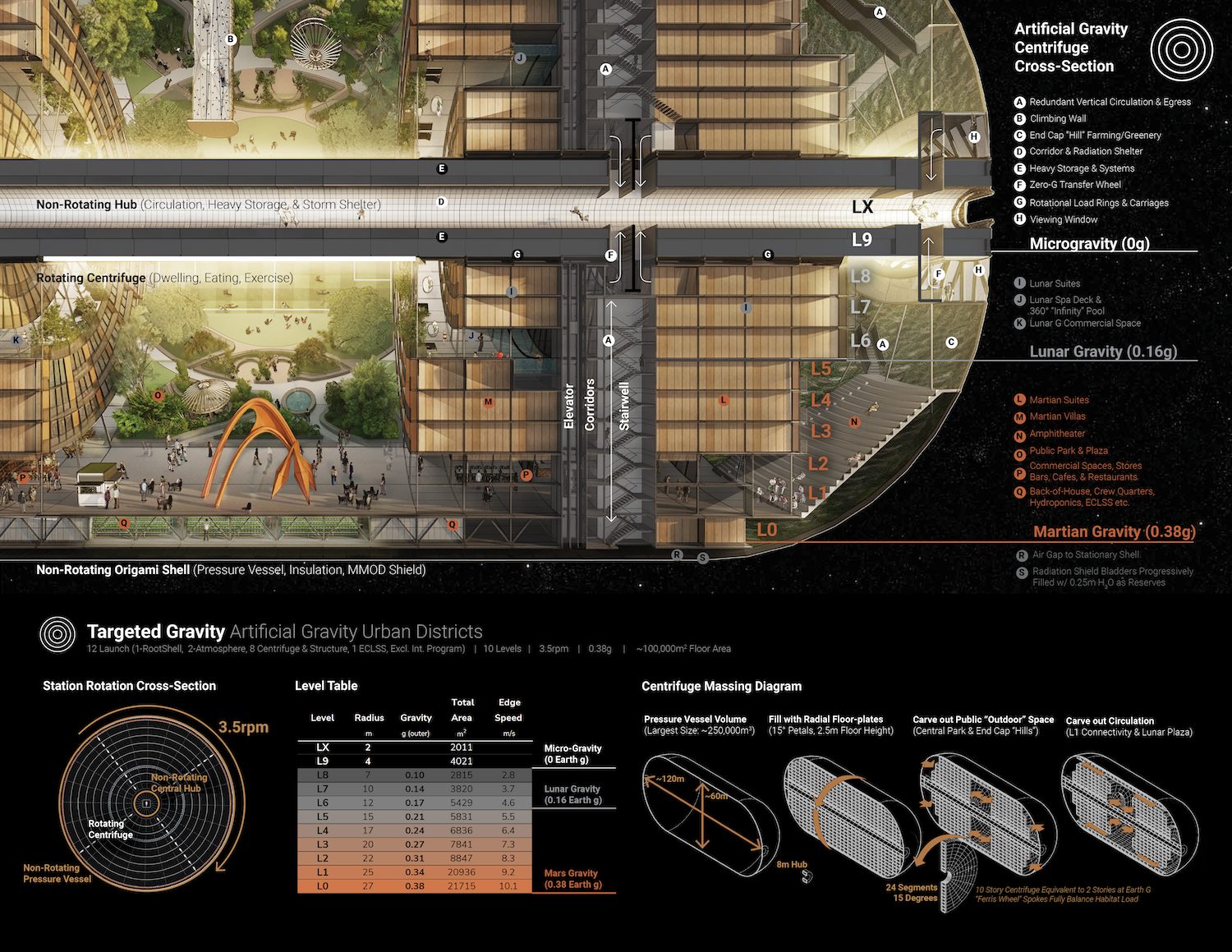
Above: Cross-section of a 60m diameter artificial gravity centrifuge showing ten levels of habitat arranged along a gradient from Martian gravity at the outer edge to microgravity at the core. Credit: Will Root.
Honorable Mention: bioARK
Christopher Maurer, Lynn Rothschild, James W. Head III
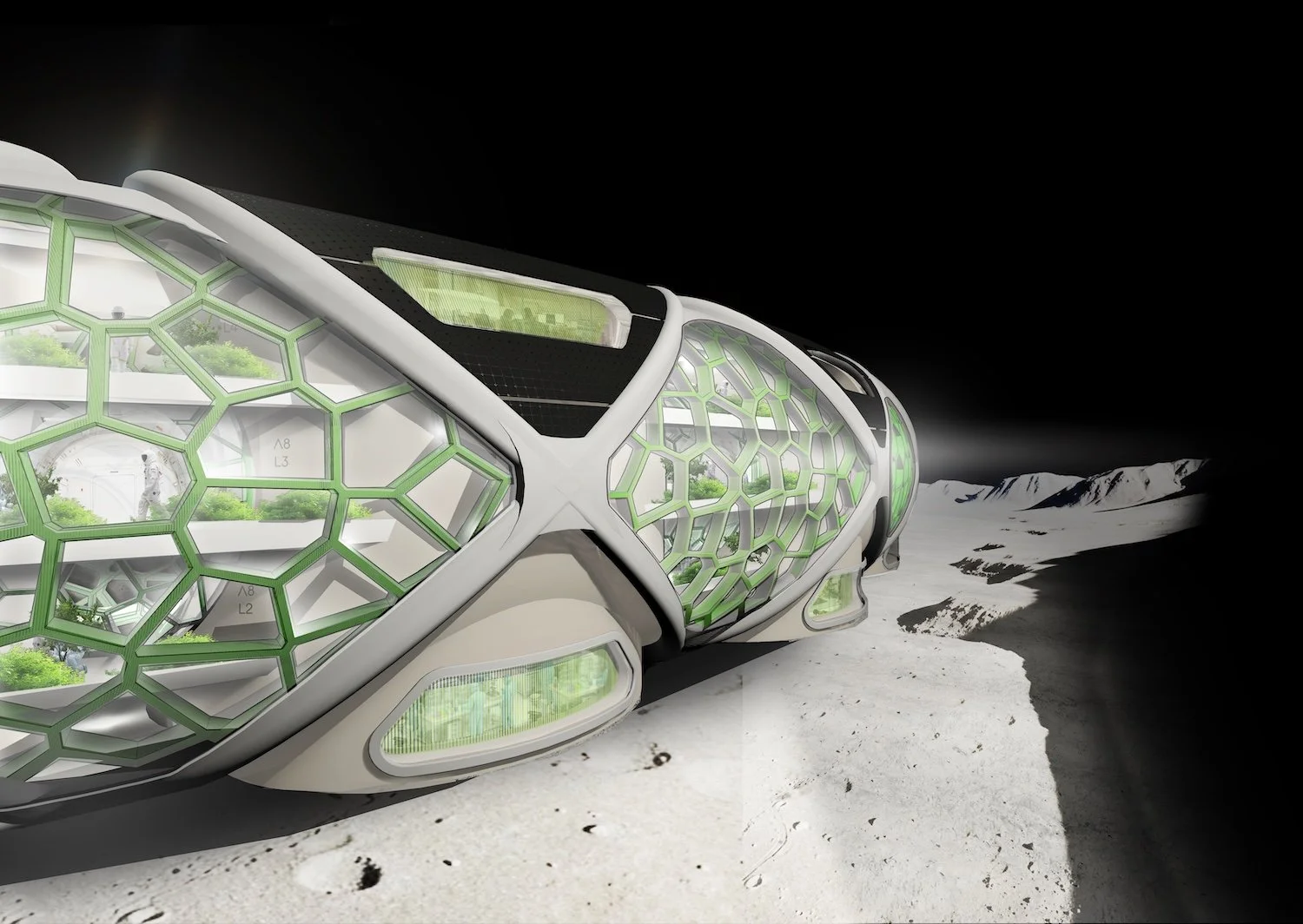
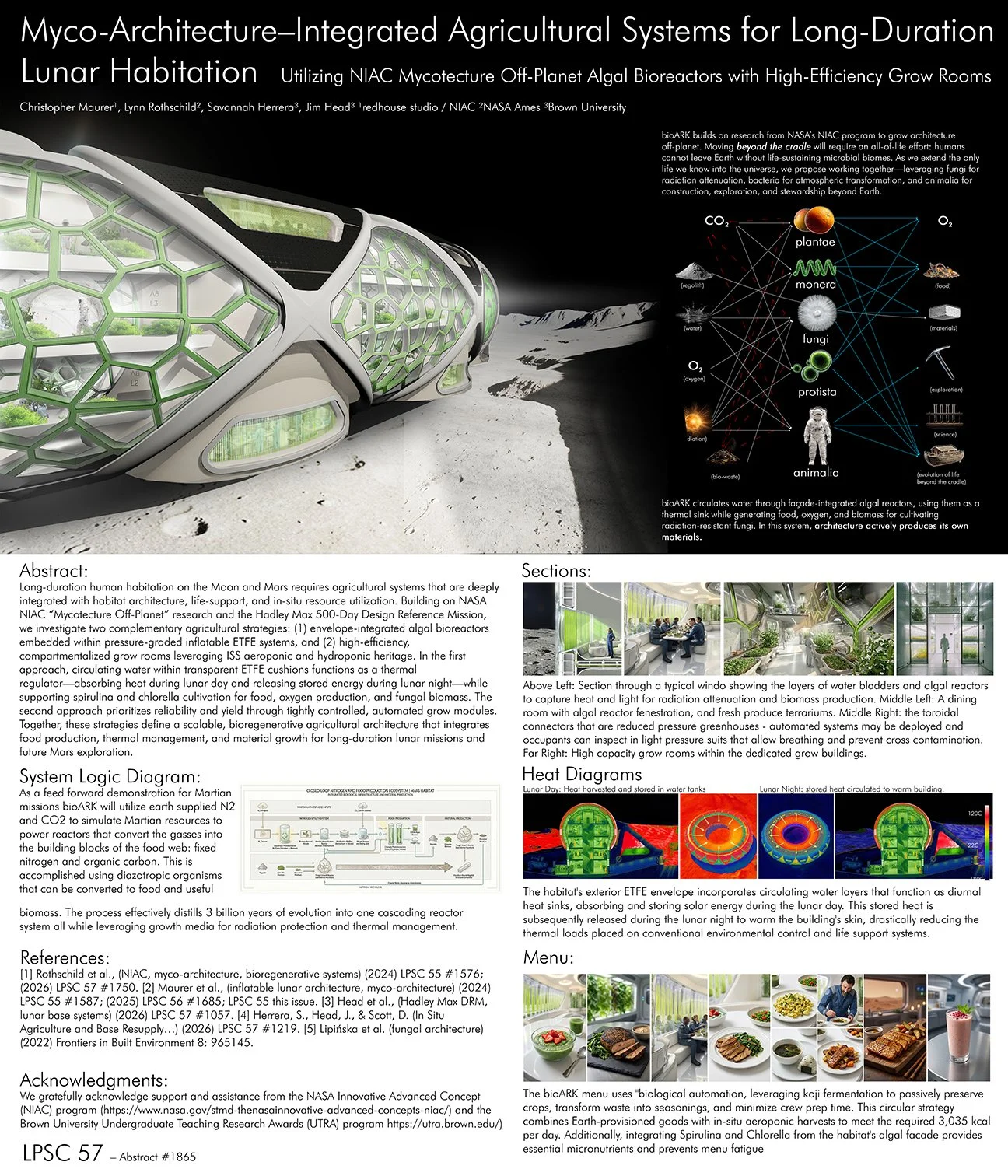
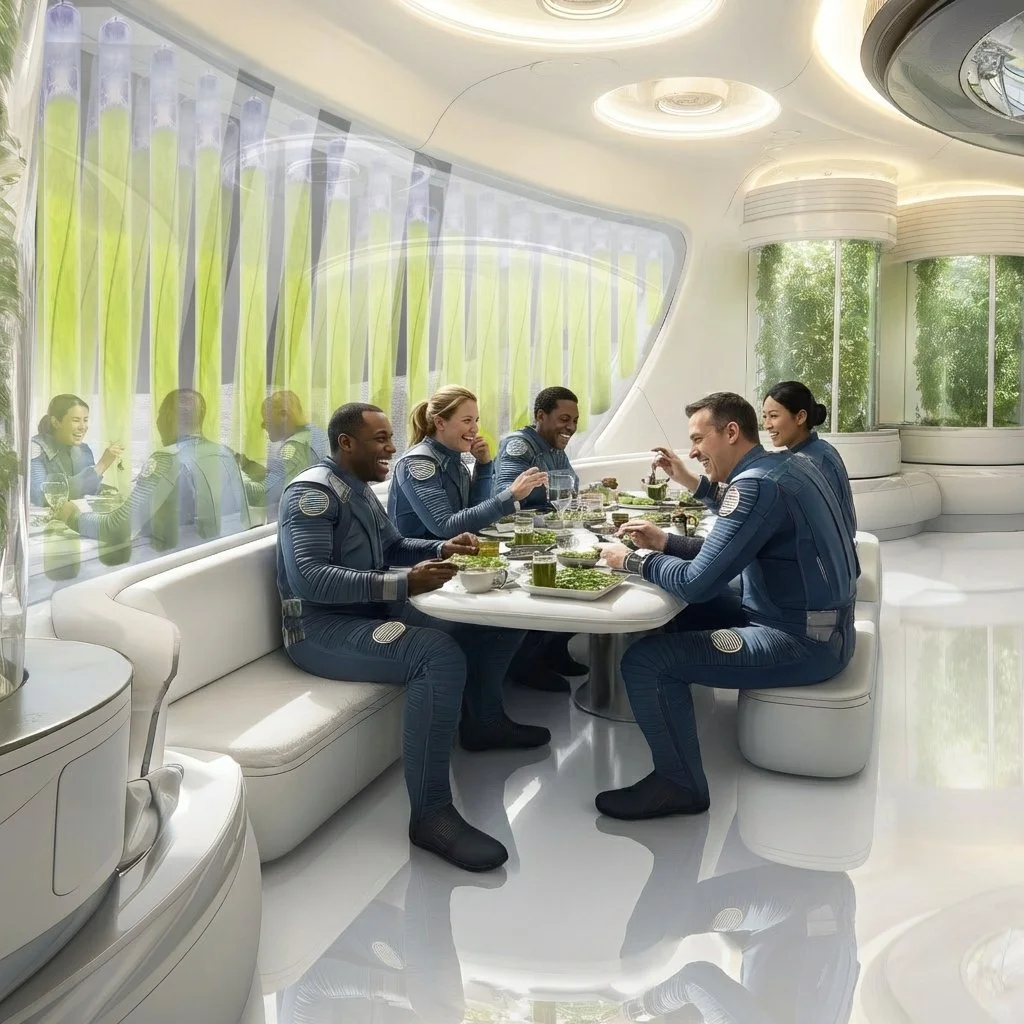
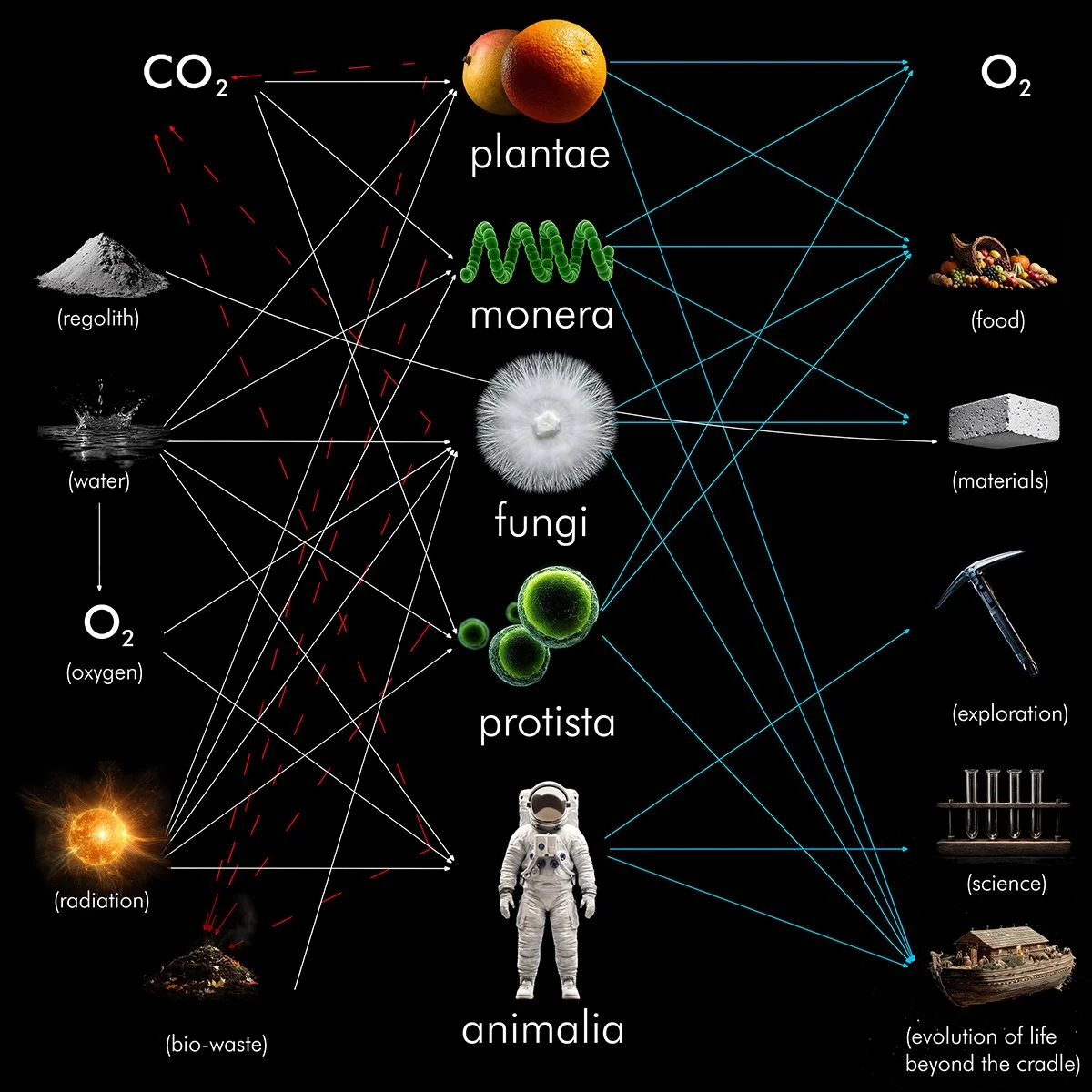
bioARK builds on research from NASA’s NIAC program to grow architecture off-planet. Moving beyond the cradle will require an all-of-life effort: humans cannot leave Earth without life-sustaining microbial biomes. As we extend the only life we know into the universe, we propose working together - leveraging fungi for radiation attenuation, bacteria for atmospheric transformation, and animalia for construction, exploration, and stewardship beyond Earth.
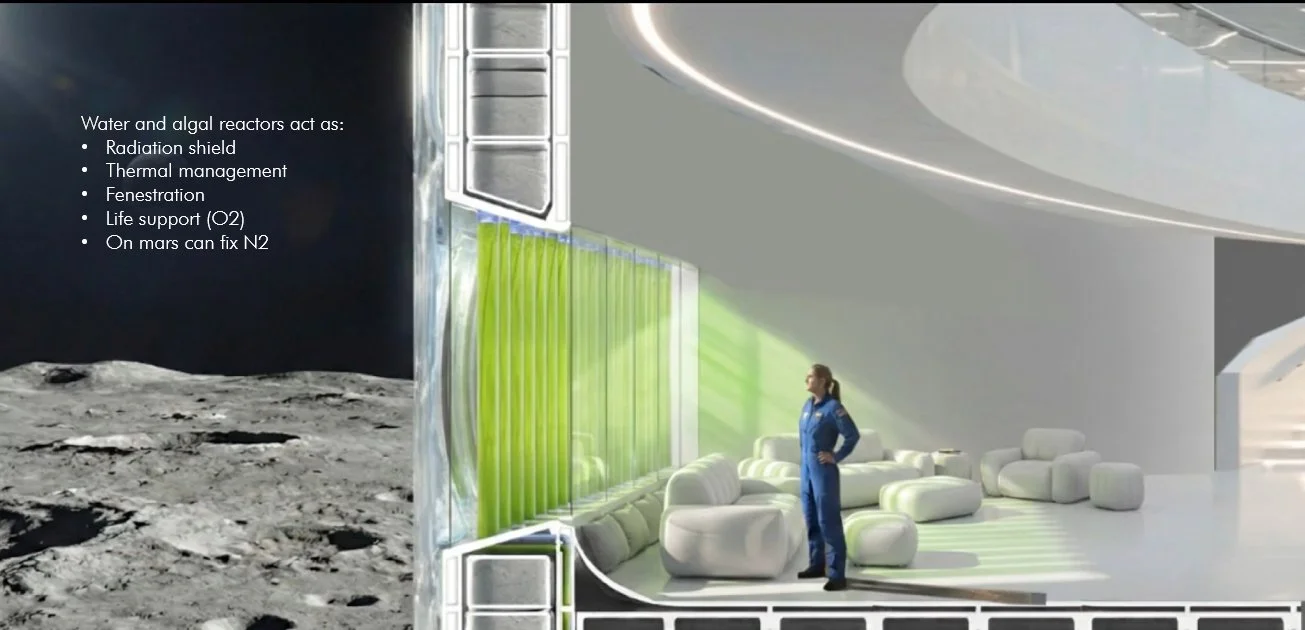
bioARK circulates water through façade-integrated algal reactors, using them as a thermal sink while generating food, oxygen, and biomass for cultivating radiation-resistant fungi. In this system, architecture actively produces its own materials.
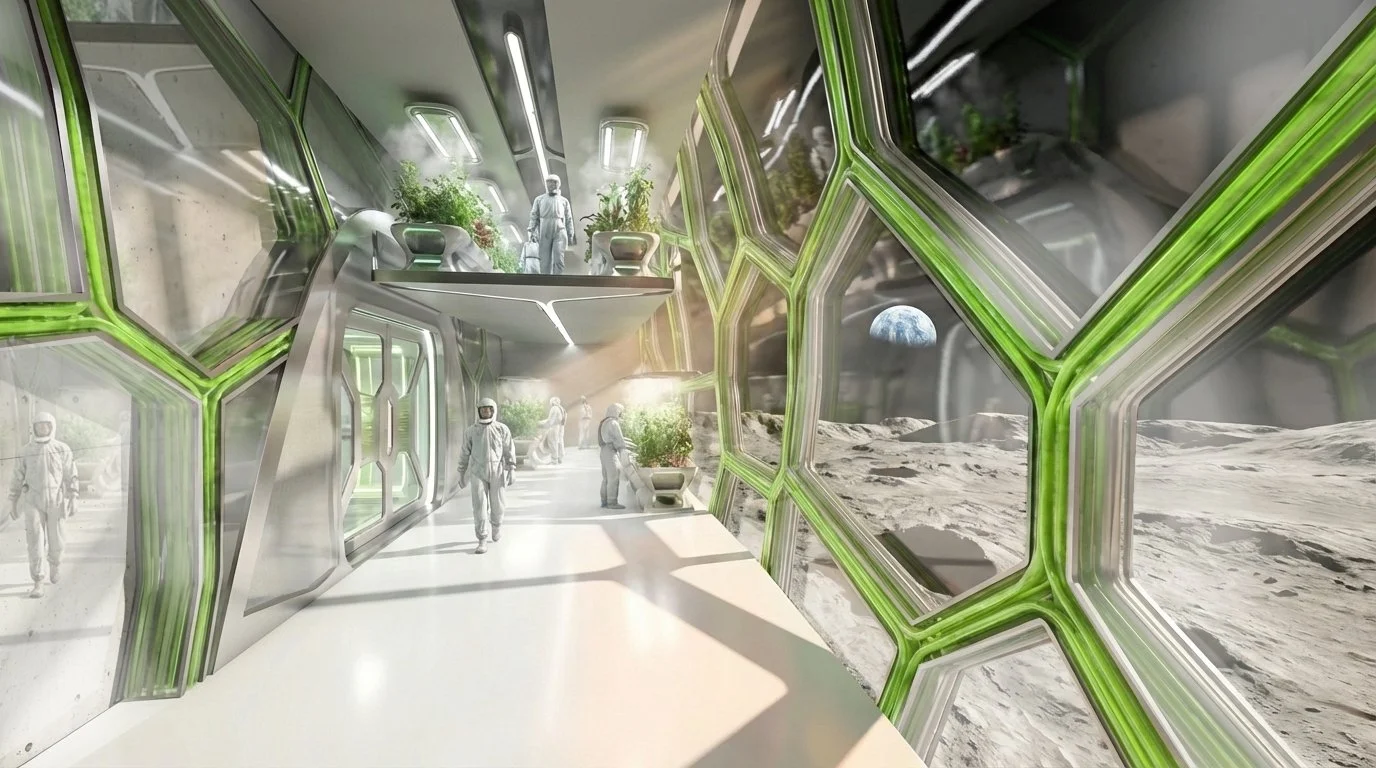
Above: Interior perspective of toroidal habitat with circulating algal facade. Credit: Christopher Maurer.
Honorable Mention: Project Loop
Silvio De Mio
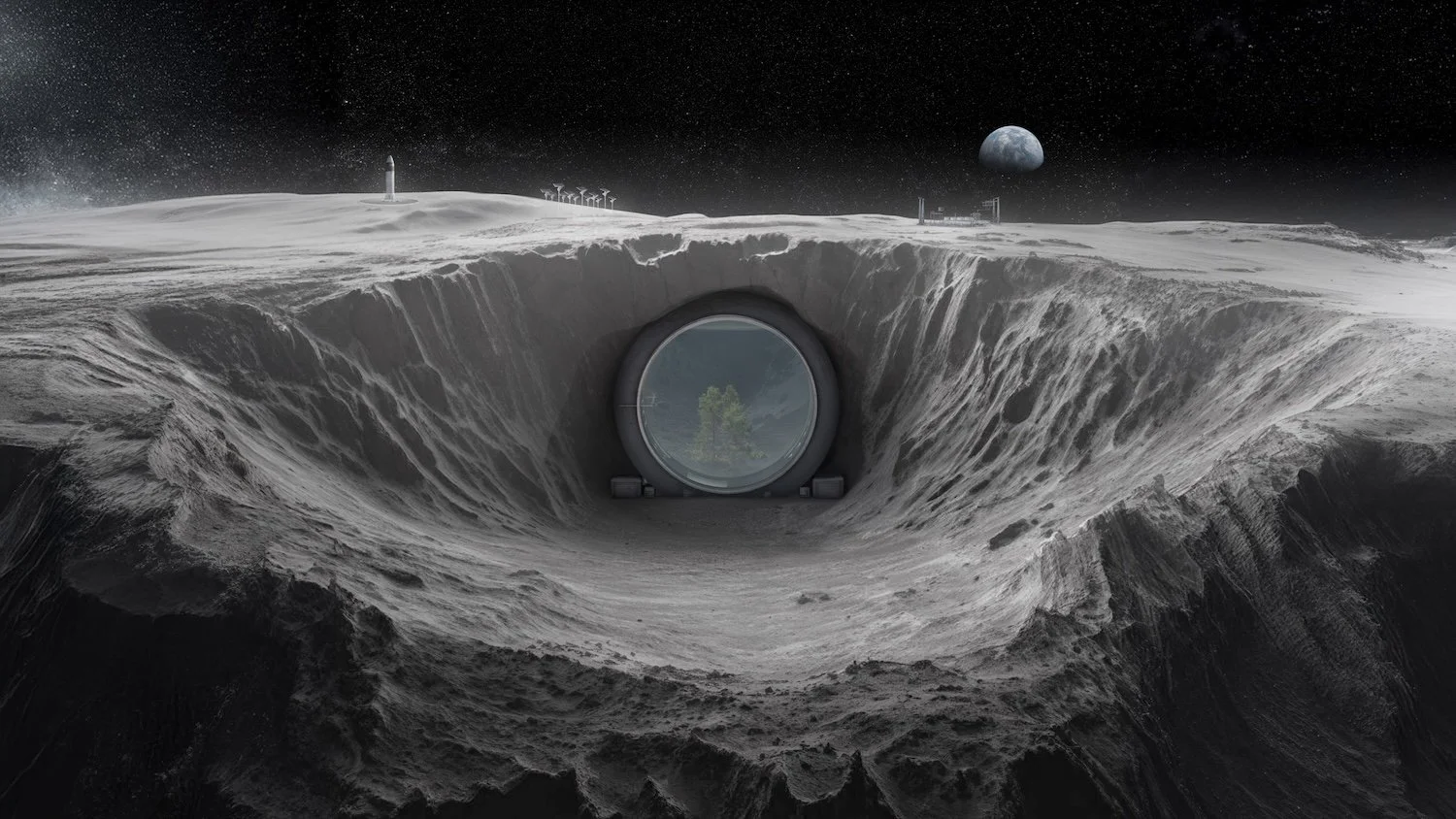
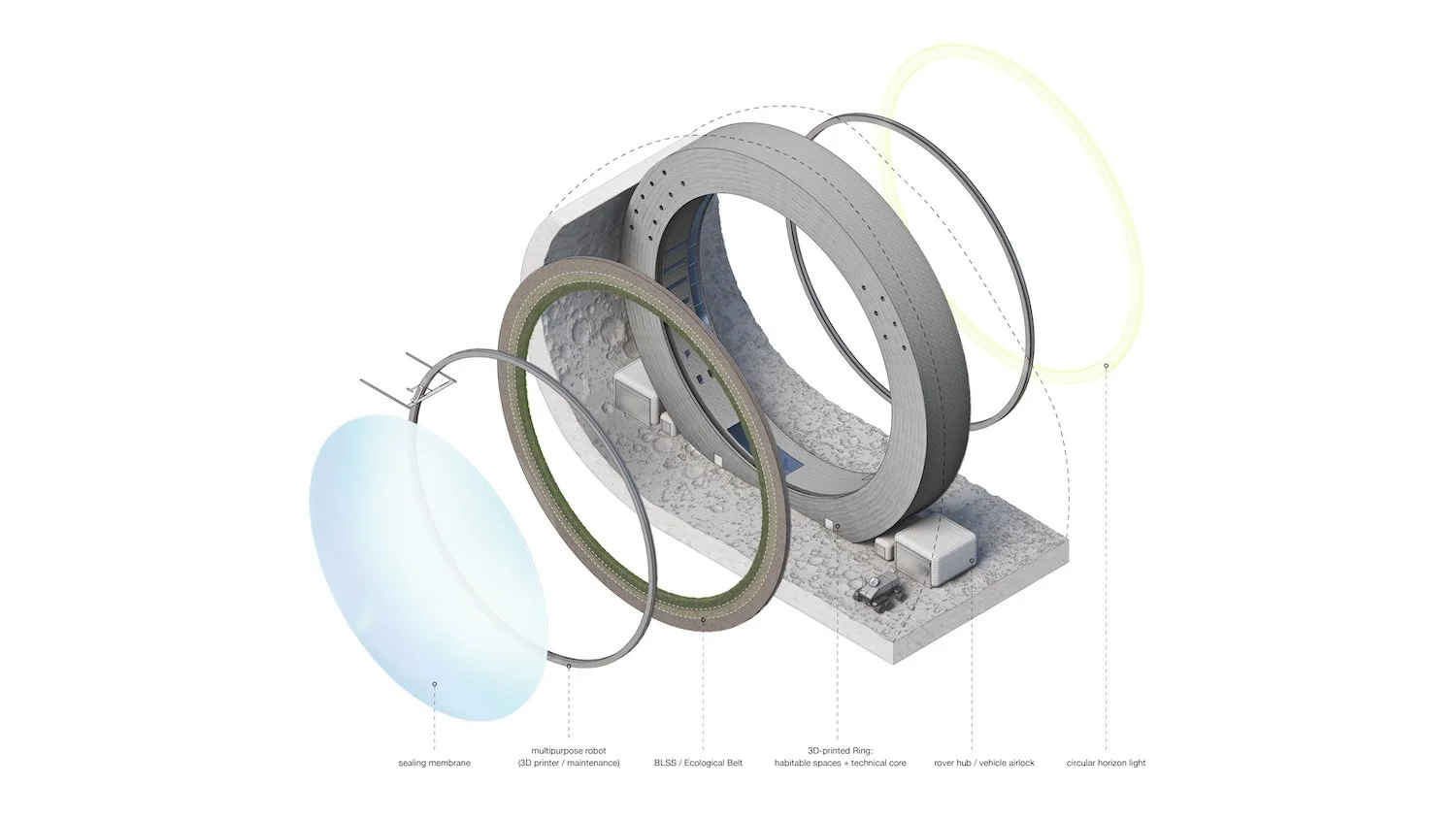
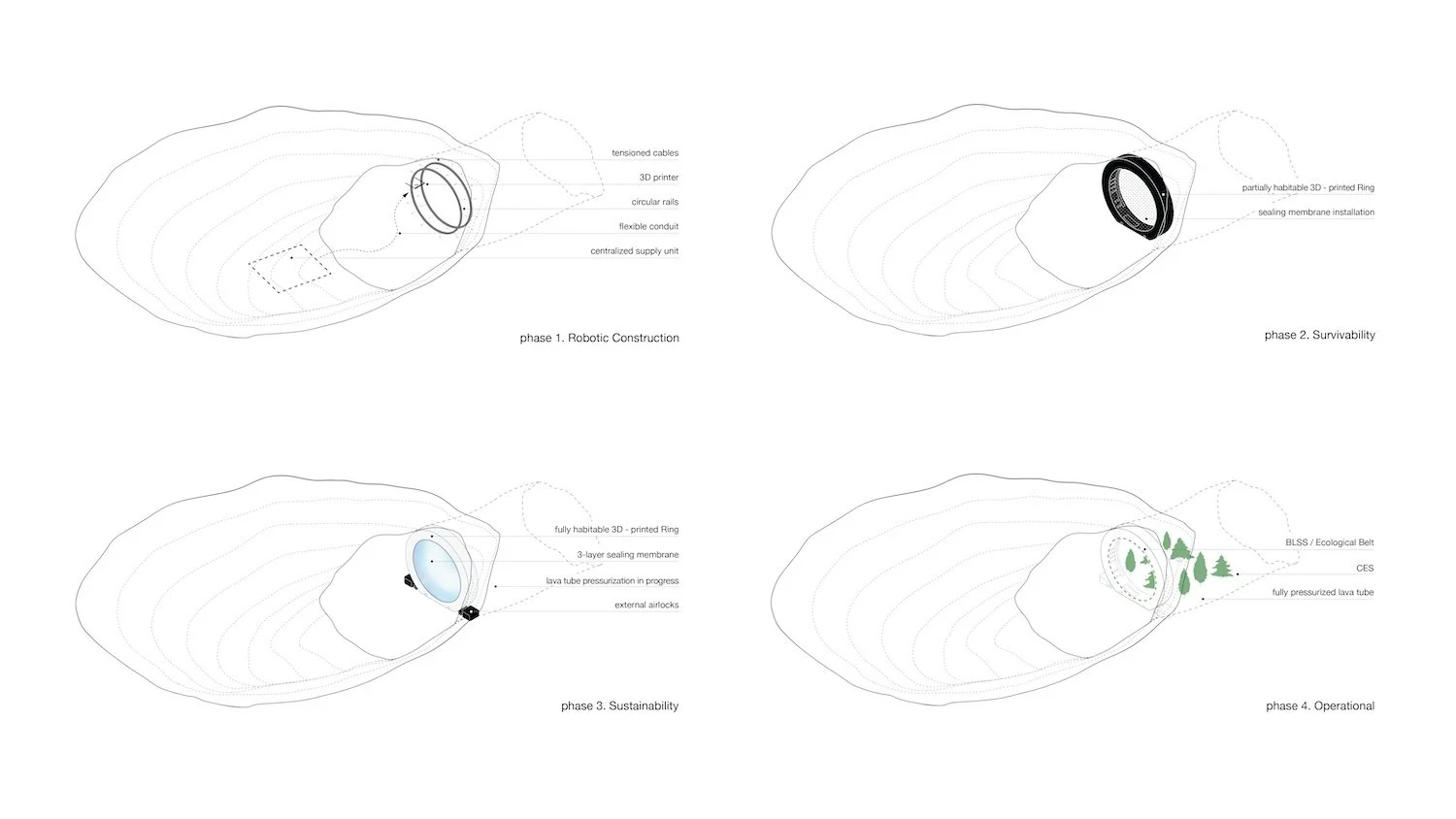
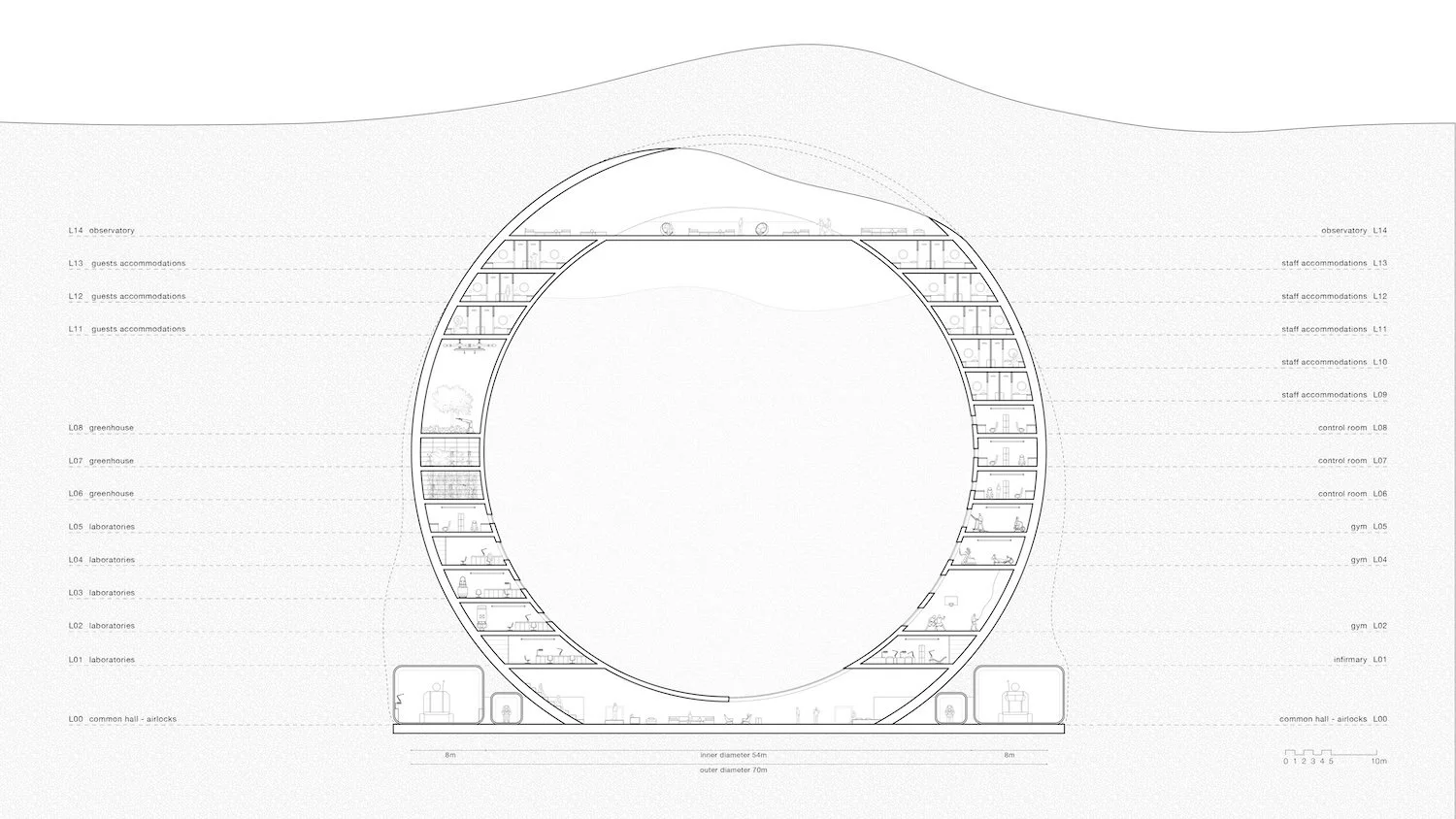
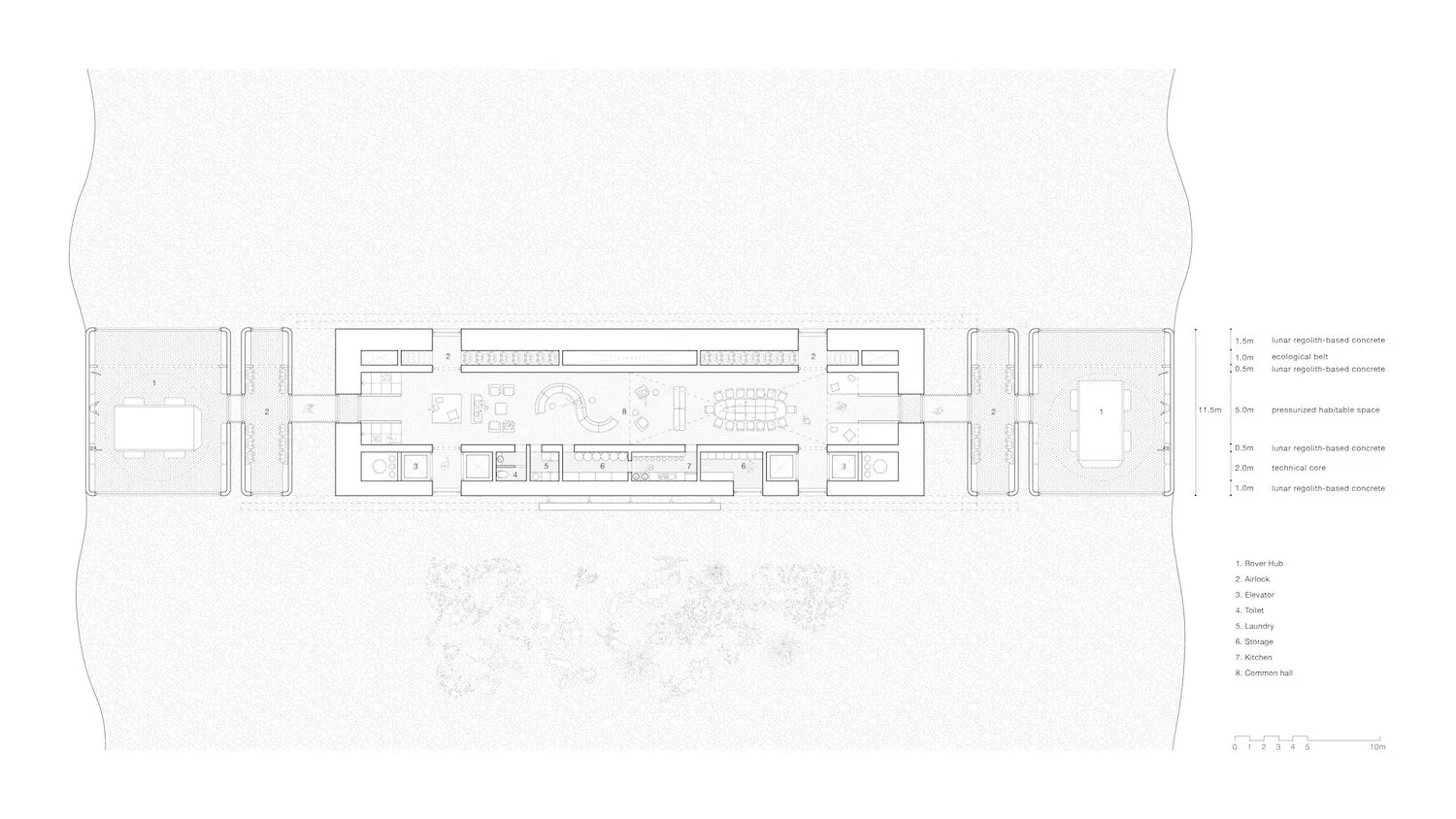
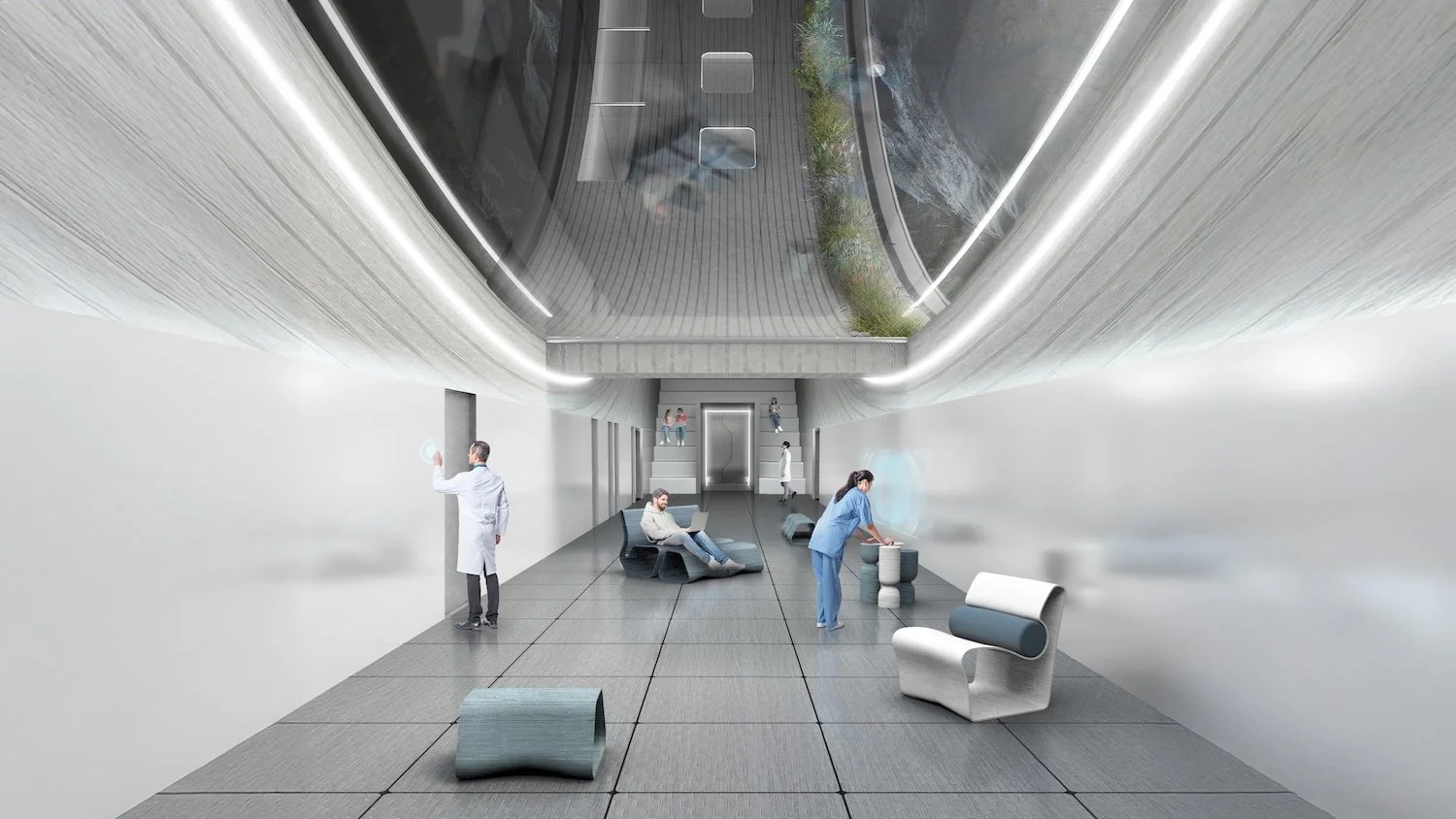
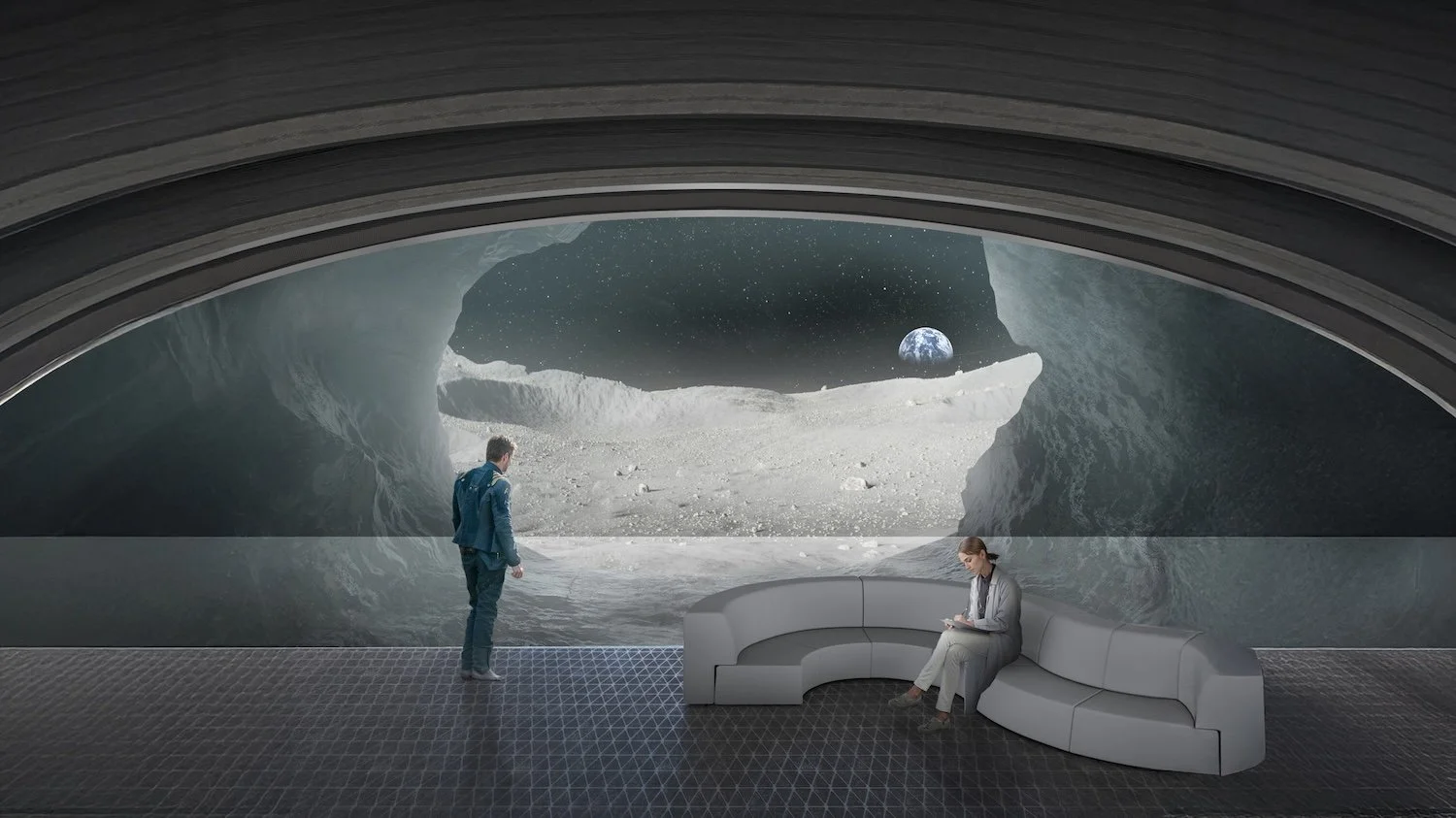
Project Loop envisions a lunar lava tube base featuring a multifunctional architecture: a 3D-printed ISRU-based ring that acts as a habitable structure and operational infrastructure. Positioned at the tube entrance, this construction seals the underground cavity with a polymer composite membrane over its hole. Addressing both technical and habitability related challenges, the ring structure is designed in layers. It integrates pressurized primary functions such as laboratories and dormitories with a Bioregenerative Life Support System (BLSS) that recycles air, water, and waste. Including a robust pressurization system, the ring will also gradually pressurize the lava tube itself, expanding the base into a wide underground environment, fostering a lunar urbanity.
This approach enables a Closed Ecological System (CES) that improves long-term habitability, mitigating psychological challenges of confinement with a subterranean landscape and supporting large-scale agriculture for food production. The outlined strategy provides a paradigm for resilient lunar presence and informs a scalable blueprint for future planetary urbanism.
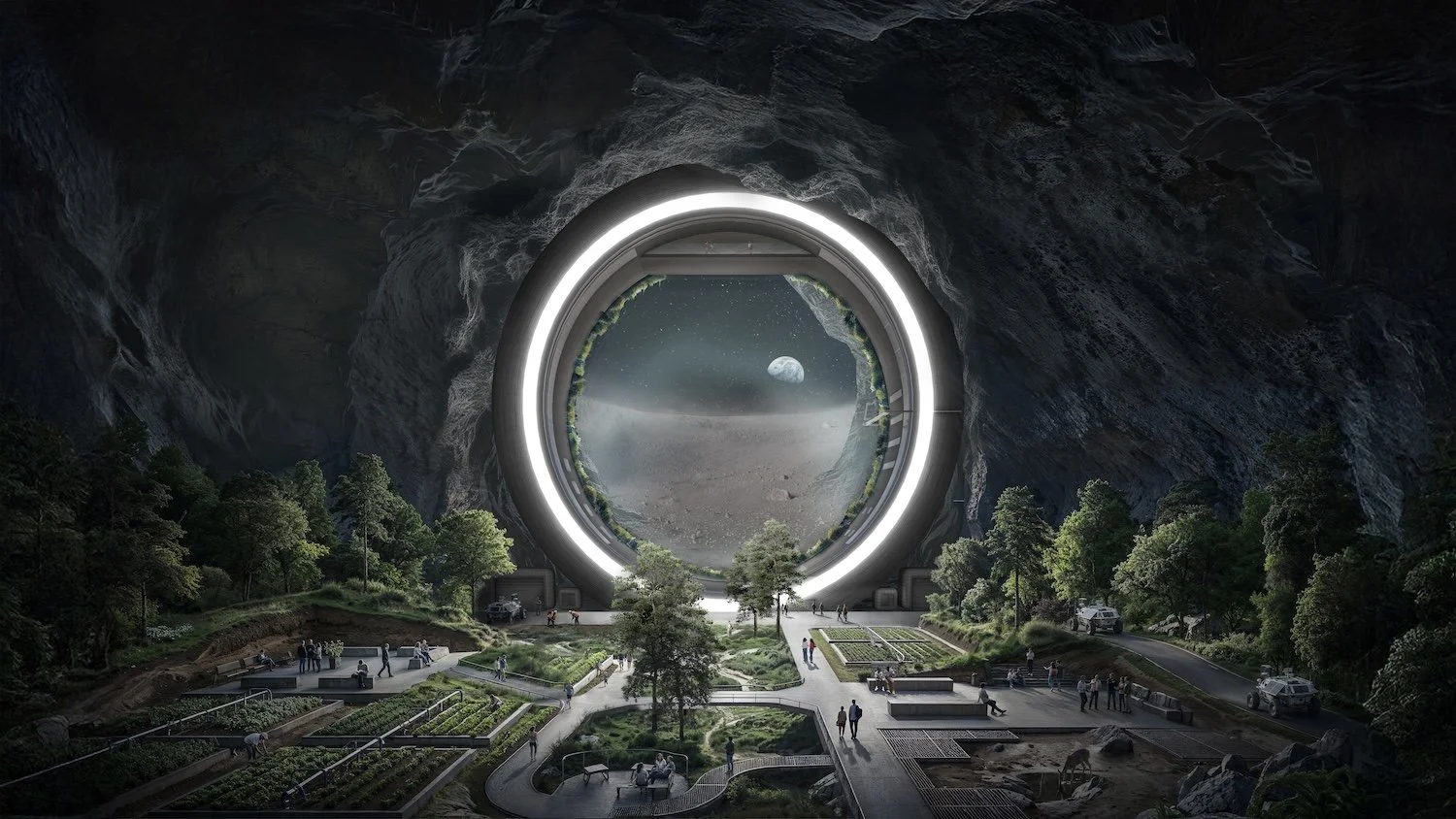
Above: View inside the lava tube. Credit: Silvio De Mio.
Honorable Mention: Zephyr
Hugo Shelley & JP Hastings-Edrei
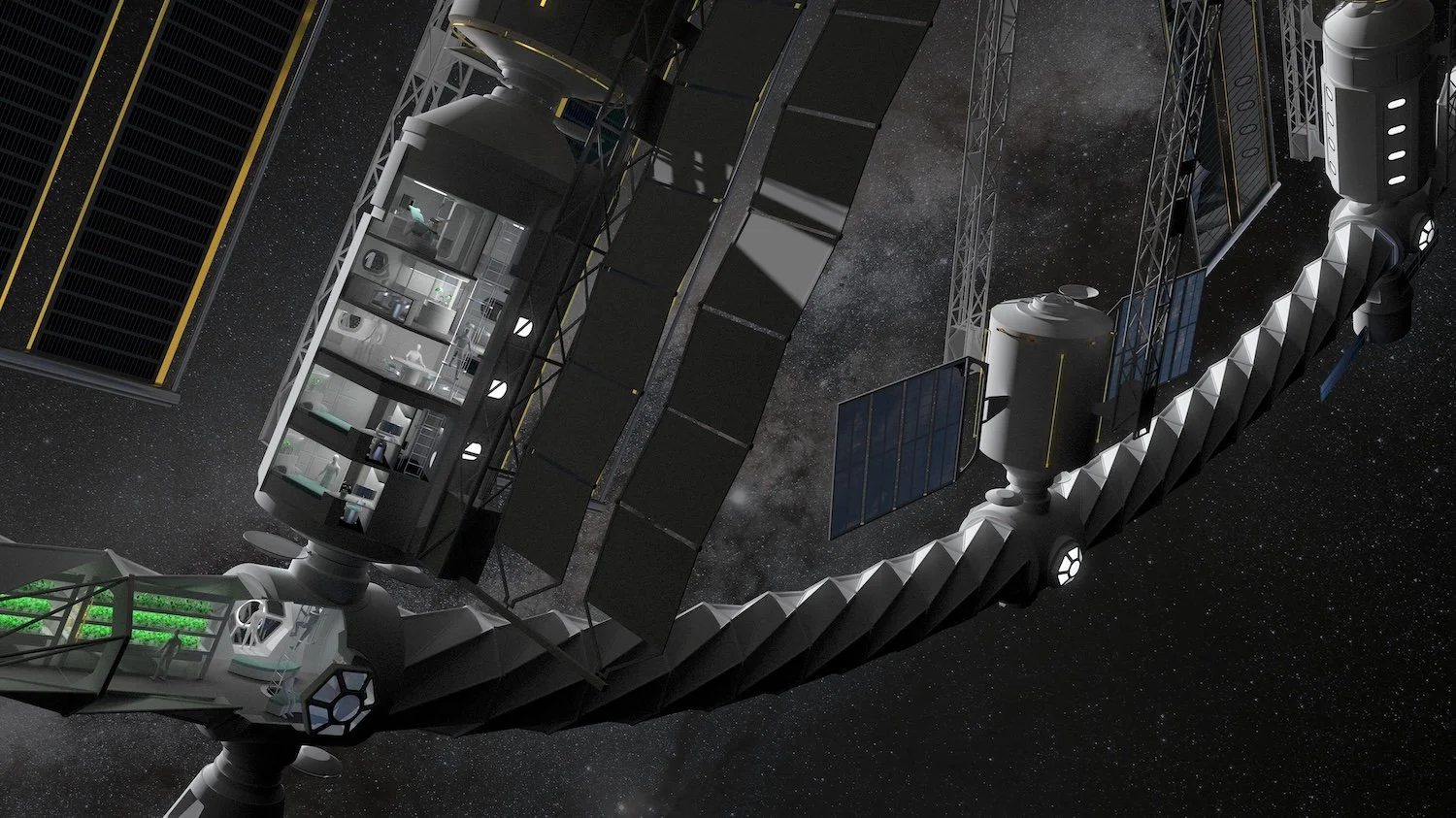
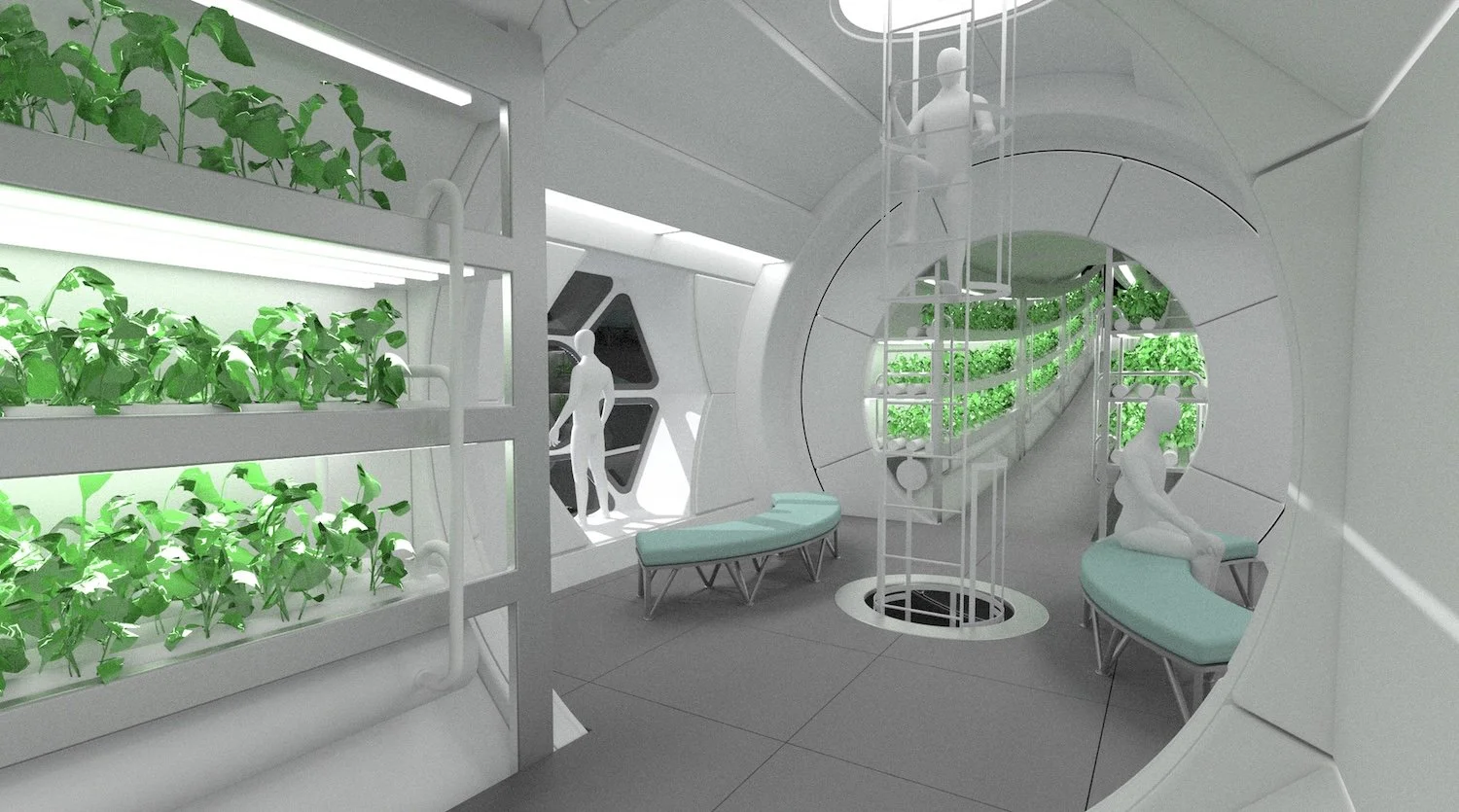
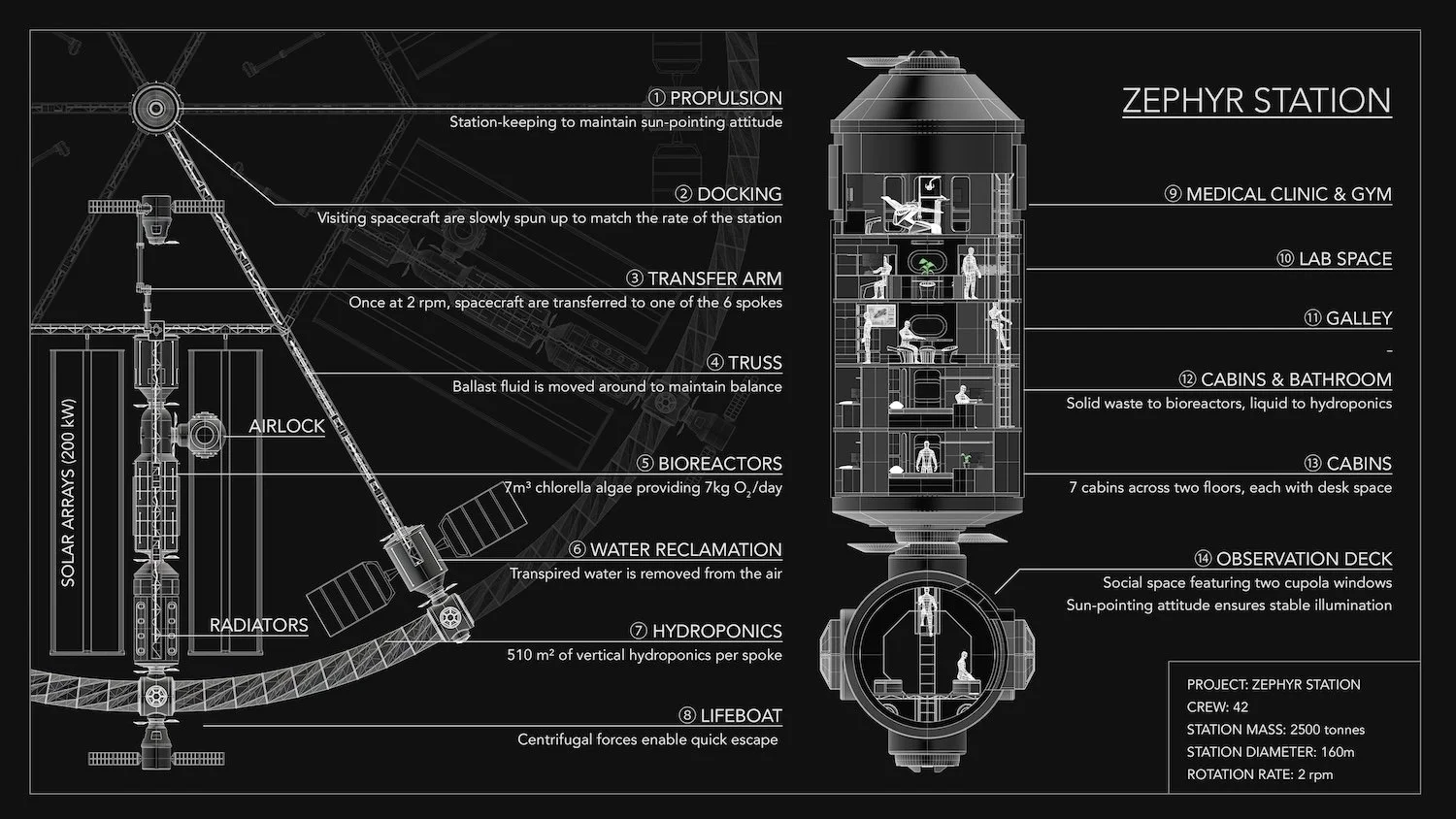
Zephyr is an orbiting laboratory specialising in bioregenerative life support technologies. The rotating station houses bioreactors and hydroponic farms, enabling crews to investigate how partial gravity affects crop development, cellular growth, gene expression and other critical biological processes.
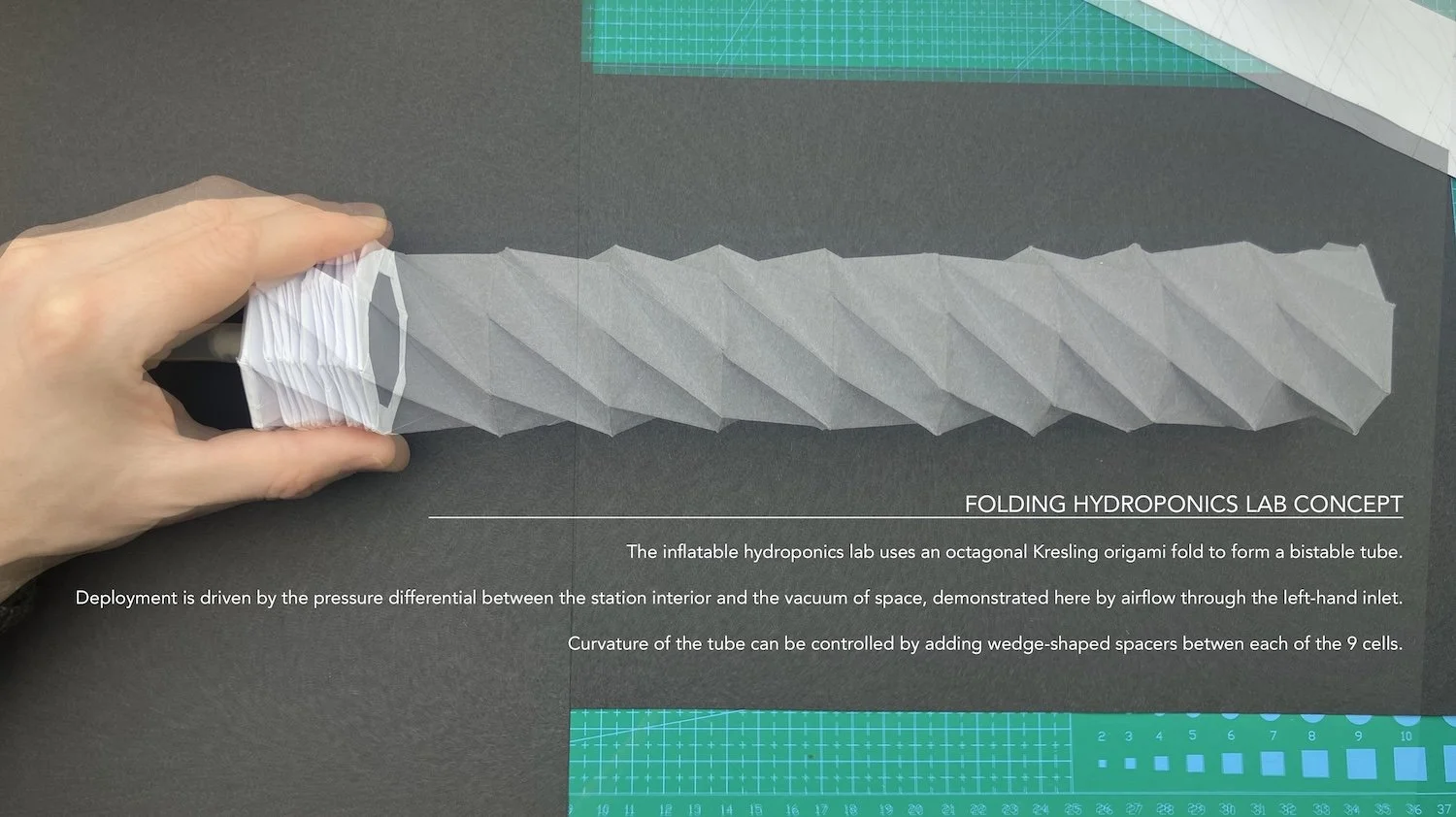
The station rotates at 2 rpm and provides 0.37G of Mars-analog gravity. Each semi-autonomous spoke contains a habitation module, a bioreactor with 7 cubic meters of chlorella algae producing ~1 kg of oxygen per person per day, and a unique, self-deploying hydroponics farm. Zephyr is a stepping stone on the way to sustainable off-world habitats, allowing us to develop the life support technologies needed for long-term missions to Mars and beyond.
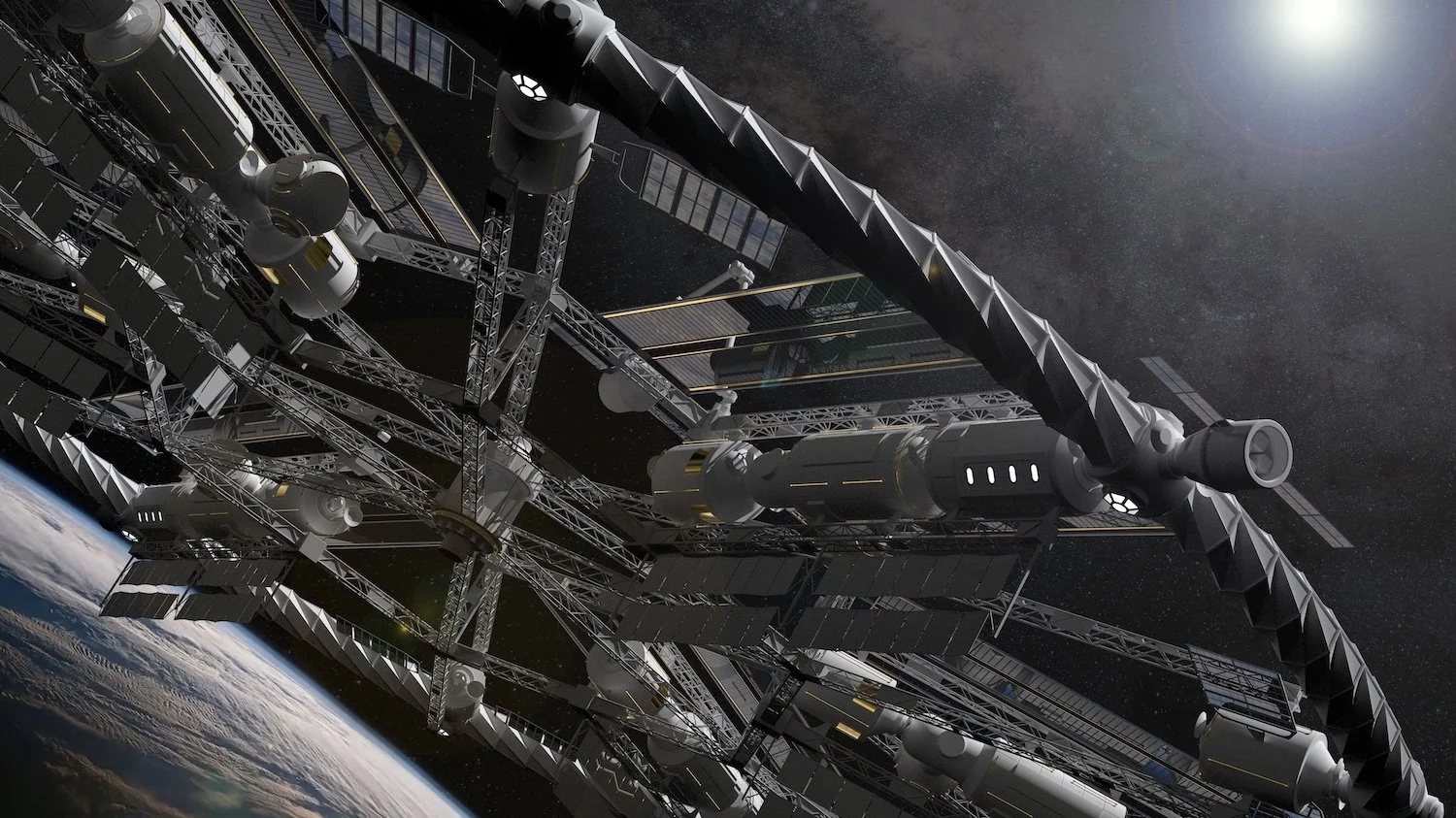
Above: Exterior view of rotating habitat in sun-synchronous orbit around Earth. Credit: Hugo Shelley.
Honorable Mention: Orbital Emergency Granary
Filip Sledz and Maciej Jamrozik
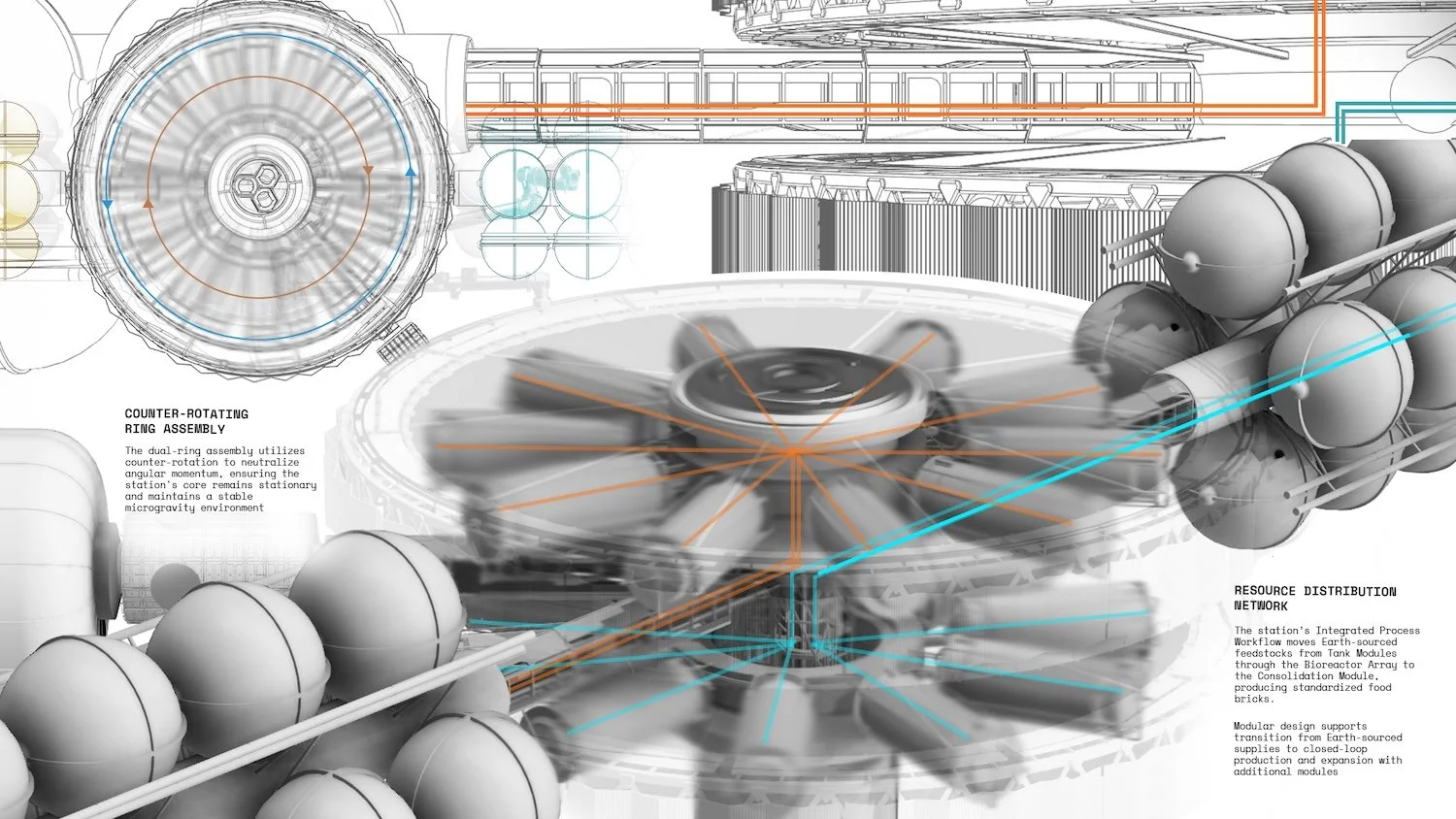
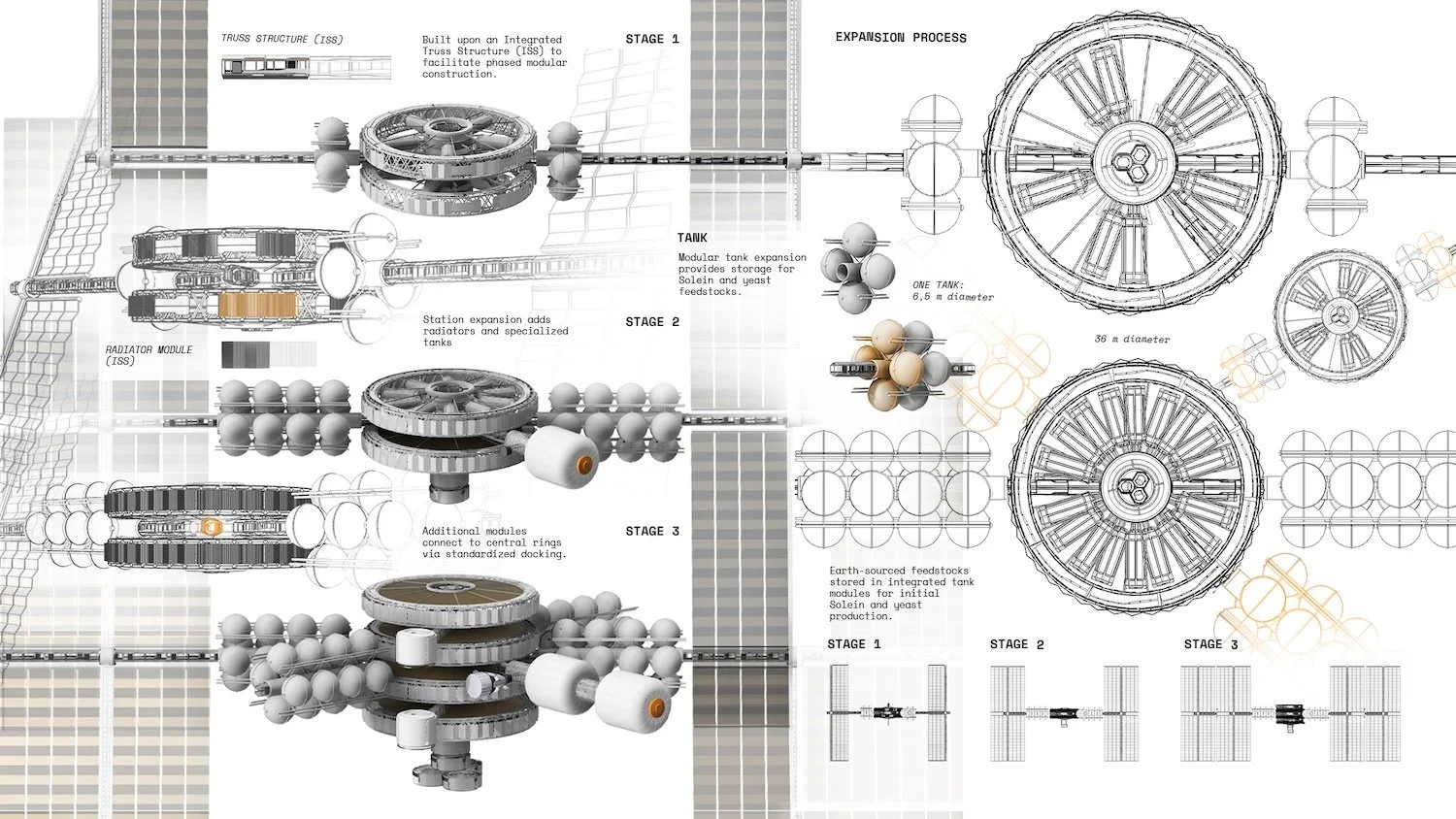
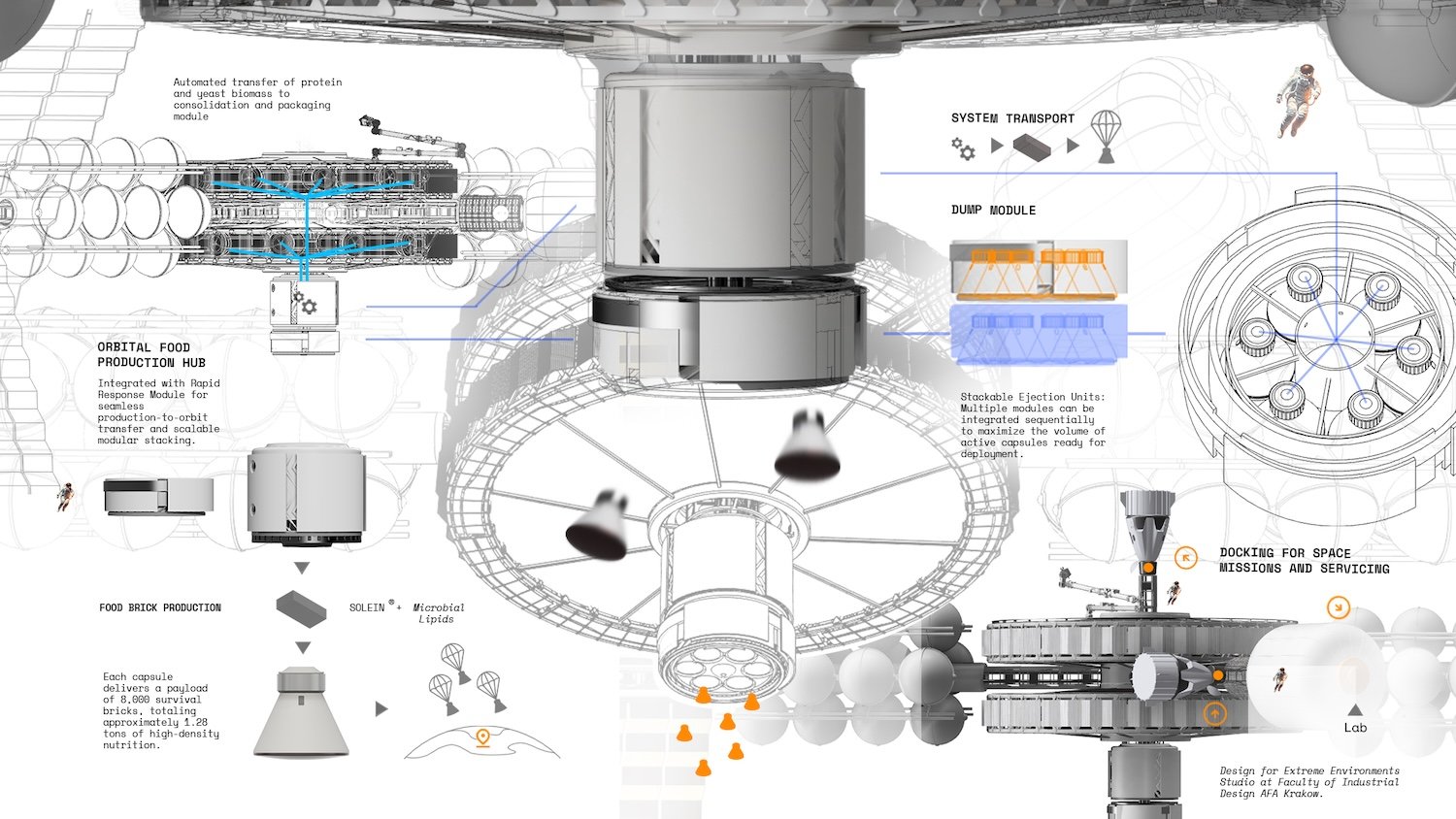
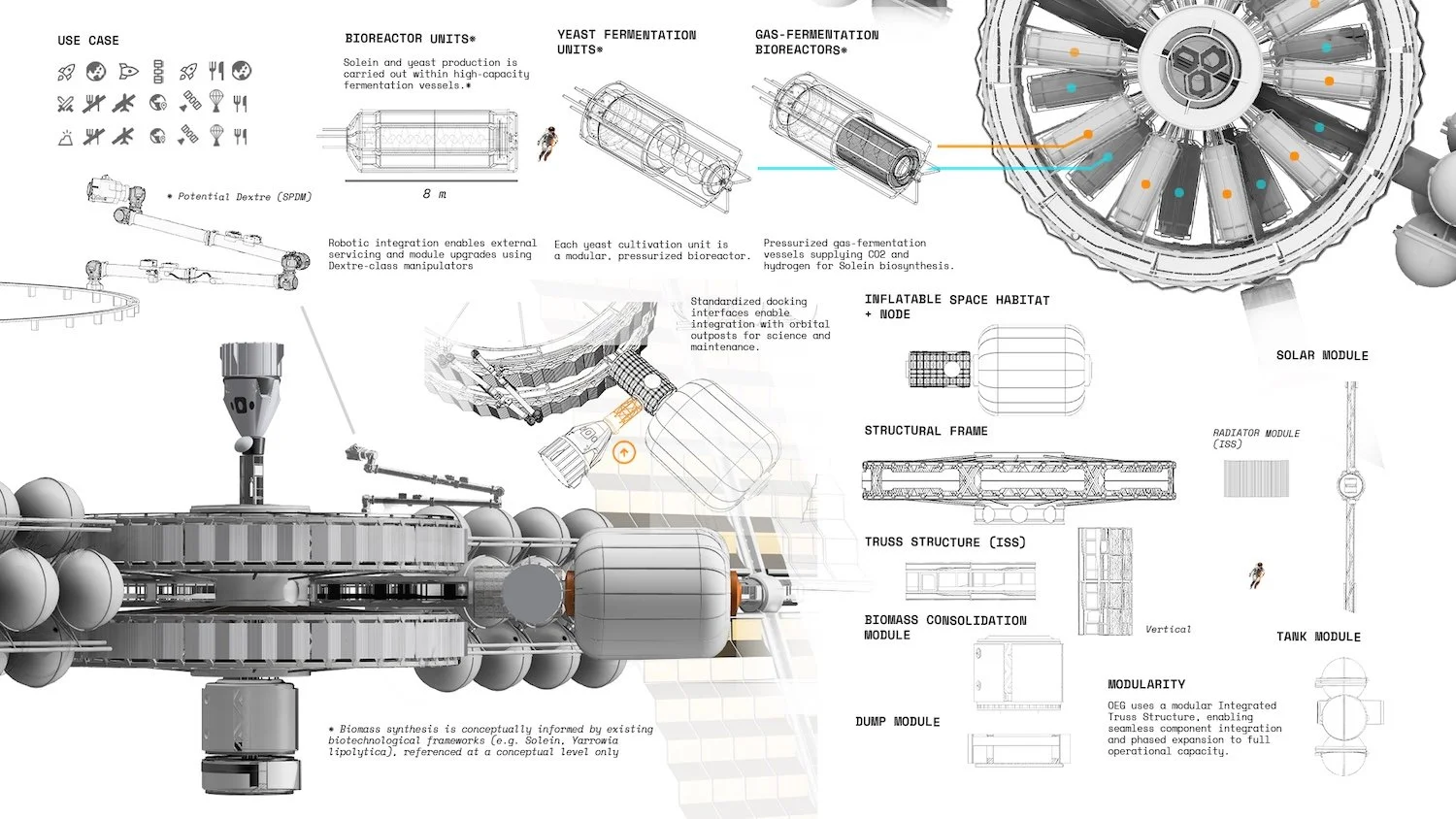
Orbital Emergency Granary is a scalable orbital factory designed as Earth’s strategic food reserve. In an era of increasing climate instability and geopolitical tensions, conventional food aid systems face mounting limitations. The Granary addresses this vulnerability by enabling industrial-scale food production in space and rapid delivery to regions affected by humanitarian crises.
OEG’s defining innovation lies in transitioning from research station to orbital production hub with substantial growth potential. The system launches with two rings and scales with demand, adding production and habitation modules as needed. This architecture enables progression from proof of concept to full operational capacity.
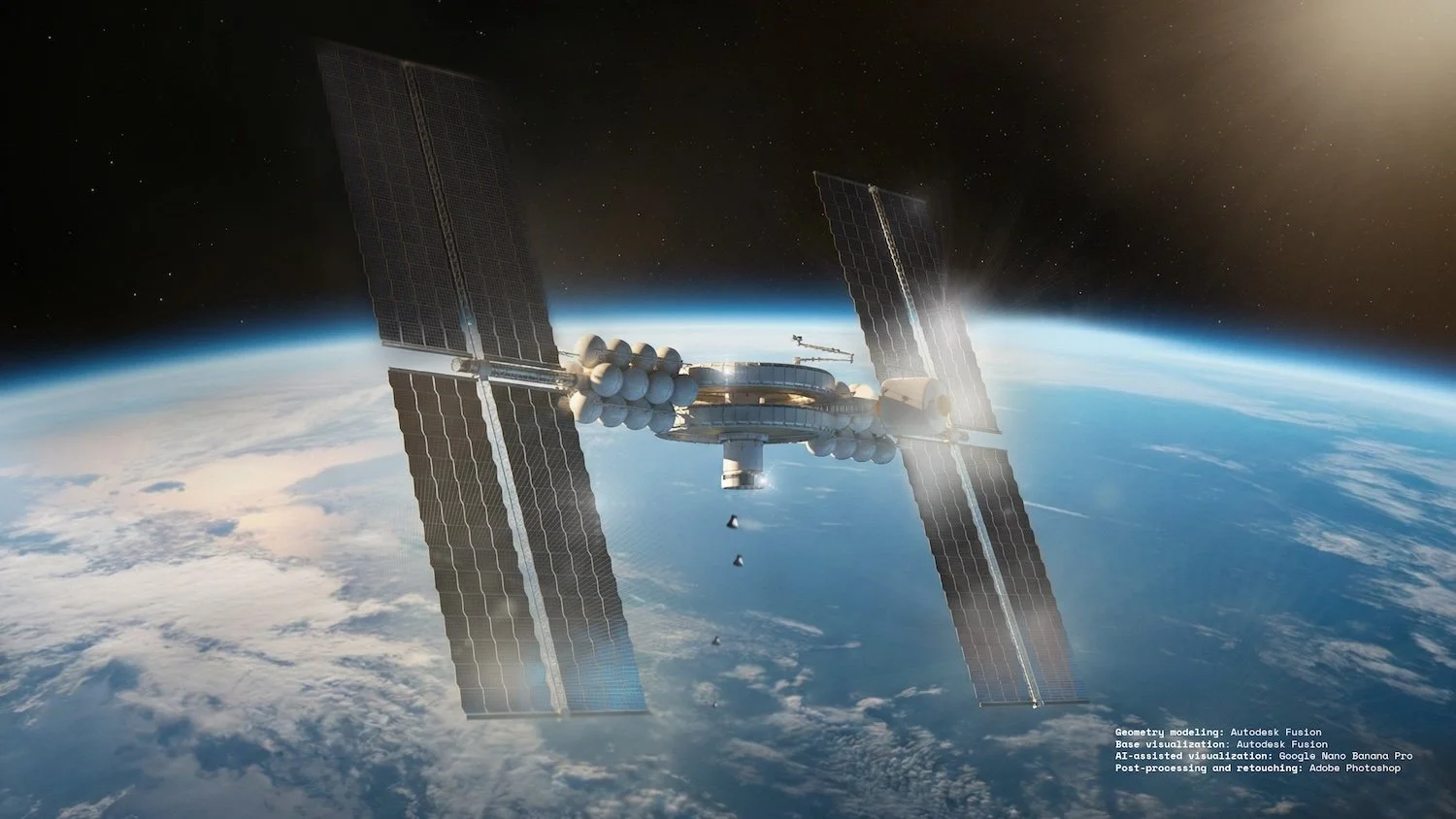
Above: Exterior view of OEG in orbit around Earth. Credit: Filip Sledz, Maciej Jamrozik.
Finalist: Kessler Orbital Station
Joseph M. Mwaisaka
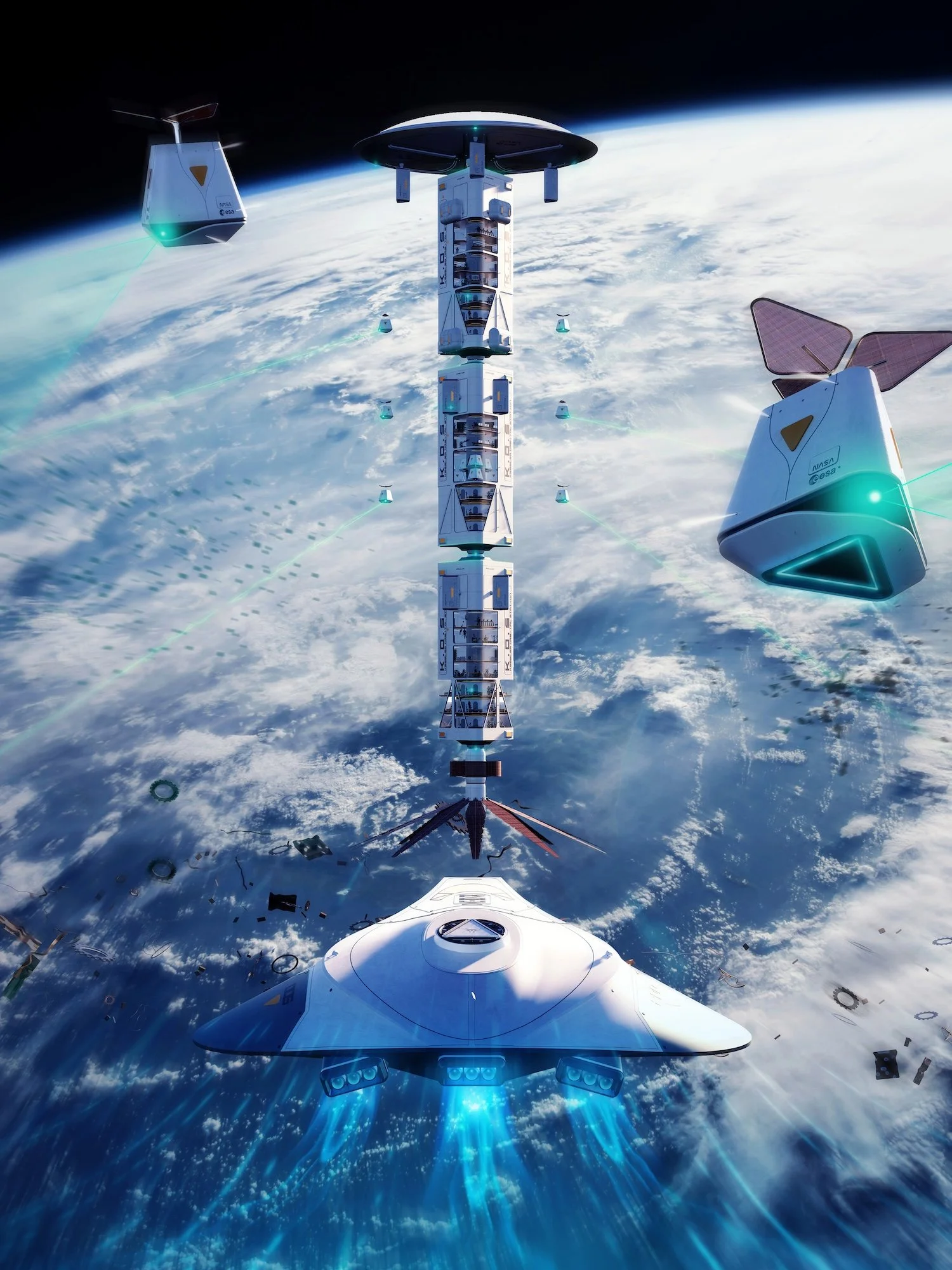
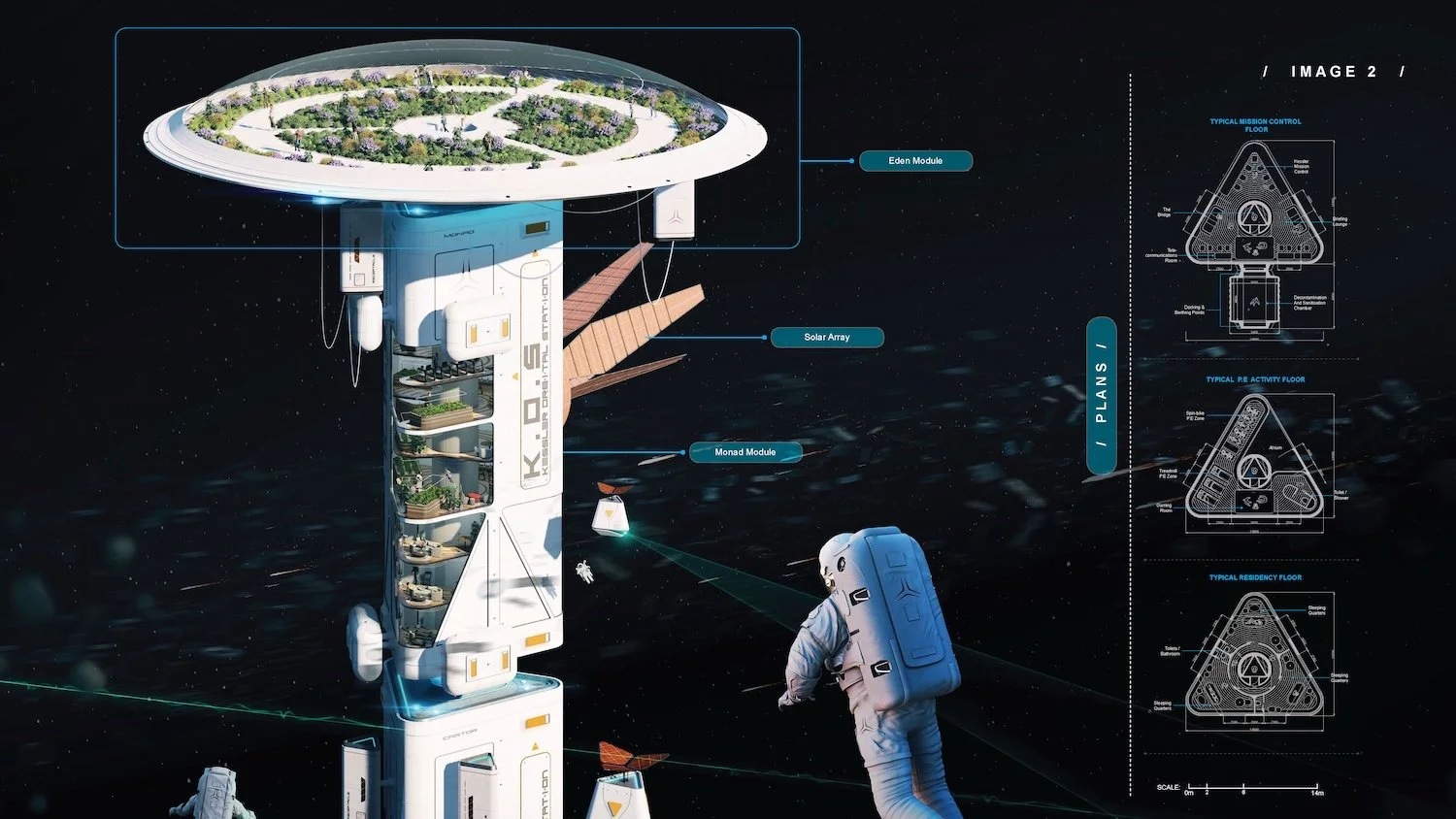
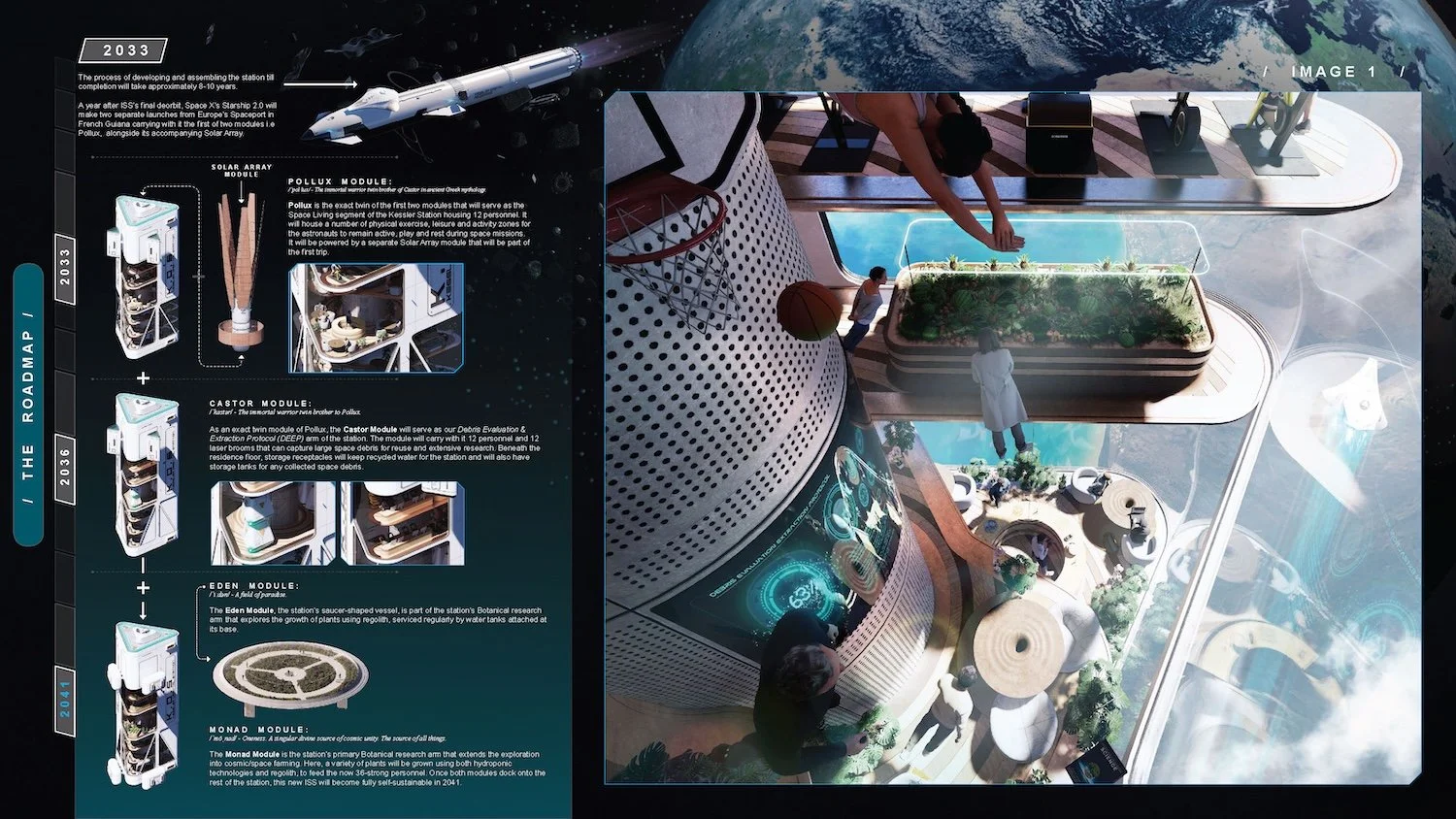
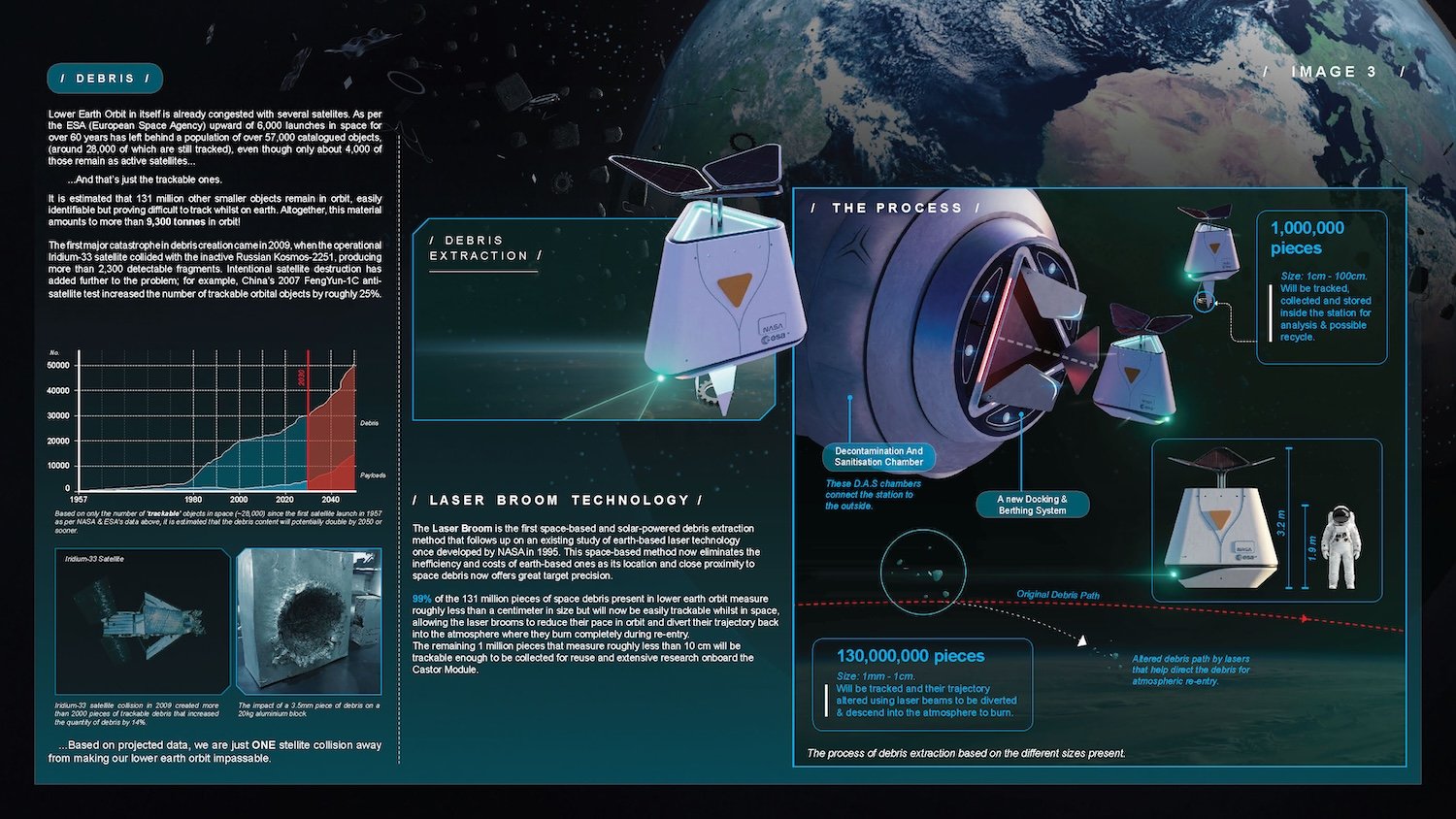
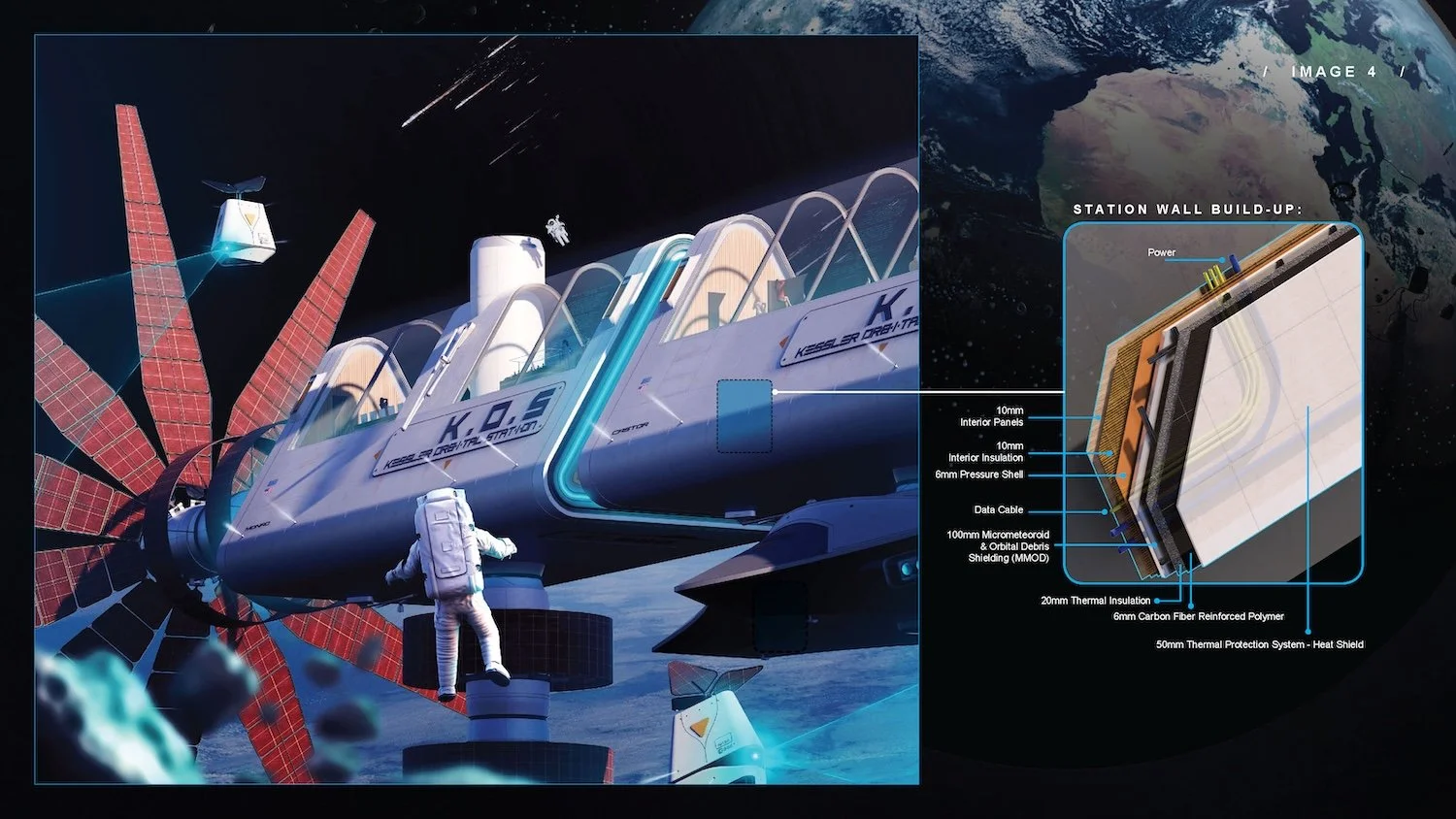
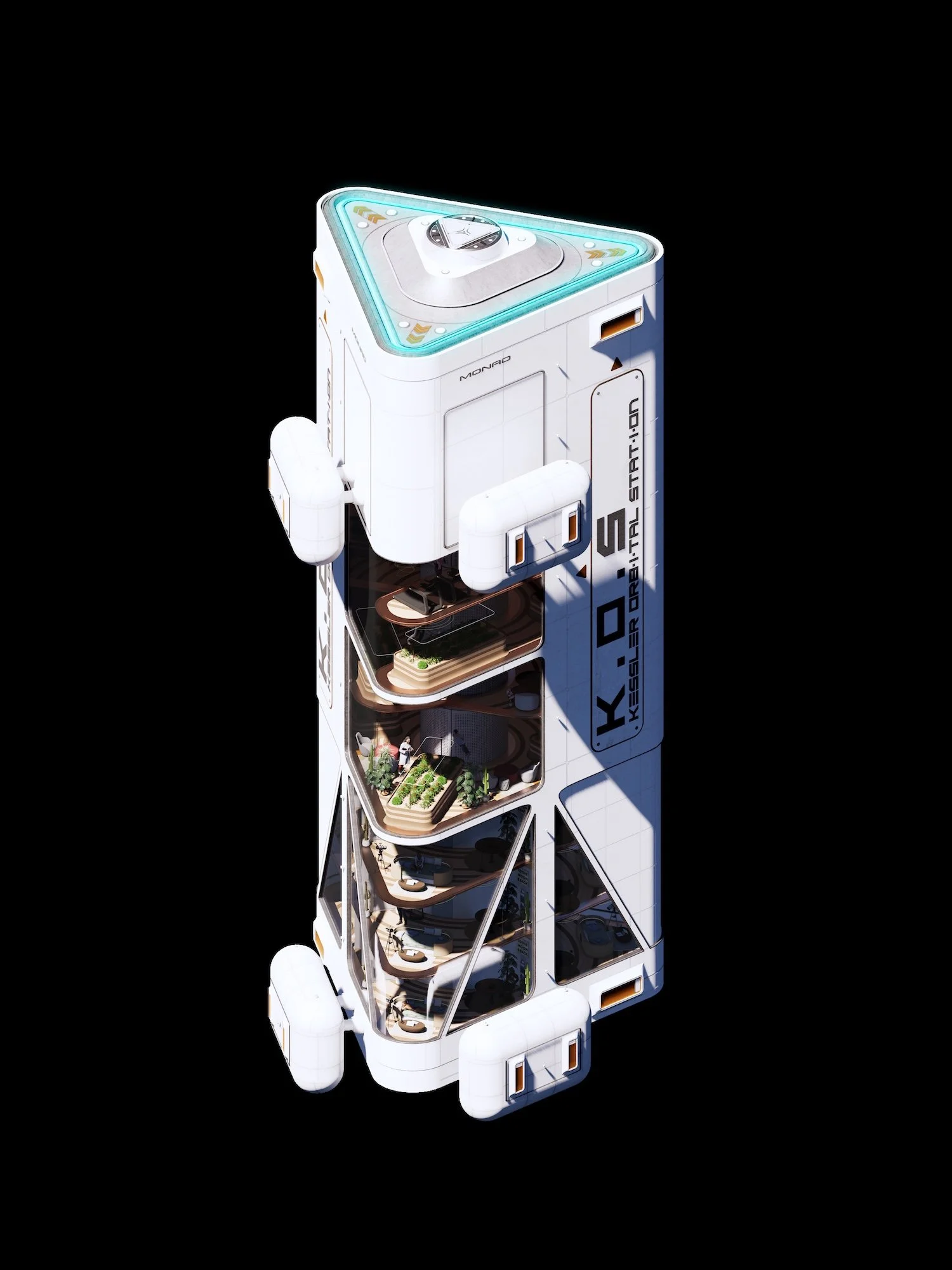
Envisioned as a vertical skyscraper station, the Kessler Orbital Station integrates habitation, research, and orbital maintenance into a single architectural system. Its spatial logic prioritizes adaptability and growth, with three identical modules connected through a ‘bridge’ and with variable gravity environments. Within this framework, crews move between weightlessness and stability, between observation, production, and restoration. The station supports long-term human presence while quietly performing a critical task: mitigating orbital debris through continuous monitoring, redirection, and recovery. This debris extraction method is made possible through the use of space-based laser brooms.
A brief video introducing the project is available on YouTube.
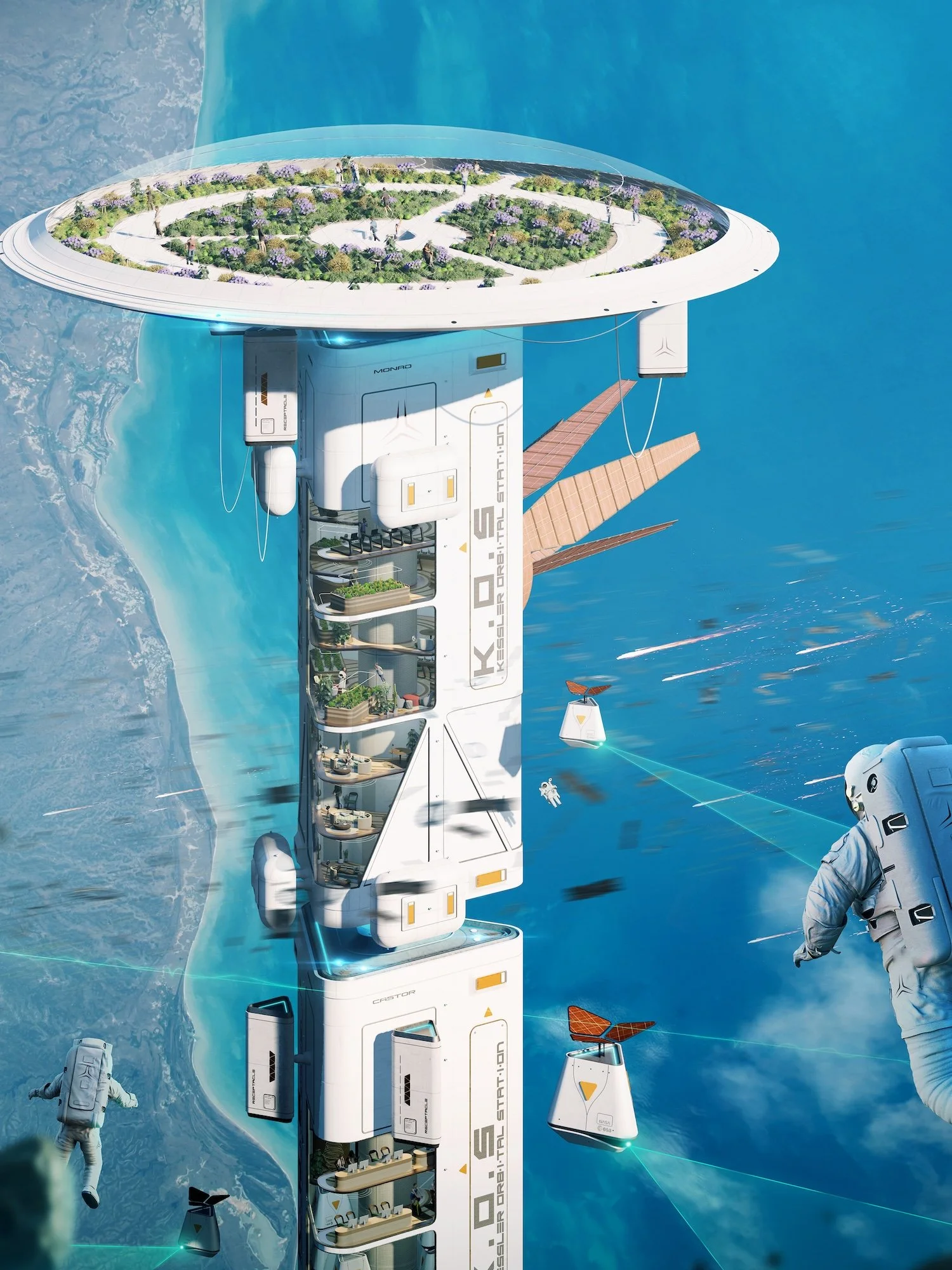
Above: Exterior view of Kessler Orbital Station. Credit: Joseph M. Mwaisaka

Finalist: Lunar Nautilus
Gayathri Dhanapal and Jacob Oommen
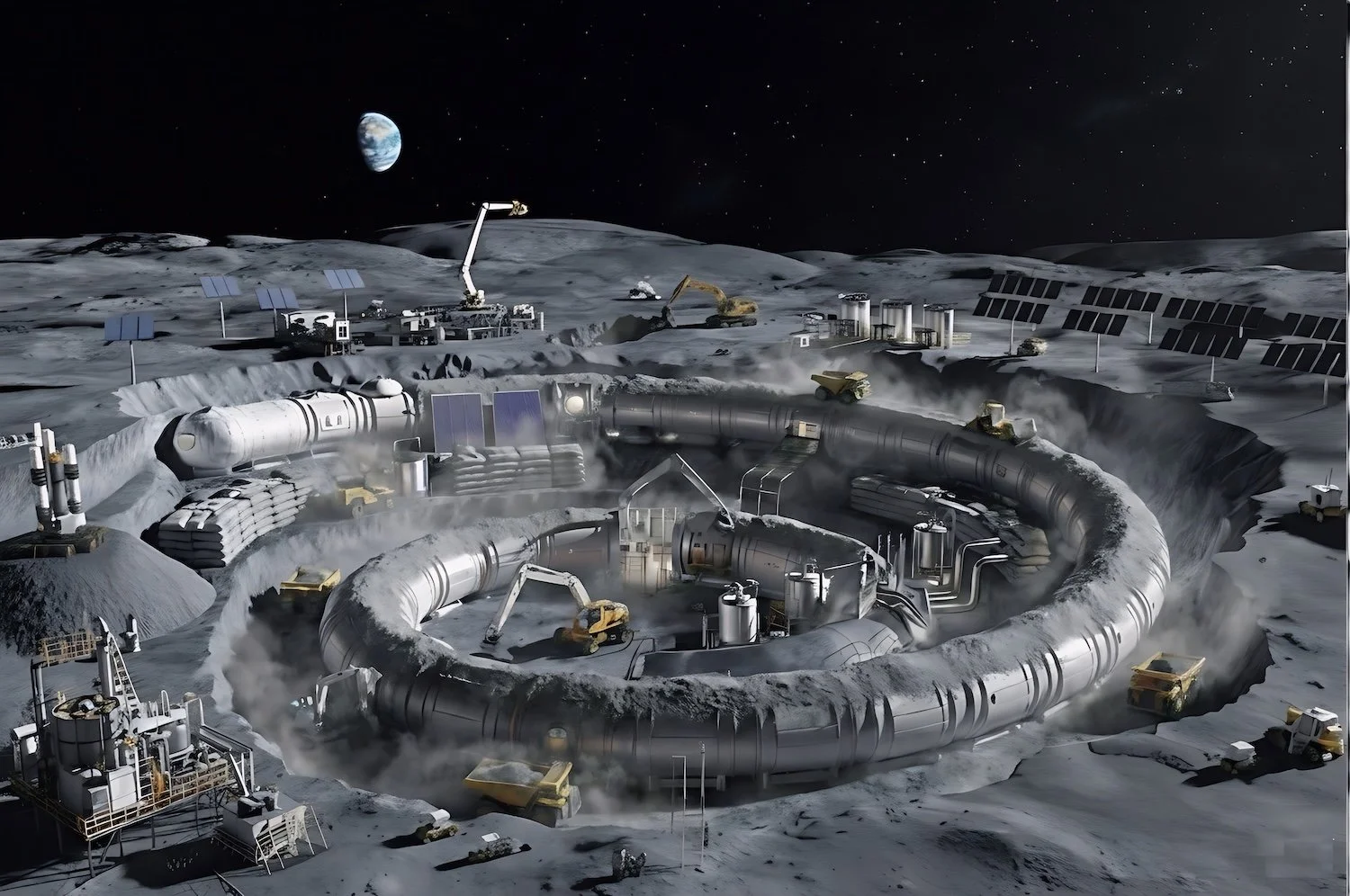
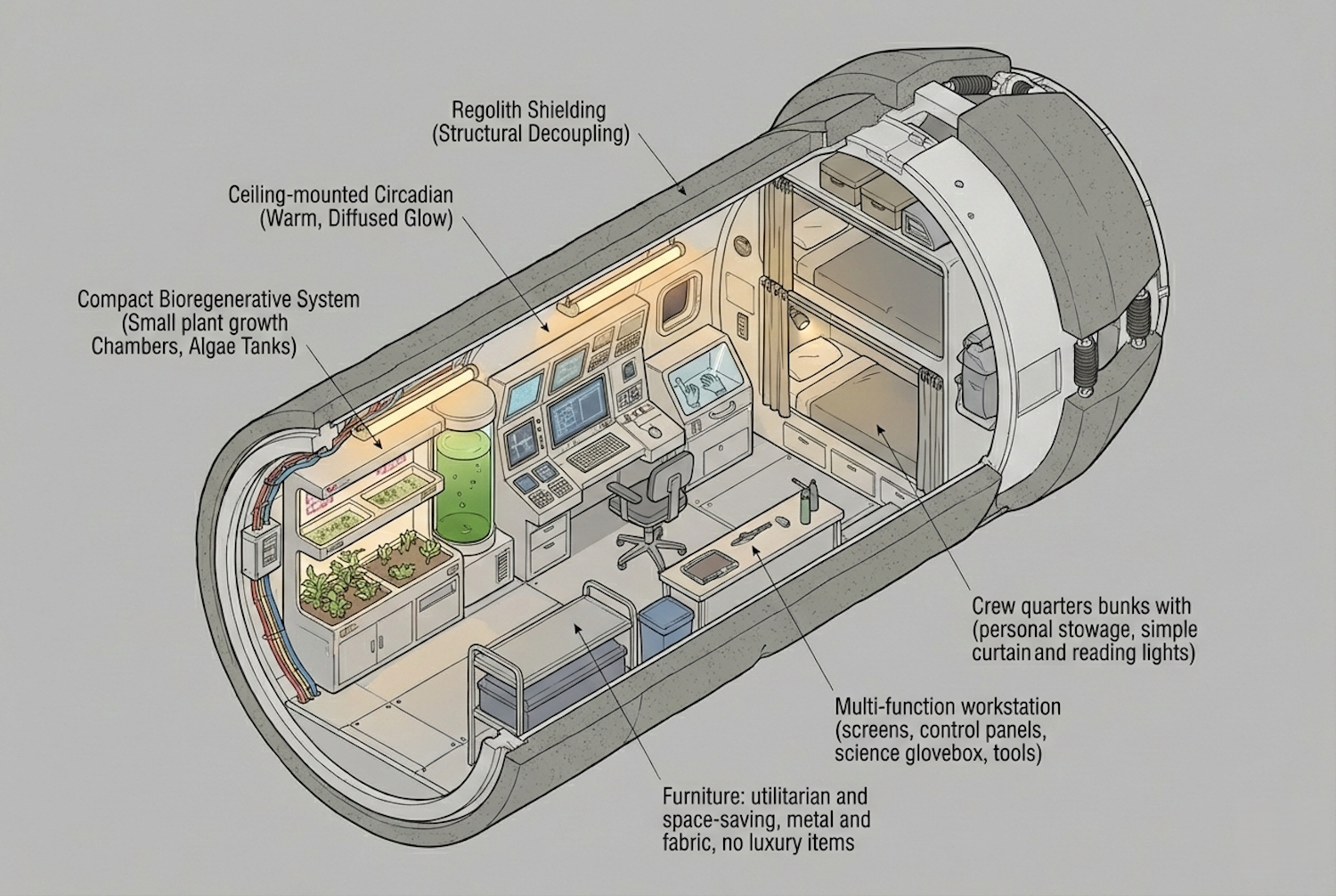
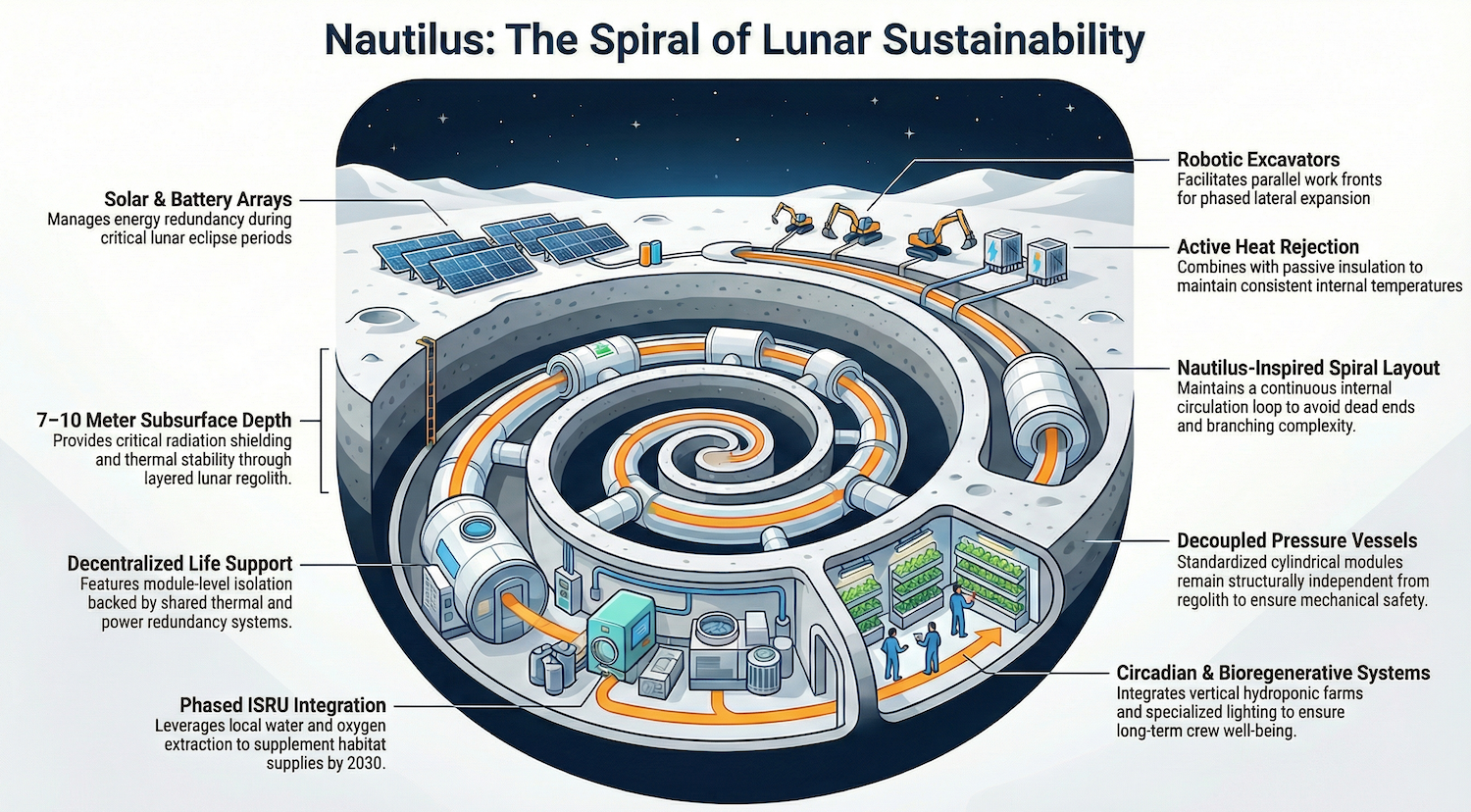
The Lunar Nautilus is a near-term subsurface settlement concept for the Moon’s South pole that asks whether an engineered Spiral can play the role that lava tubes and caves cannot yet fill in the polar regions, where no large natural cavities are confirmed and site selection is driven by illumination, communications, and ice access. It targets the first few dozen residents — 4-6 crew in early phases, scaling by adding standardized cylinders — who must live and work continuously rather than rotate through short sorties.
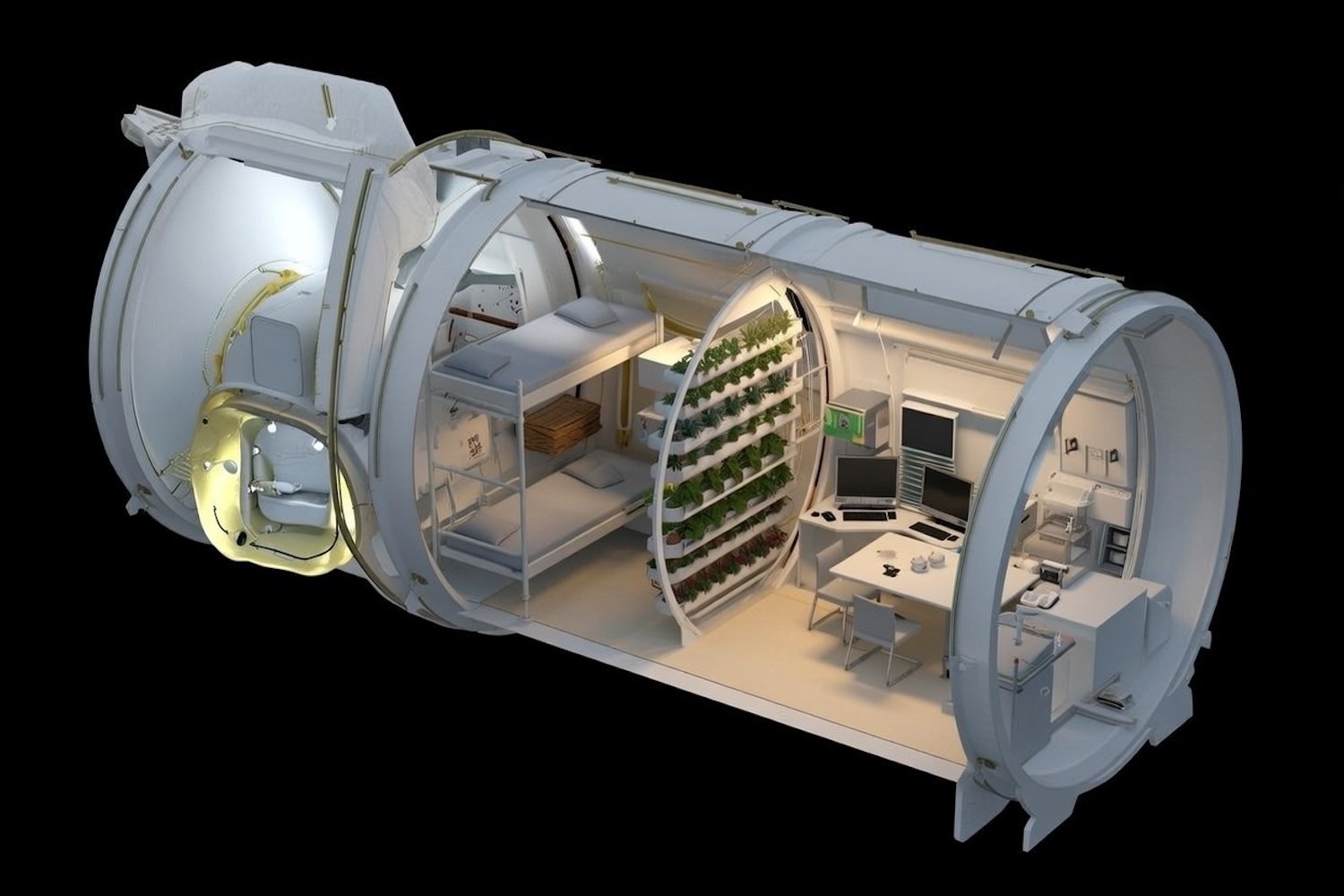
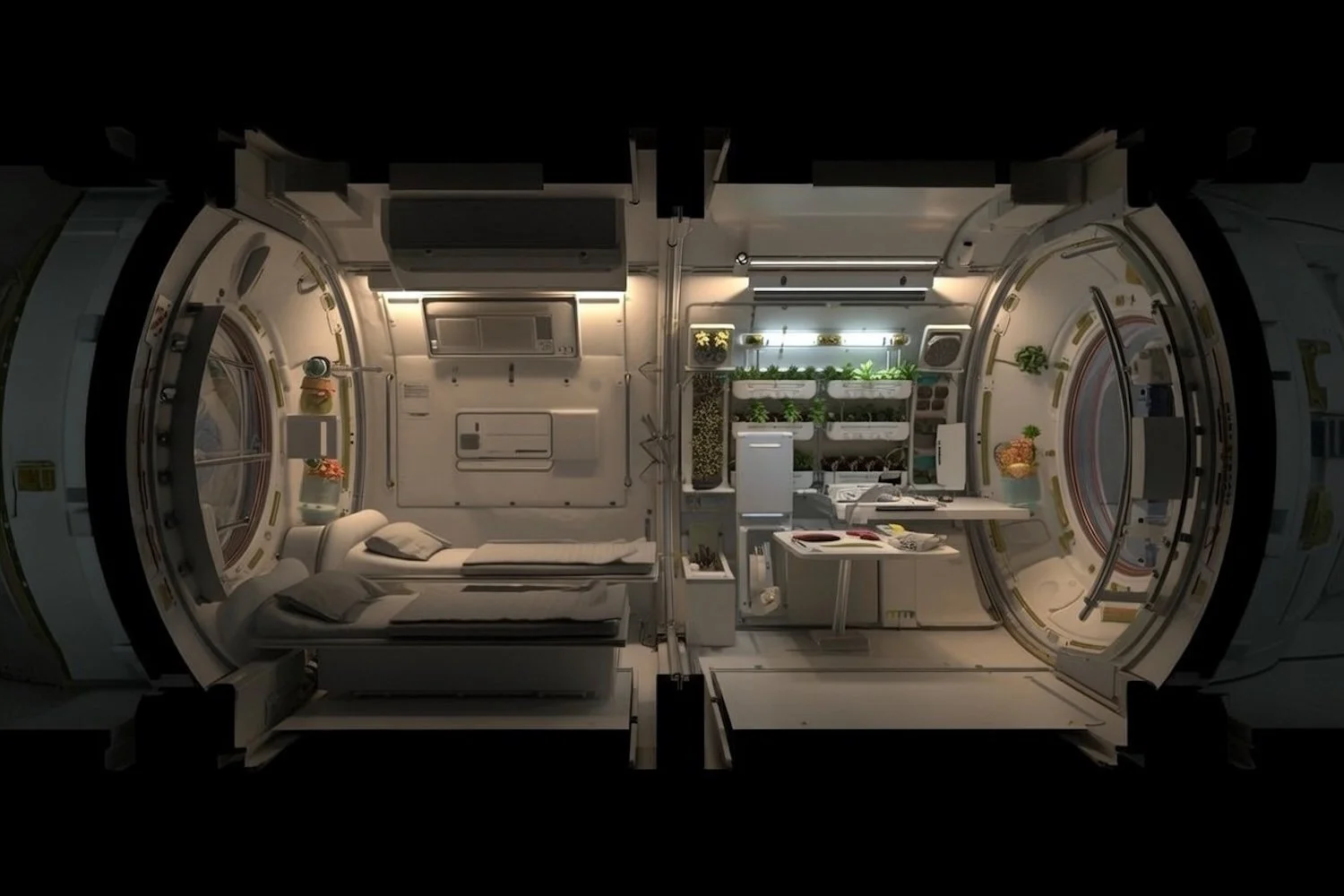
The habitat uses a shallow, modular band at a constant 7-10 m depth. Pressurized volume comes from the cylindrical pressure vessels derived from flight proven spacecraft and station hardware, structurally decoupled from the regolith, which is used strictly as shielding to avoid dependency on poorly constrained regolith strength and creep. Expansion proceeds laterally along a nautilus- inspired loop at constant depth, so excavation effort scales linearly with added modules rather than with depth.
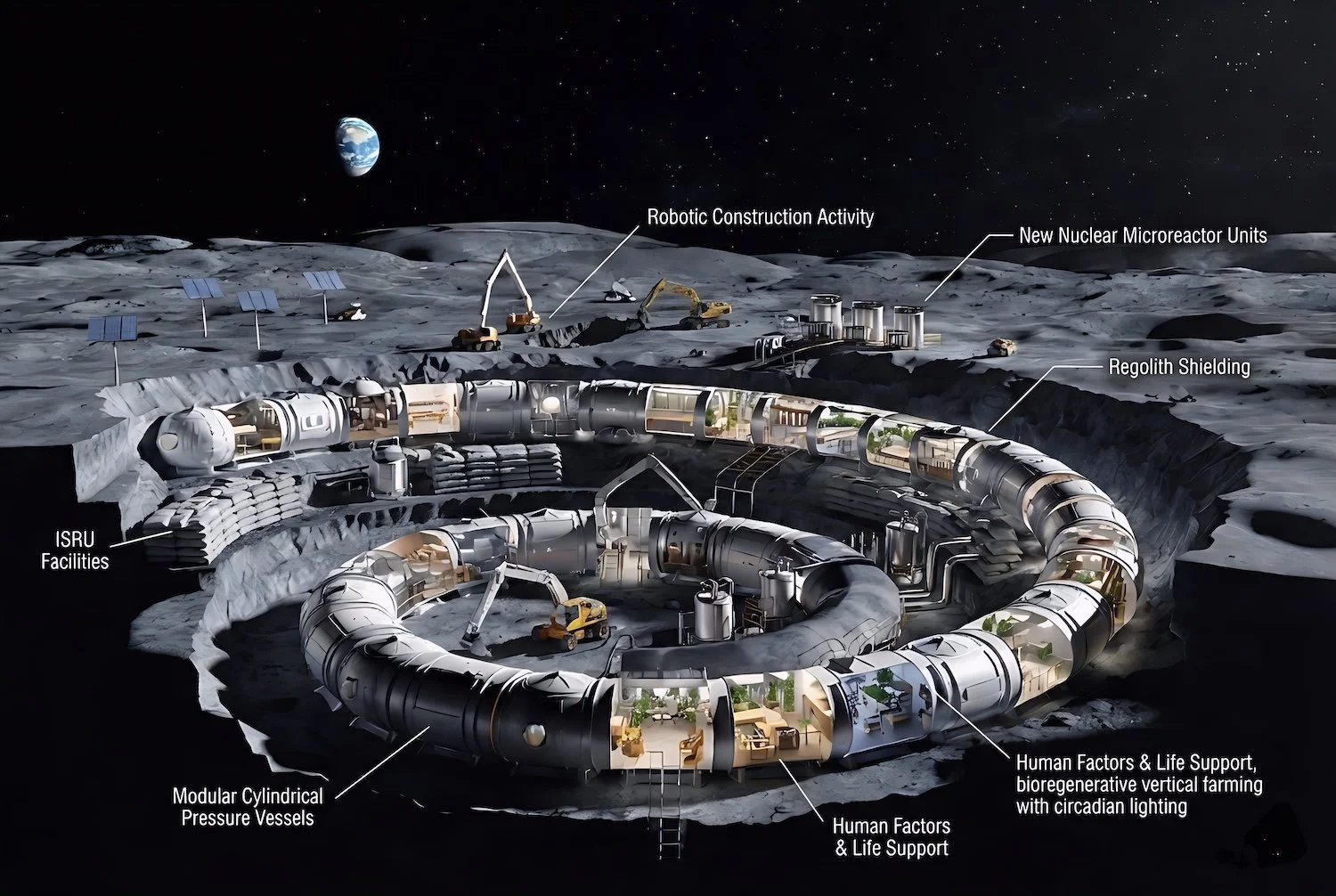
Above: Rendered diagram of Lunar Nautilus concept. Credit: Gayathri Dhanapal, Jacob Oommen
Finalist: Lunar Tripolis
Dr. Parisa Haji and Silveria Asuncion Herras
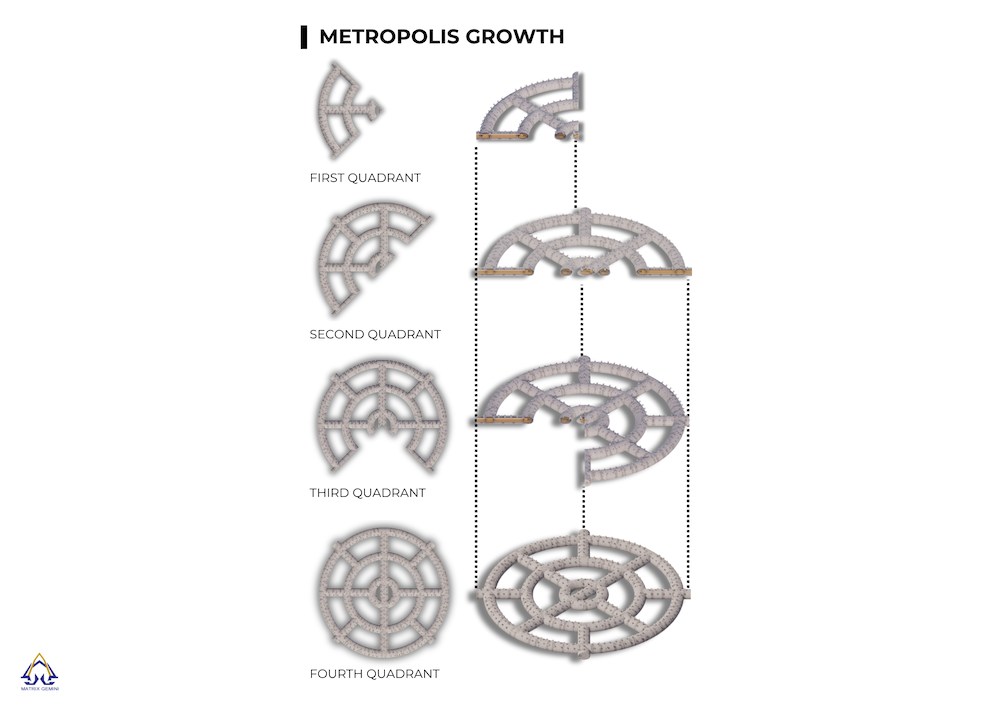
Lunar Tripolis is an integrated, permanent lunar city designed for sustained human settlement rather than temporary or inflatable deployment. Envisioned as a fully buried metropolis near the lunar south pole, Lunar Tripolis shields occupants from the Moon’s most severe environment, including meteoroid impacts, extreme temperature variations, and high radiation exposure. All inhabited structures are covered by 0.5 m of regolith mortar and 1.0 m of engineered regolith.
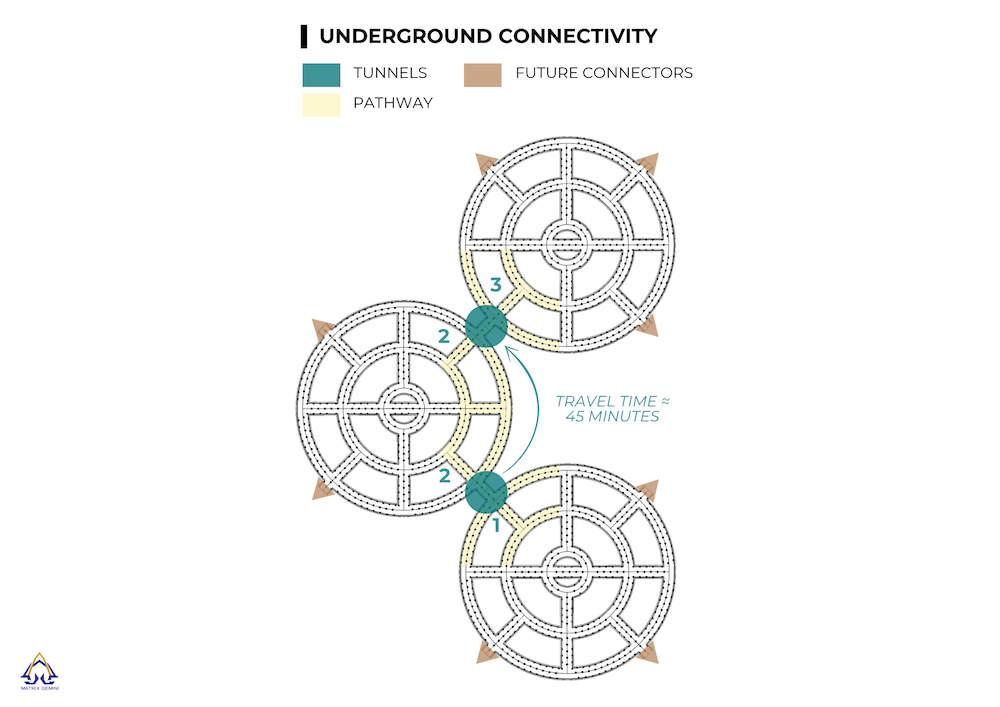
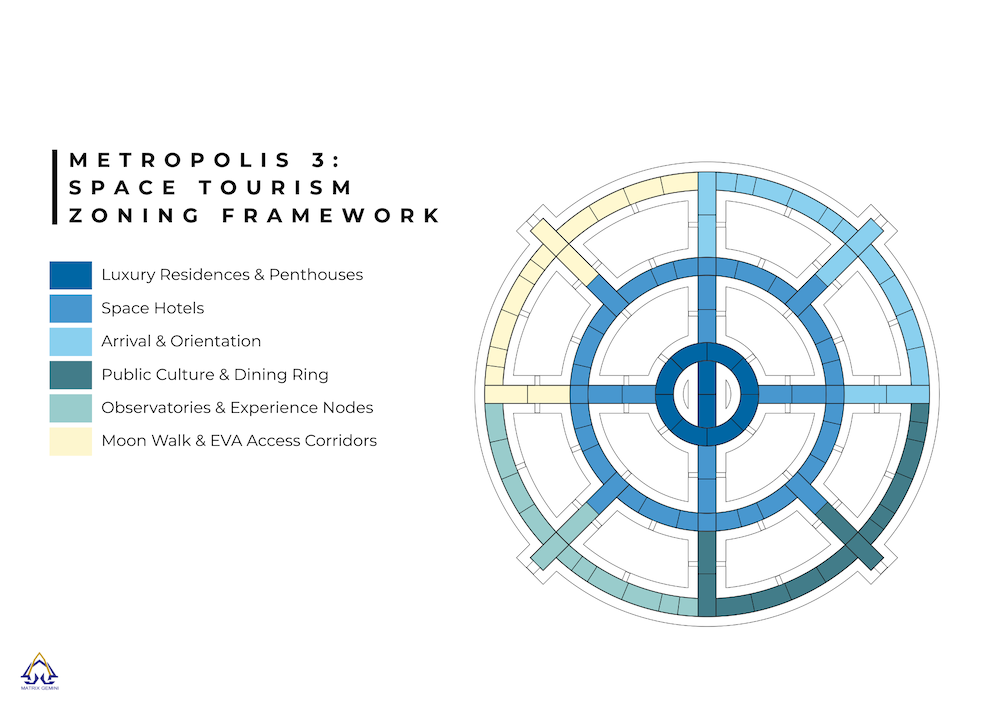
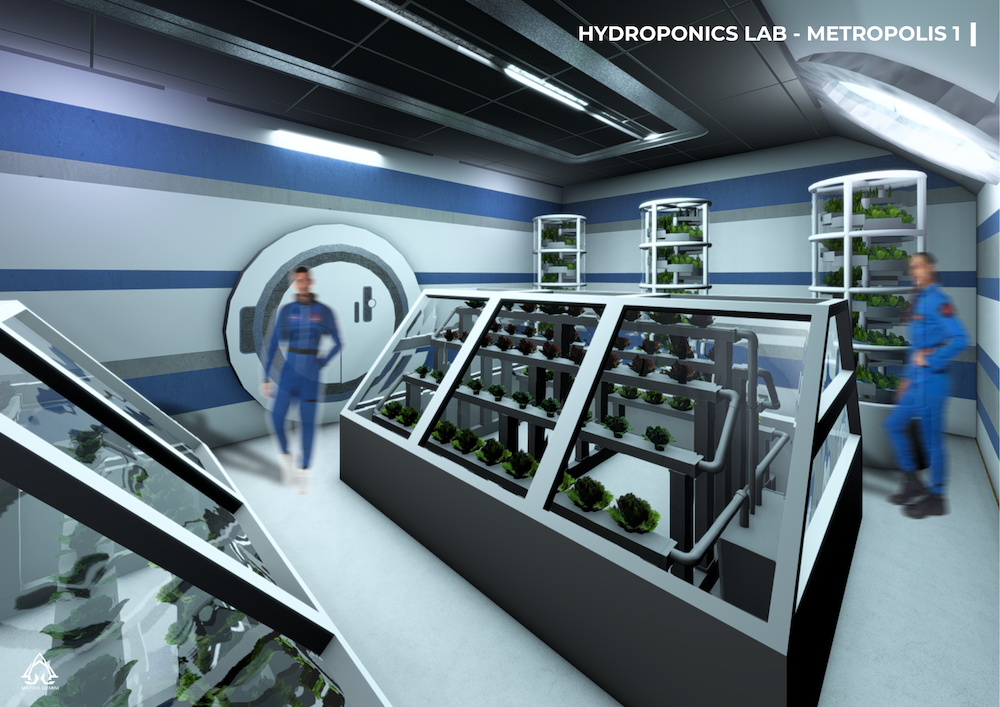
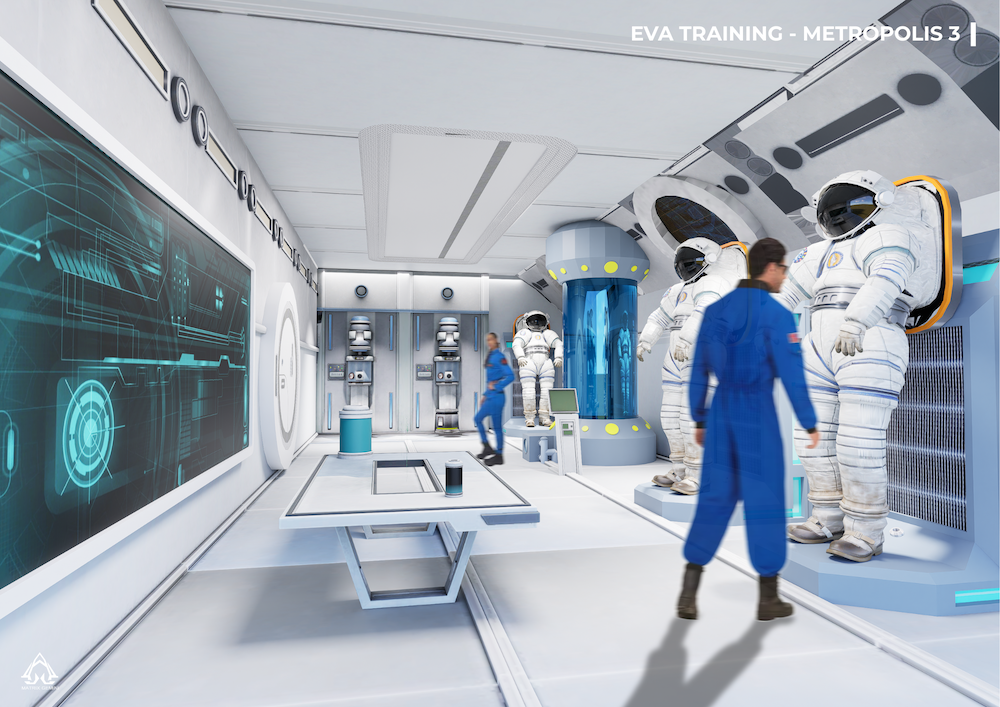
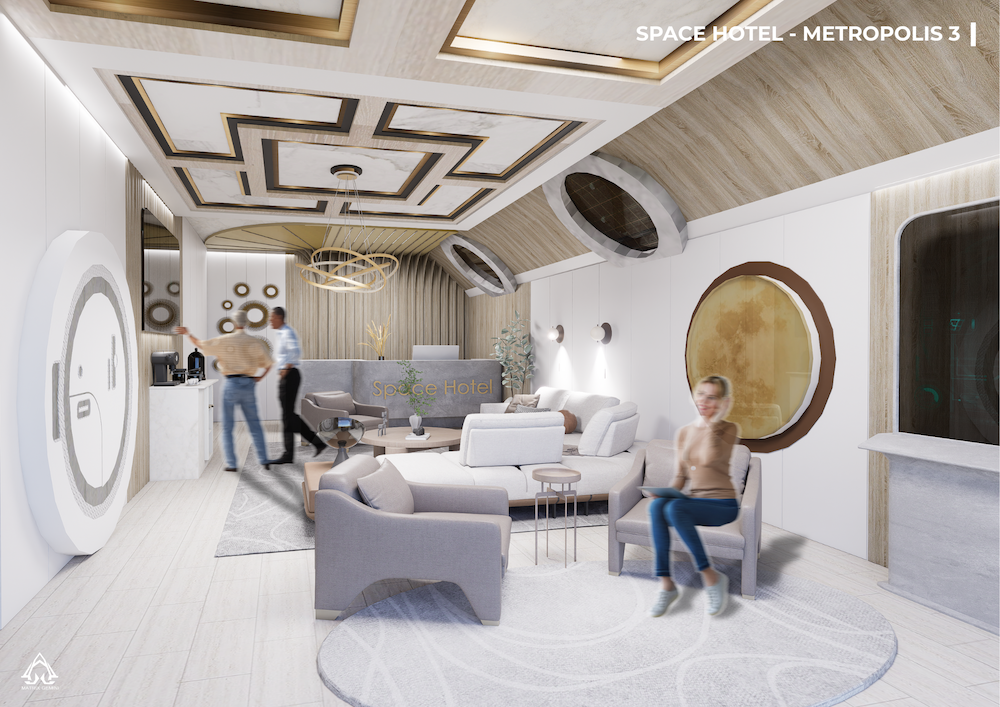
Lunar Tripolis is designed to serve as a true city rather than an isolated outpost. The system is composed of three interconnected metropolises, each serving a distinct sector while operating as an independent urban organism. Metropolis I supports international space agencies and includes governance, mission control, scientific research, and long-duration crew habitation. Metropolis II functions as the industrial and economic core, enabling private-sector participation through in-situ resource utilization (ISRU), advanced manufacturing, waste management, and large-scale lunar construction. Metropolis III serves as the public experience of the Moon, offering space tourism, short-term habitation, training, and recreational Moon walks, fostering a deeper respect for Earth as the Blue Marble in space and a new perspective on human civilization rooted in sustainability and global inclusiveness.
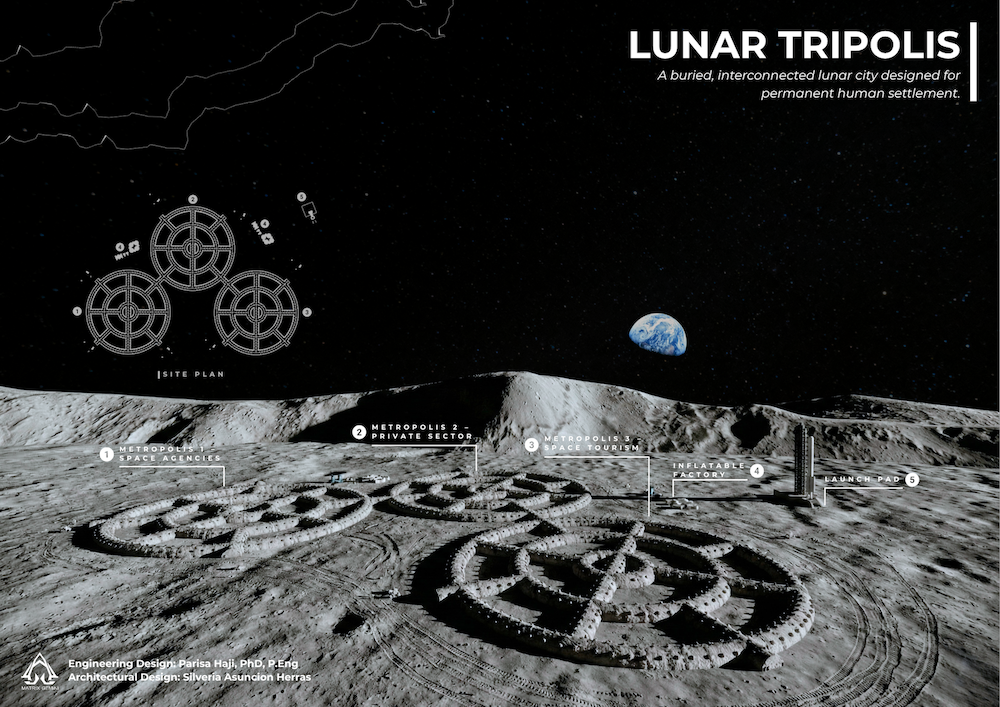
Above: View of Metropolis I, II, and III on the lunar surface. Credit: Dr. Parisa Haji, Silveria Asuncion Herras
Finalist: Moon Walker
Xinyuan Kong, Jiayi Li and Ziyue Feng
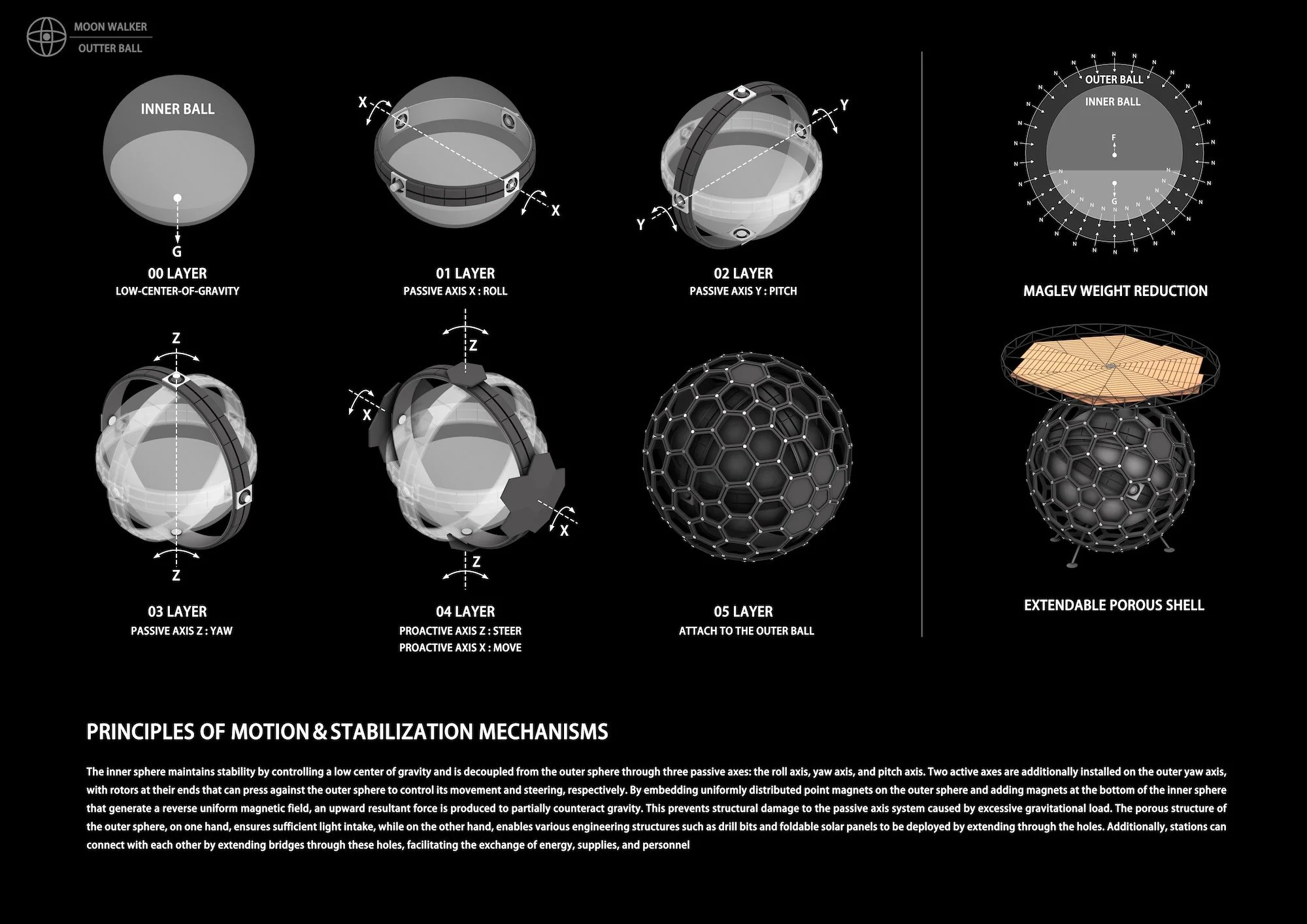
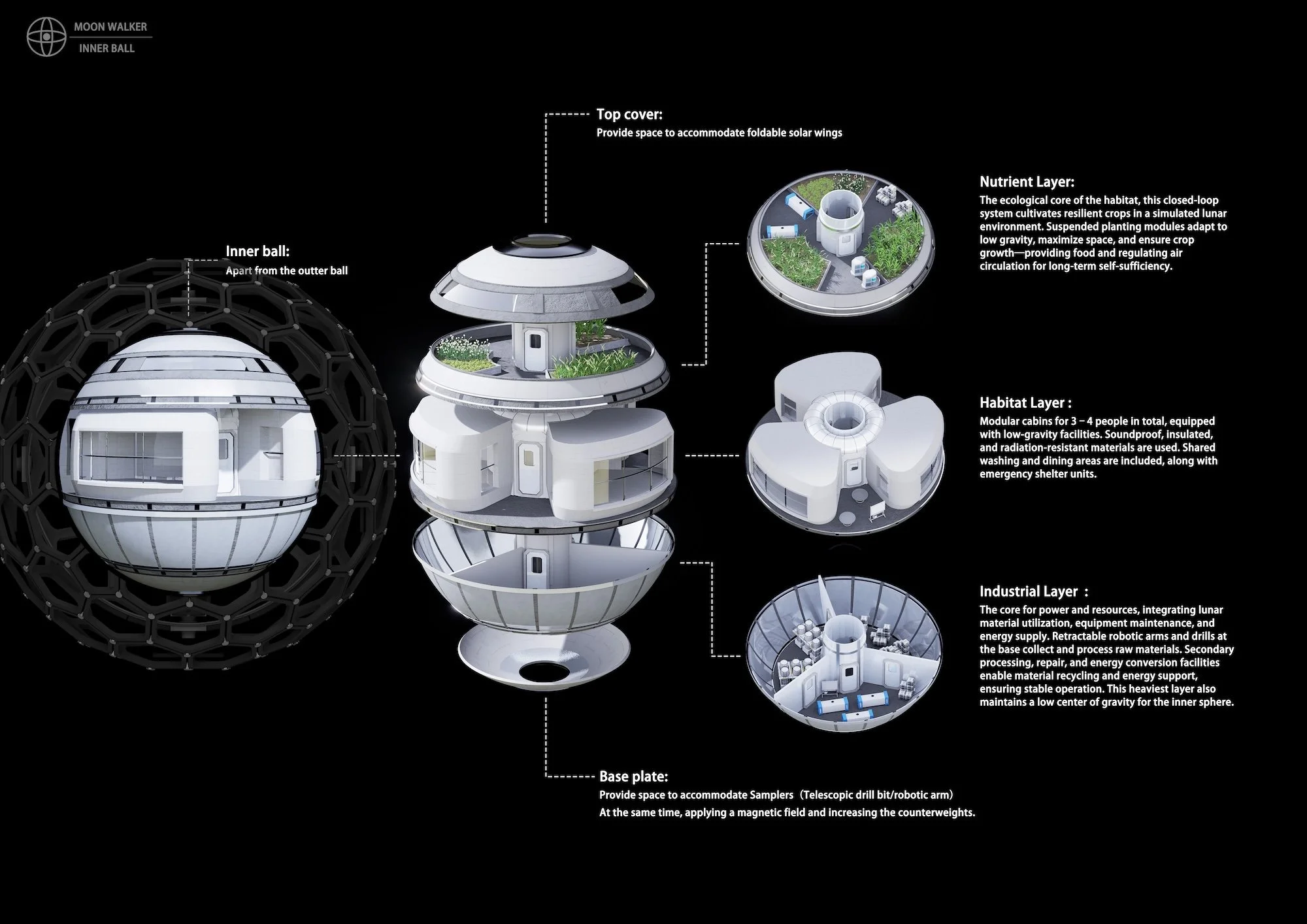
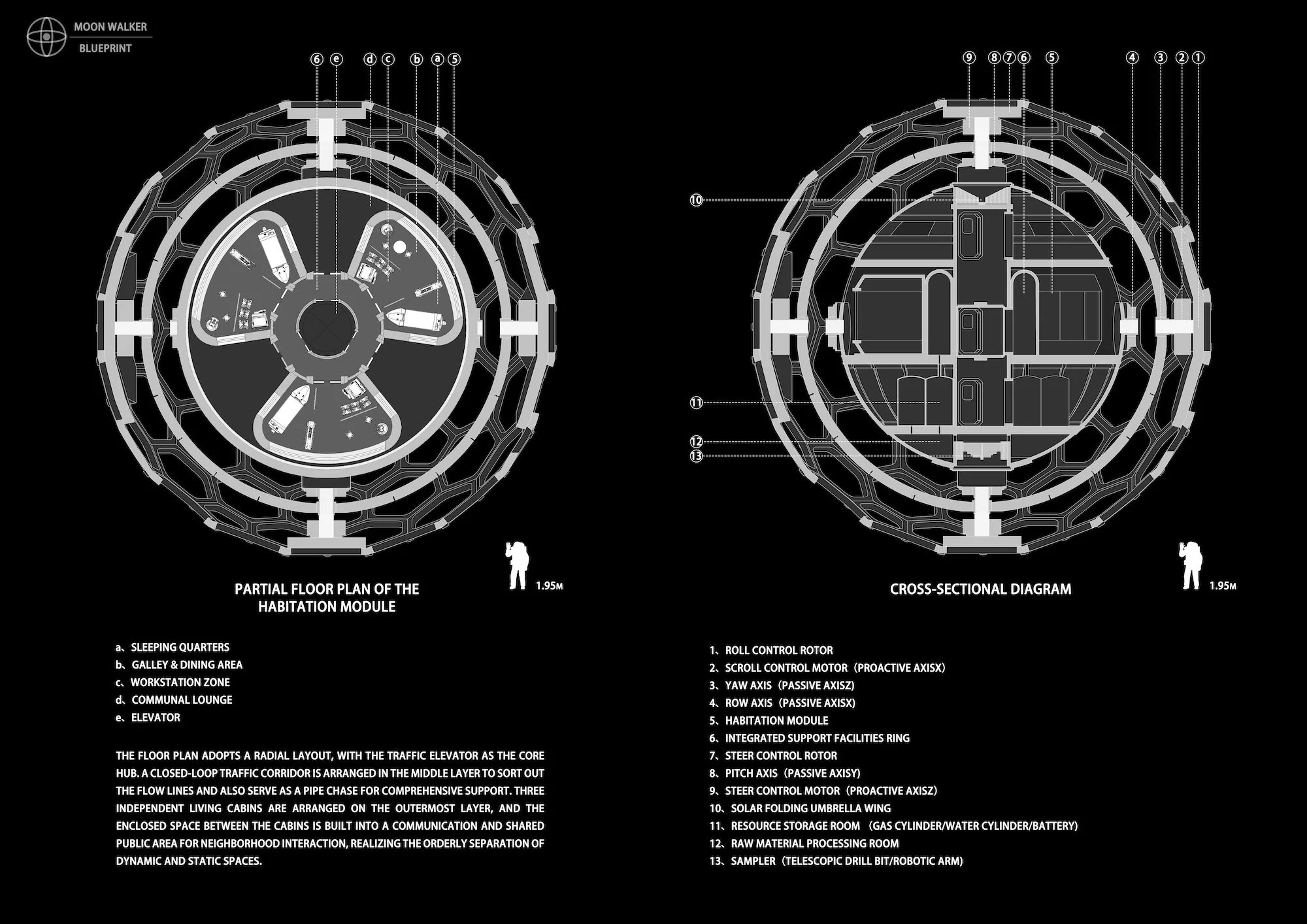
Moon Walker is a mobile research outpost inspired by tumbleweeds, designed for the Lunar South Pole. Each outpost could accommodate a crew of four, Its spherical, lattice outer shell ensures lightweight construction and introduces natural lighting, enabling engineering structures to extrude from the pores of the shell to operate. The core habitat is decoupled from the outer shell via a multi-axis gimbal and supported by a magnetic levitation system to counteract vibrations and partial gravity, maintaining a stable, horizontal interior even while rolling.
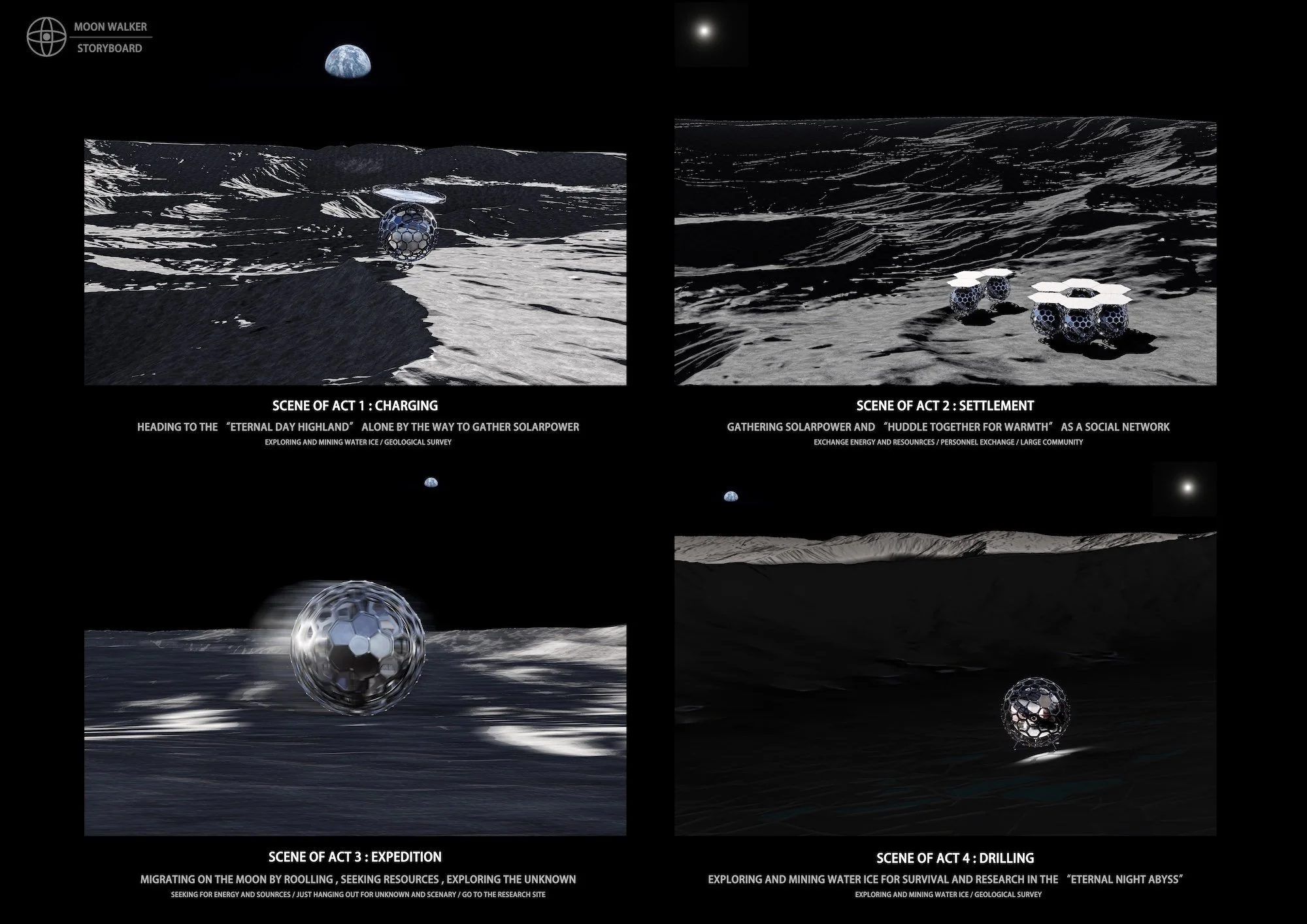
A key challenge at the Lunar South Pole is the scattered and limited nature of resources in fixed locations. This outpost addresses this by rolling autonomously between scientifically rich sites, such as various craters, for in-situ exploration. It can extract water ice from permanently shadowed regions for oxygen and fuel, then migrate to polar "peaks of eternal light" for solar power replenishment, achieving versatile energy self-sufficiency.
Individual Moon Walker units can operate independently, extending the reach of human exploration, or dock together to form modular communities. This enables the sharing of energy, supplies, and data, establishing a flexible, resilient, and scalable network for sustained lunar research.
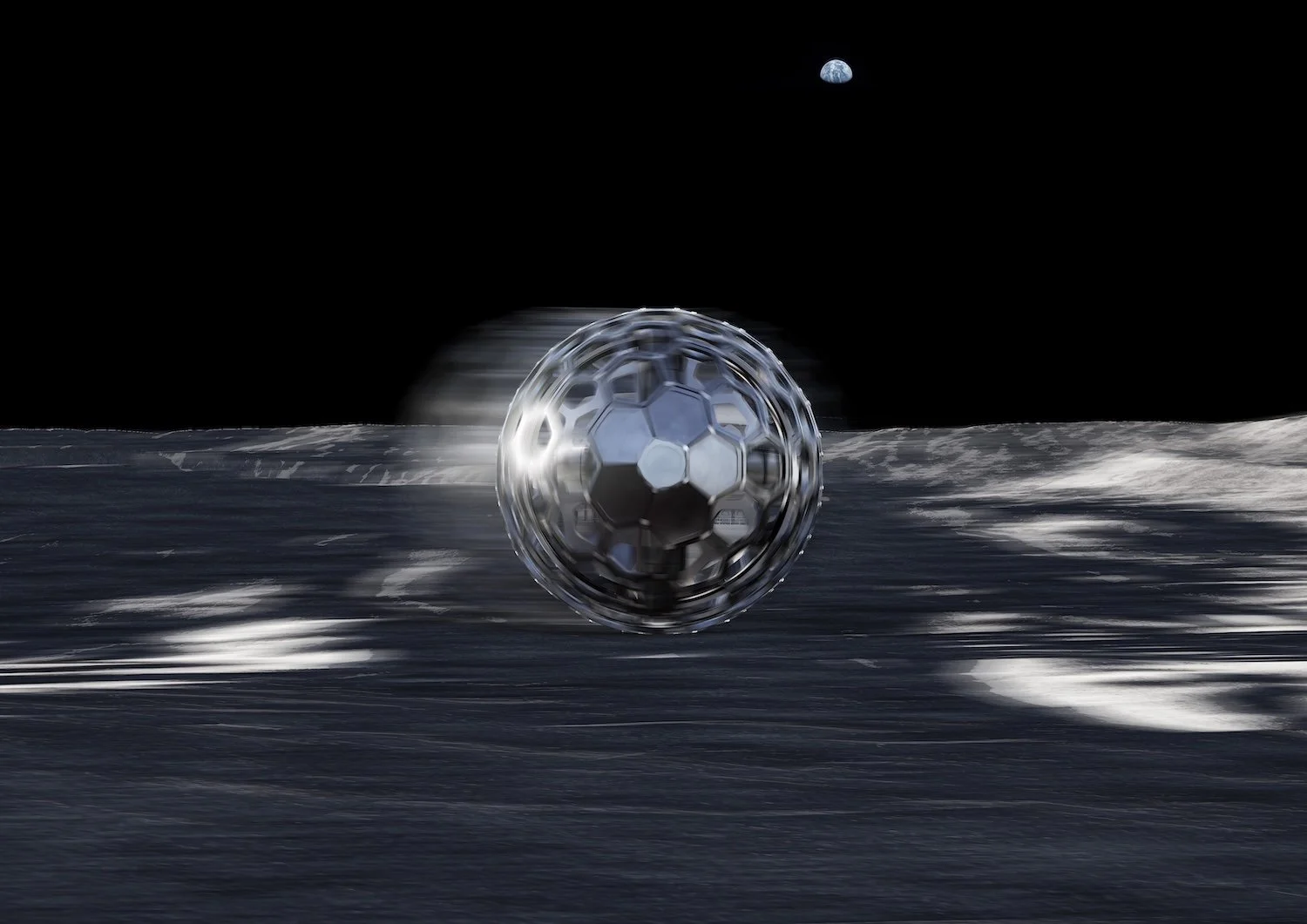
Above: View of a Moon Walker outpost in motion along the lunar surface. Credit: Xinyuan Kong, Jiayi Li, Ziyue Feng
Finalist: Project T.O.S.S.
Luyao Li, Kexin Zhong and Yuying Wei
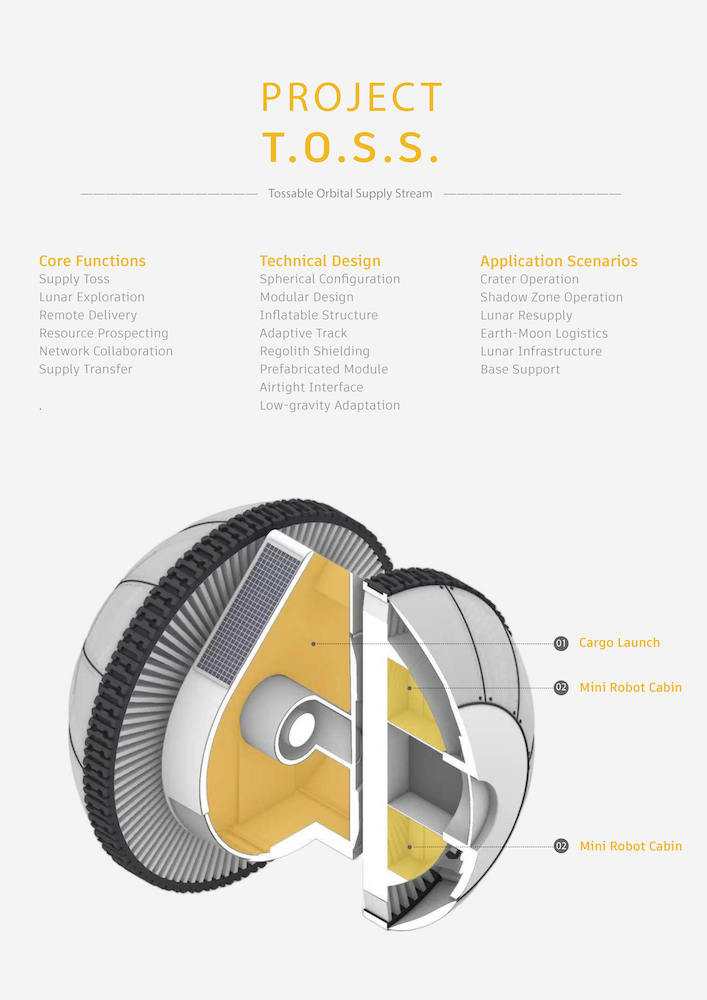
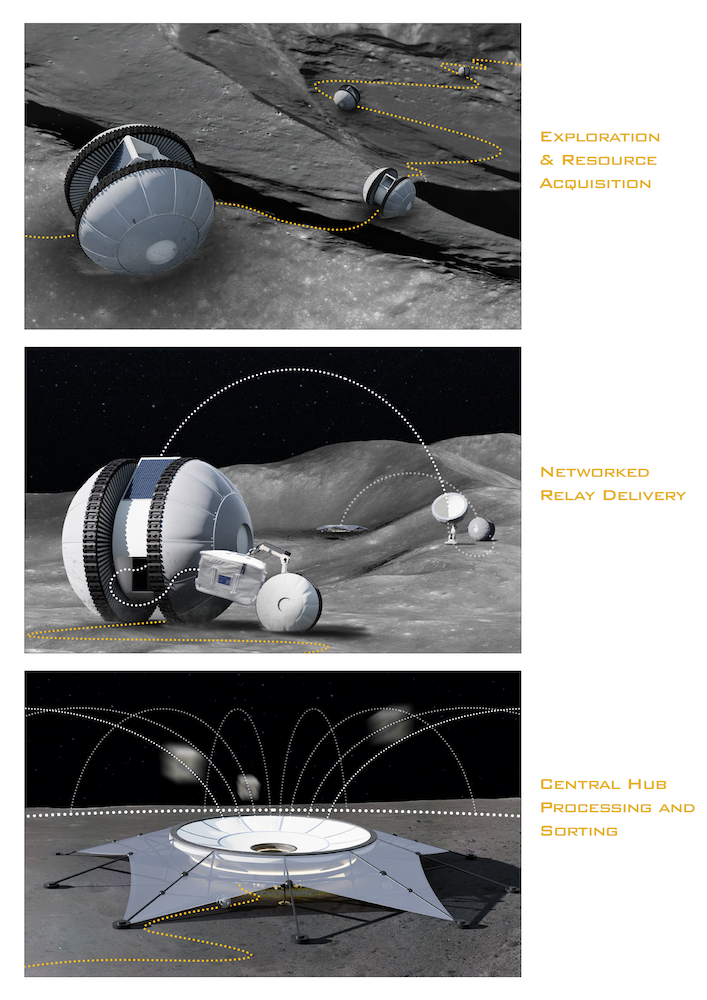
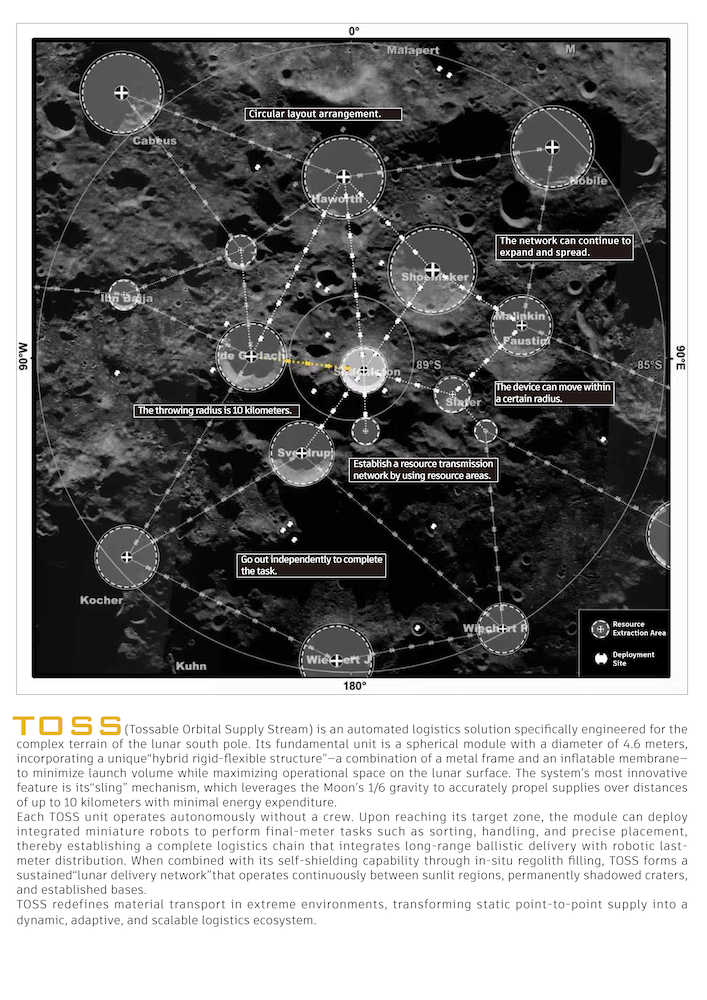
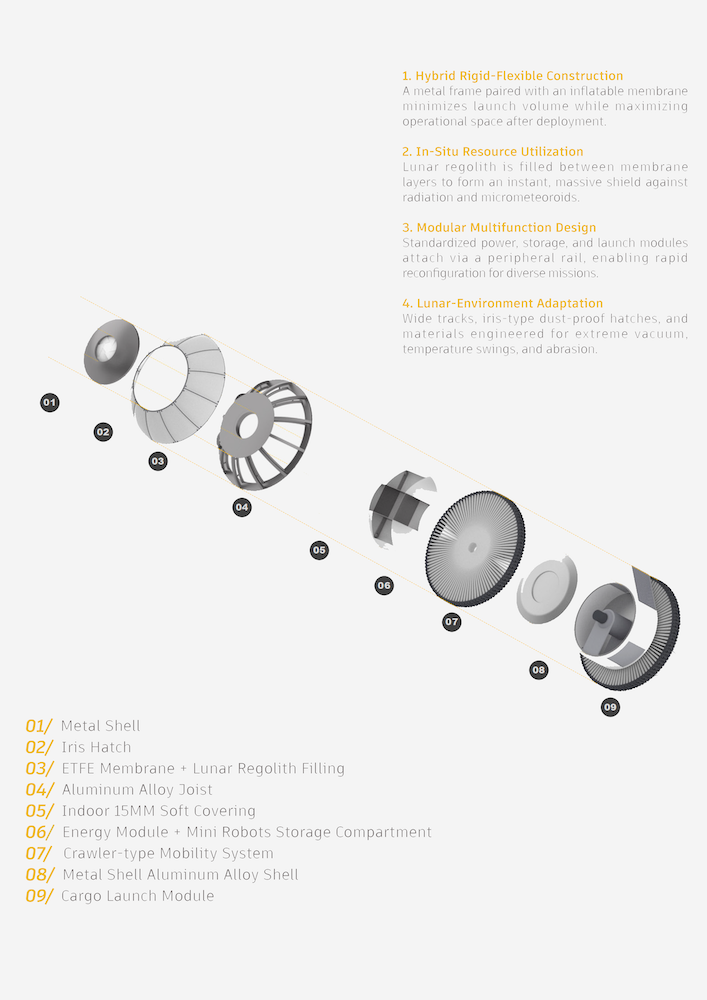
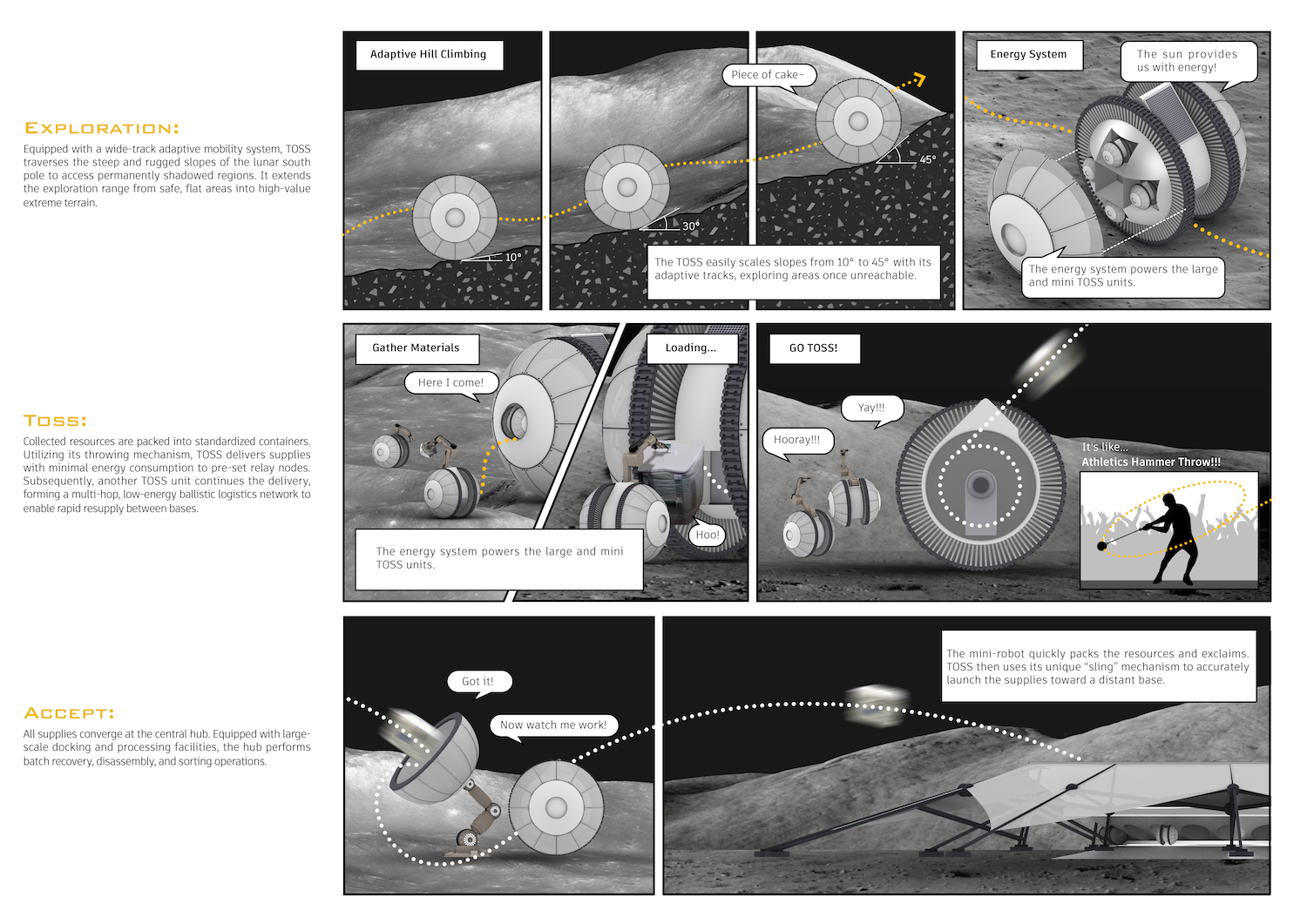
(Tossable Orbital Supply Stream) is an automated logistics solution specifically engineered for the complex terrain of the lunar south pole. Its fundamental unit is a spherical module with a diameter of 4.6 meters, incorporating a unique “hybrid rigid-flexible structure” — a combination of a metal frame and an inflatable membrane — to minimize launch volume while maximizing operational space on the lunar surface. The system’s most innovative feature is its “sling” mechanism, which leverages the Moon’s 1/6 gravity to accurately propel supplies over distances of up to 10 kilometers with minimal energy expenditure.
Each TOSS unit operates autonomously without a crew. Upon reaching its target zone, the module can deploy integrated miniature robots to perform final-meter tasks such as sorting, handling, and precise placement, thereby establishing a complete logistics chain that integrates long-range ballistic delivery with robotic last-meter distribution. When combined with its self-shielding capability through in-situ regolith filling, TOSS forms a sustained “lunar delivery network” that operates continuously between sunlit regions, permanently shadowed craters, and established bases.
TOSS redefines material transport in extreme environments, transforming static point-to-point supply into a dynamic, adaptive, and scalable logistics ecosystem.
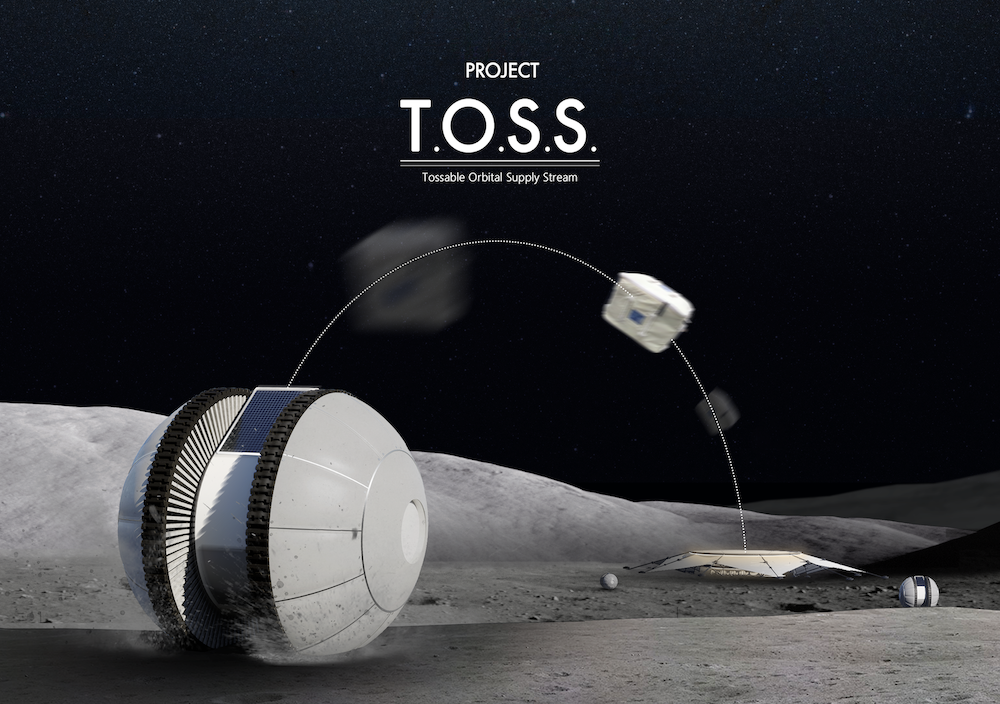
Above: View of a TOSS unit in operation on the lunar surface. Credit: Luyao Li, Kexin Zhong, Yuying Wei
Finalist: Sky Hook Nexus
Yaokun Liu and Jingjing Shao
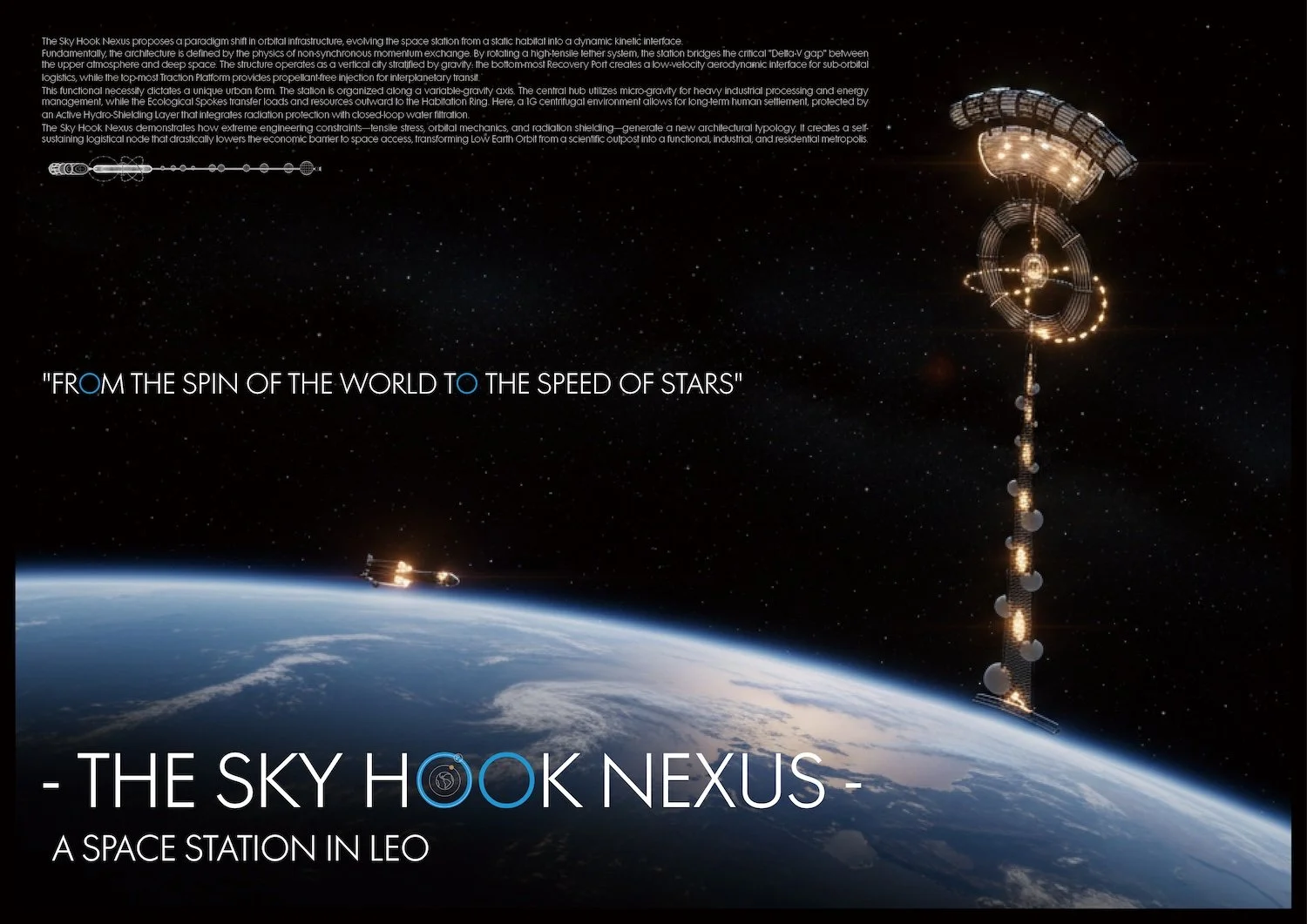
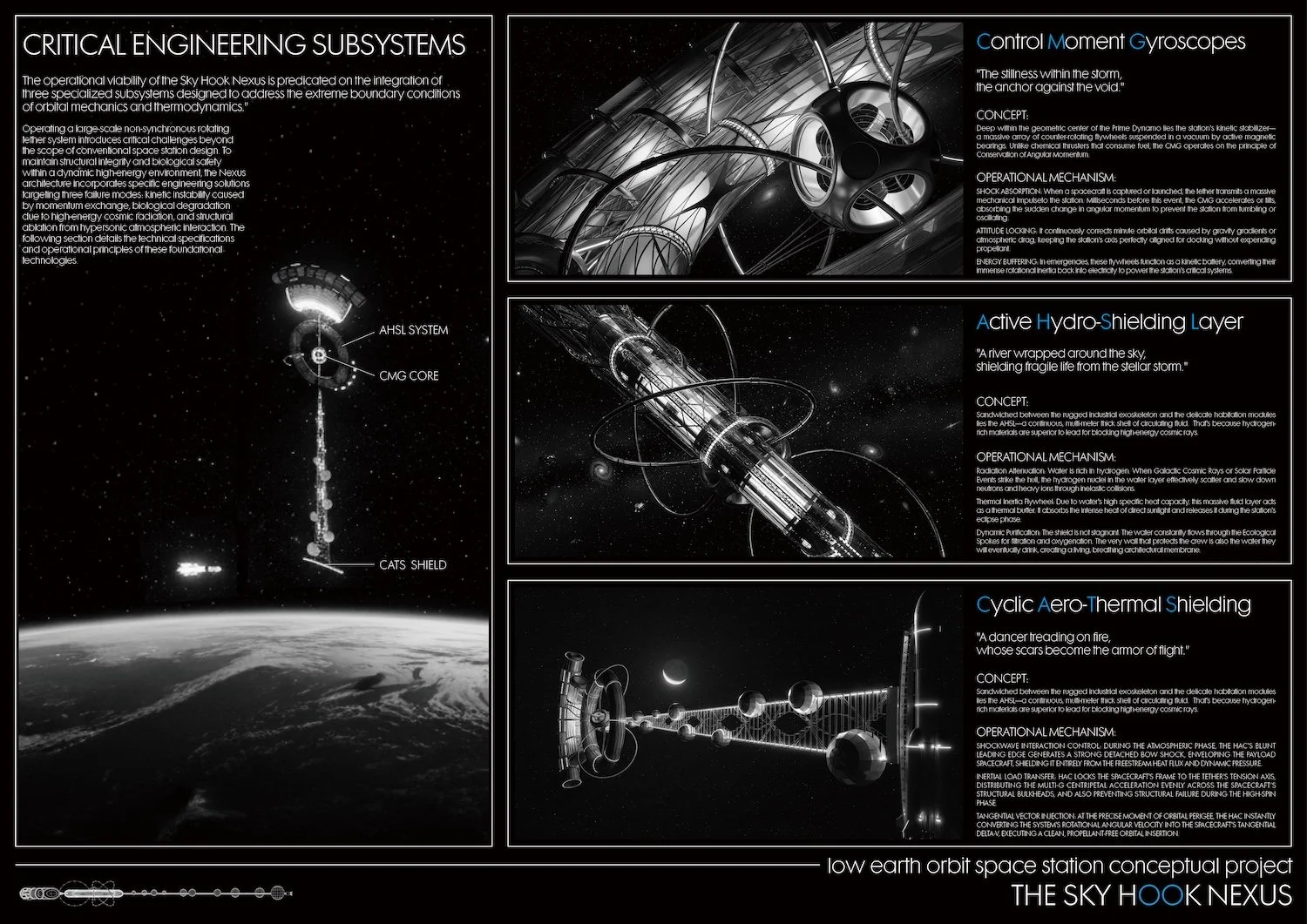
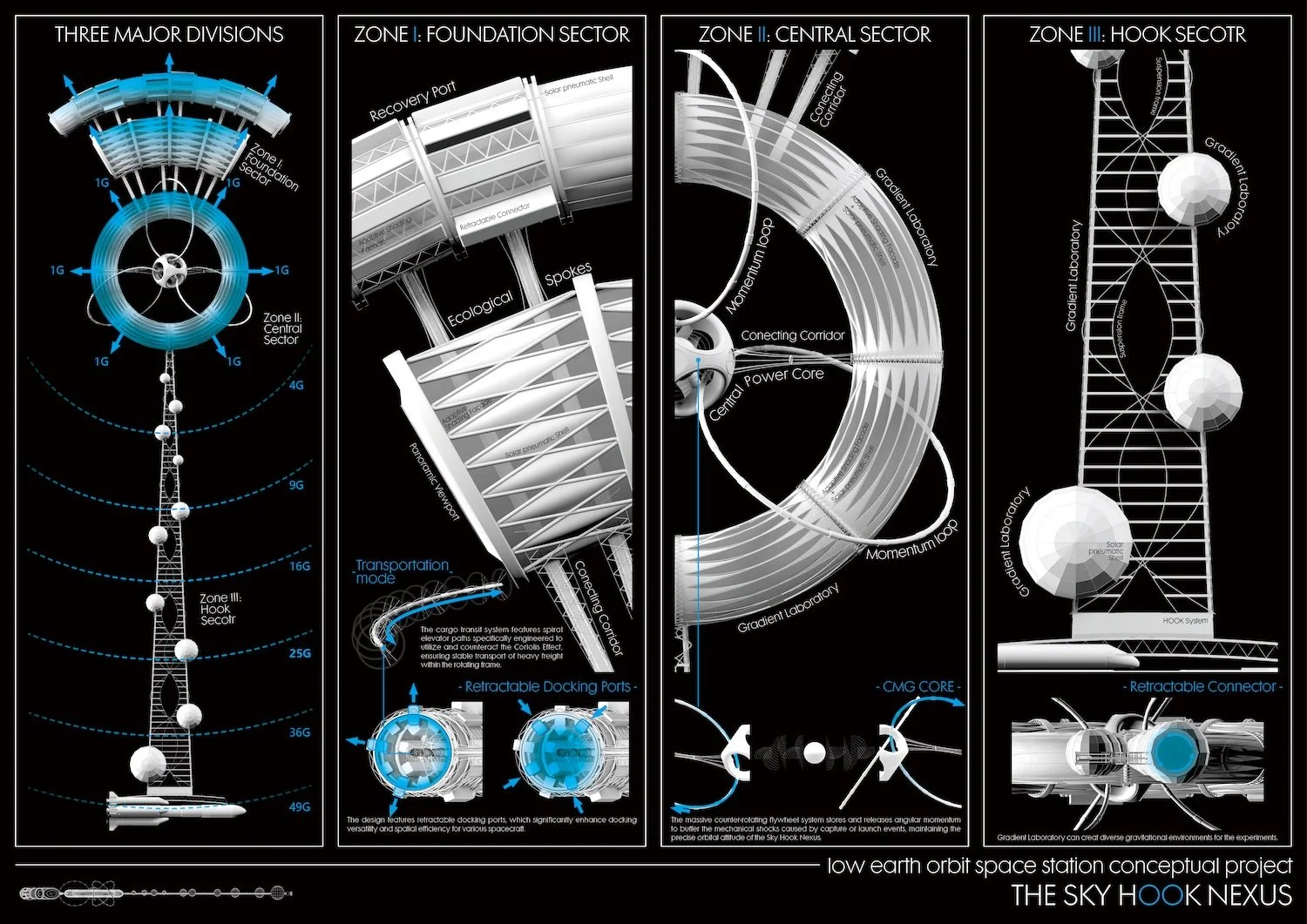
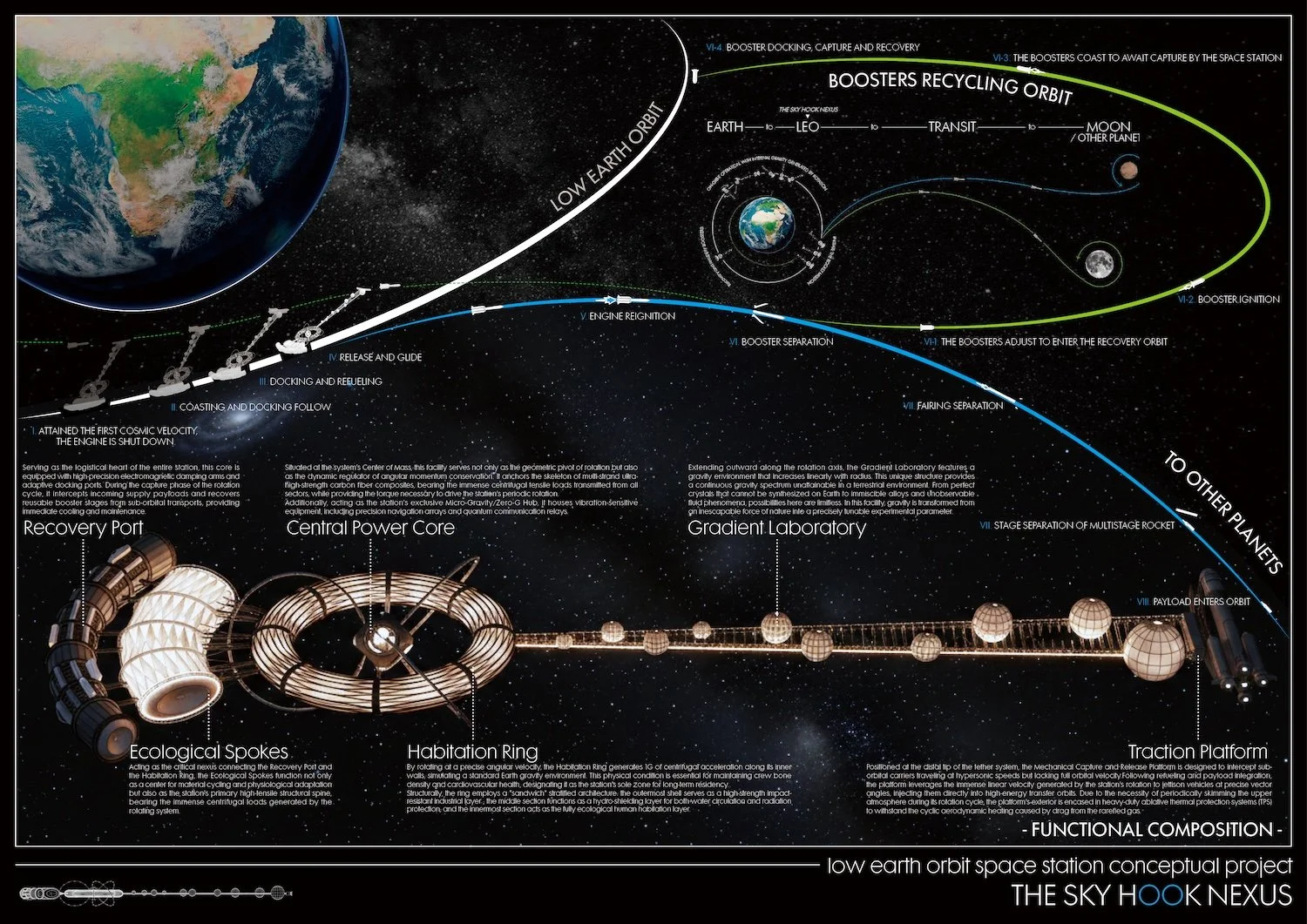
The Sky Hook Nexus proposes a paradigm shift in orbital infrastructure, evolving the space station from a static habitat into a dynamic kinetic interface. Fundamentally, the architecture is defined by the physics of non-synchronous momentum exchange. By rotating a high-tensile tether system, the station bridges the critical “Delta-V gap” between the upper atmosphere and deep space. The structure operates as a vertical city stratified by gravity: the bottommost Recovery Port creates a low-velocity aerodynamic interface for sub-orbital logistics, while the topmost Traction Platform provides propellant-free injection for interplanetary transit. The central hub utilizes micro-gravity for heavy industrial processing and energy management, while the Ecological Spokes transfer loads and resources outward to the Habitation Ring. Here, a 1G centrifugal environment allows for long-term human settlement. The Sky Hook Nexus creates a self-sustaining logistical node that drastically lowers the economic barrier to space access, transforming Low Earth Orbit from a scientific outpost into a functional, industrial, and residential metropolis.
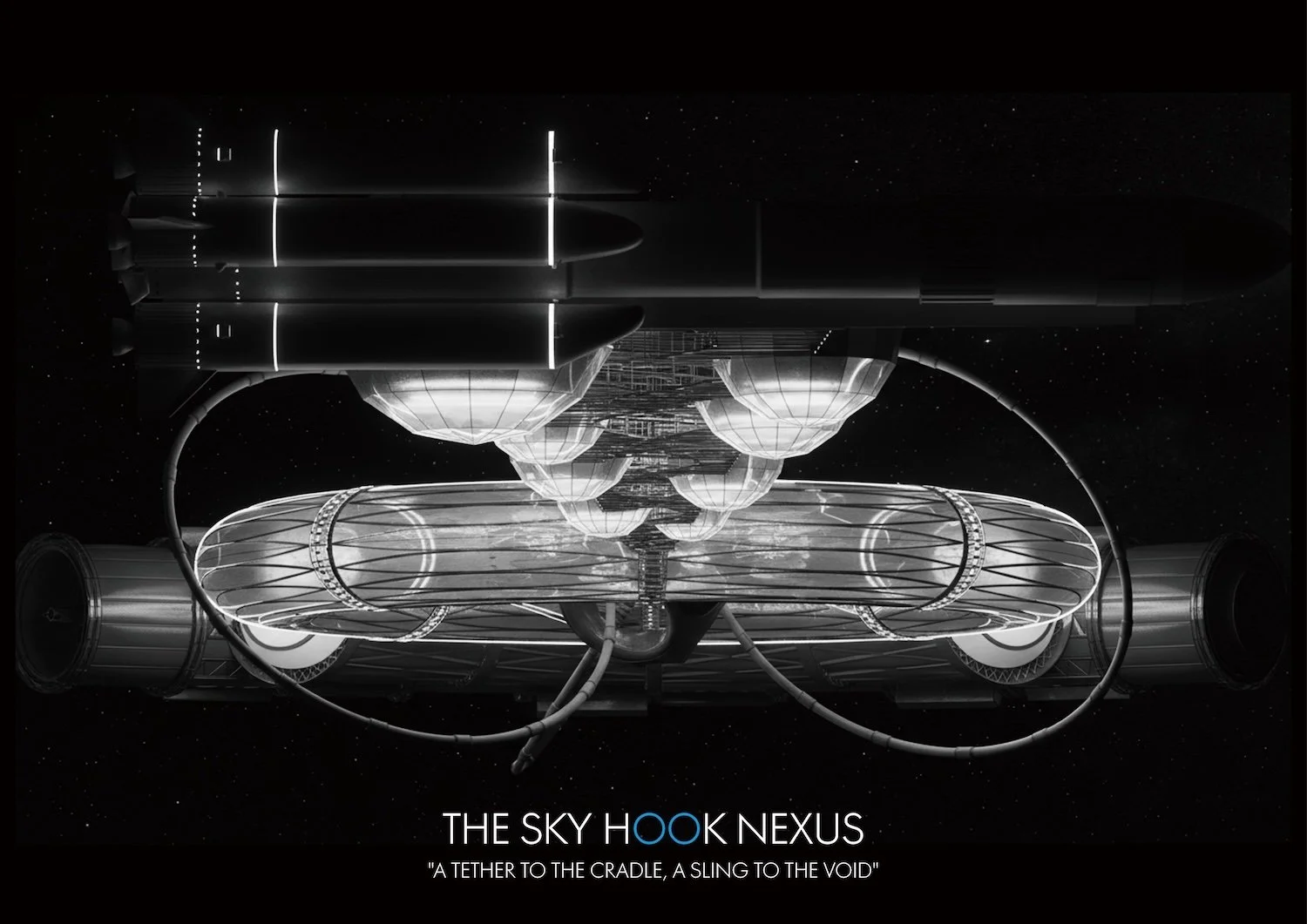
Above: View of Sky Hook Nexus, from Recovery Port looking up to Central Sector (Habitation Ring). Credit: Yaokun Liu, Jingjing Shao